

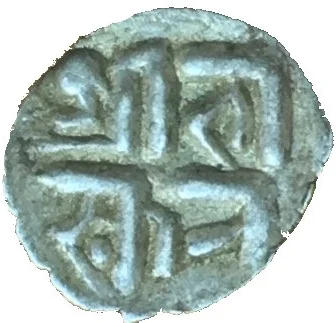
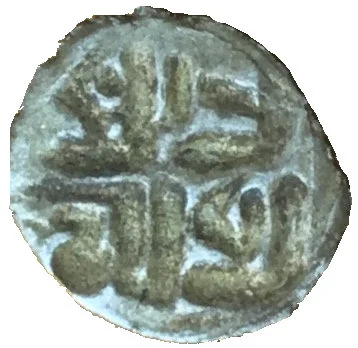
1⁄32 Mohar – Kathmandu Kingdom
Nepal
Context
Years: 1700–1715
Country: Nepal 
Issuer: Kathmandu Kingdom
Ruler: Bhaskara Malla
Currency:
(1546—1932)
Demonetized: Yes
Material
References
KM: #Click to copy to clipboard213
Numista: #120170
Value
Bullion value: $1.74
Obverse
Reverse
Edge
Mintings
| Year | Mint Mark | Mintage | Quality | Collection |
|---|---|---|---|---|
| — | — | — |
Historical background
In the early 18th century, the Kathmandu Valley was not a single kingdom but a confederation of three rival city-states: Kathmandu, Patan, and Bhaktapur, each ruled by its own Malla king. This political fragmentation was directly reflected in the monetary system, which was complex and decentralized. The primary circulating currency was the Mohar, a silver coin minted independently by each kingdom. While similar in name and metallic content, the coins bore distinct symbols and inscriptions unique to each ruler, making them not fully interchangeable and creating a constant undercurrent of economic competition and occasional distrust between the states.
The currency situation was further complicated by a heavy reliance on foreign coinage, particularly Mughal Rupees from the south. These rupees, along with Tibetan silver and Chinese coins from the northern trade routes, circulated widely alongside the local mohars. This was due to the Valley's crucial role as a trans-Himalayan trade entrepôt, linking India and Tibet. The value of coins was determined by their intrinsic silver weight and fineness, leading to frequent assays, clipping, and complex exchange rates. Money changers (sarrafs) held significant power, facilitating trade and often acting as informal bankers.
Despite the rivalry, the Malla period was one of artistic and economic prosperity, and this extended to coinage. The silver mohars of this era, especially from the reign of rulers like Bhupatindra Malla of Bhaktapur, are considered numismatic masterpieces, intricately hand-struck with detailed iconography of deities, animals, and royal symbols. However, the lack of a unified monetary authority meant the system was inherently inefficient for broader trade. This fragmented economic landscape would persist until the mid-18th century, when Prithvi Narayan Shah's Gorkha conquests unified the valley and began to impose a standardized currency, ending the era of the three Malla mints.
The currency situation was further complicated by a heavy reliance on foreign coinage, particularly Mughal Rupees from the south. These rupees, along with Tibetan silver and Chinese coins from the northern trade routes, circulated widely alongside the local mohars. This was due to the Valley's crucial role as a trans-Himalayan trade entrepôt, linking India and Tibet. The value of coins was determined by their intrinsic silver weight and fineness, leading to frequent assays, clipping, and complex exchange rates. Money changers (sarrafs) held significant power, facilitating trade and often acting as informal bankers.
Despite the rivalry, the Malla period was one of artistic and economic prosperity, and this extended to coinage. The silver mohars of this era, especially from the reign of rulers like Bhupatindra Malla of Bhaktapur, are considered numismatic masterpieces, intricately hand-struck with detailed iconography of deities, animals, and royal symbols. However, the lack of a unified monetary authority meant the system was inherently inefficient for broader trade. This fragmented economic landscape would persist until the mid-18th century, when Prithvi Narayan Shah's Gorkha conquests unified the valley and began to impose a standardized currency, ending the era of the three Malla mints.

💎 Extremely Rare