

1 thaler – Austrian Empire
Add to wishlist
Austria
Context
Years: 1620–1621
Country: Austria
Issuer: Austrian Empire
Ruler: Ferdinand II
Currency:
(1520—1754)
Demonetized: Yes
References
KM: #
Numista: #96637
Value
Bullion value: $71.36
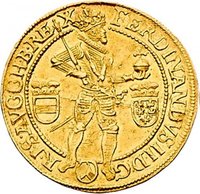
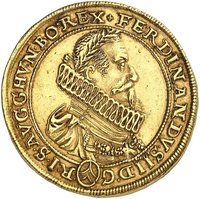
Obverse
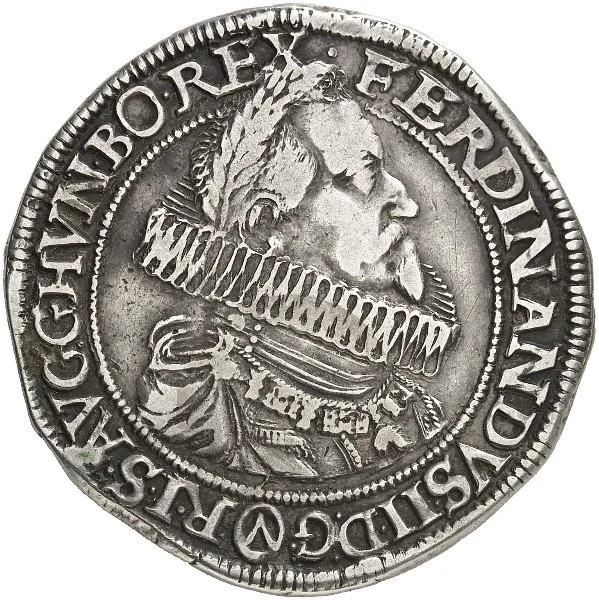
Description:
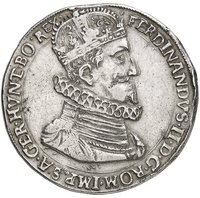
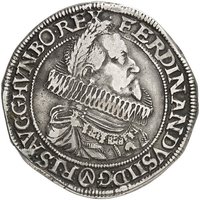
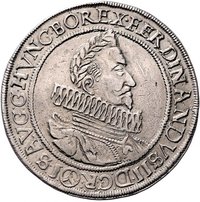
Laureate portrait facing right in beaded circle, head breaking legend. Mint mark divides inscription.
Inscription:
FERDINANDVS II D G ( Λ ) R I S AVG G HVN BO REX
Script: Latin
Reverse
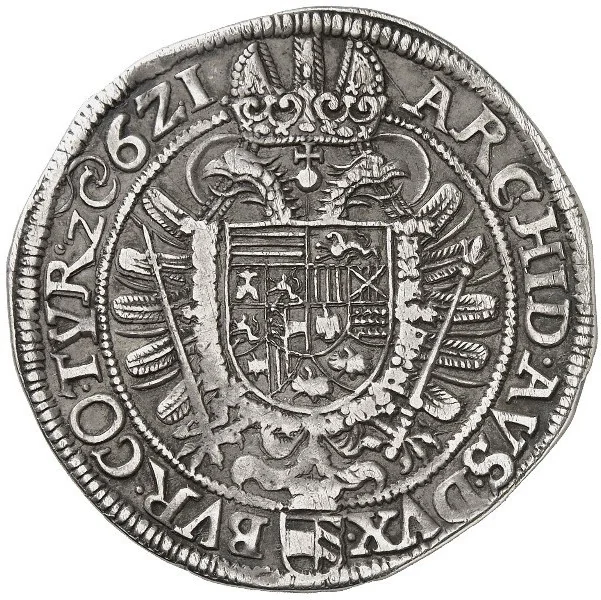
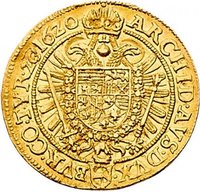
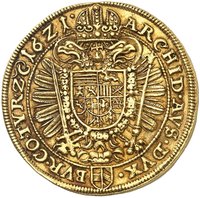
Description:
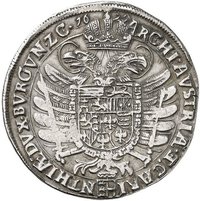
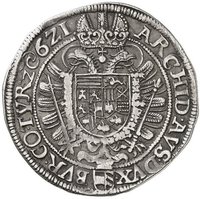
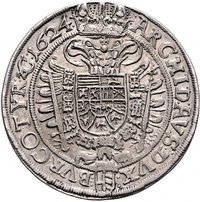
Imperial eagle with two heads in a circle, orb between heads, central composite arms, crown above. Austria and Burgundy shields below in legend. Three-digit date ends legend.
Inscription:
ARCHID AVS DVX // BVR CO TYR zC 1621
Script: Latin
Edge
Mints
| Name | Mark |
|---|---|
| Münze Österreich | — |
Mintings
| Year | Mint Mark | Mintage | Quality | Collection |
|---|---|---|---|---|
| 1620 | — | — | ||
| 1621 | — | — |
Historical background
In 1620, the currency system of the Habsburg-ruled Austrian Empire was in a state of profound crisis, a direct consequence of the ongoing Thirty Years' War (1618-1648). The immense financial strain of funding large mercenary armies forced the imperial government, under Emperor Ferdinand II, to engage in rampant currency debasement. The primary minting authority, the Hofkammer in Vienna, systematically reduced the silver content in the ubiquitous Reichsthaler and smaller Kreuzer coins to generate short-term profit, flooding the economy with inferior money.
This practice triggered Gresham's Law, where "bad money drives out good," as people hoarded older, high-silver coins and used the new debased ones for transactions. The result was catastrophic inflation, a loss of public confidence, and severe economic disruption, particularly within the hereditary Austrian lands and the Kingdom of Bohemia, where the pivotal Battle of White Mountain that same year solidified Habsburg control. Trade was stifled as merchants refused the unstable currency, and the local economies suffered.
The situation was further complicated by the empire's fragmented political and economic structure. While the central government debased coins, various constituent territories and even cities operated their own mints, leading to a chaotic mosaic of currencies of varying quality. This lack of uniformity crippled internal commerce and undermined the authority of the central treasury. Thus, in 1620, the Austrian Empire's finances were characterized by a vicious cycle of war expenditure, monetary devaluation, and inflationary turmoil, setting the stage for later, more centralized, but still problematic, monetary policies.
This practice triggered Gresham's Law, where "bad money drives out good," as people hoarded older, high-silver coins and used the new debased ones for transactions. The result was catastrophic inflation, a loss of public confidence, and severe economic disruption, particularly within the hereditary Austrian lands and the Kingdom of Bohemia, where the pivotal Battle of White Mountain that same year solidified Habsburg control. Trade was stifled as merchants refused the unstable currency, and the local economies suffered.
The situation was further complicated by the empire's fragmented political and economic structure. While the central government debased coins, various constituent territories and even cities operated their own mints, leading to a chaotic mosaic of currencies of varying quality. This lack of uniformity crippled internal commerce and undermined the authority of the central treasury. Thus, in 1620, the Austrian Empire's finances were characterized by a vicious cycle of war expenditure, monetary devaluation, and inflationary turmoil, setting the stage for later, more centralized, but still problematic, monetary policies.
✨ Legendary