

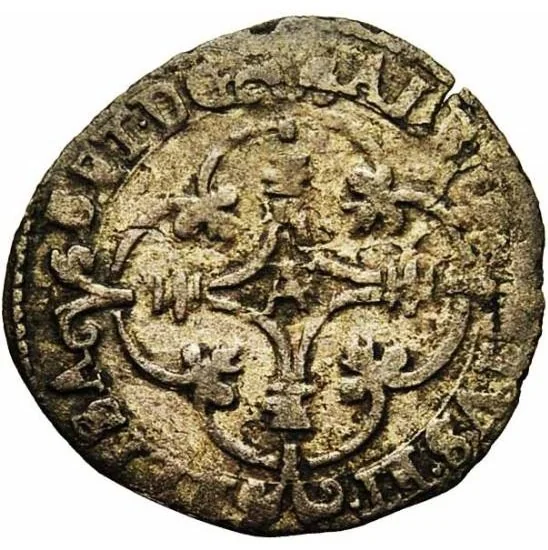
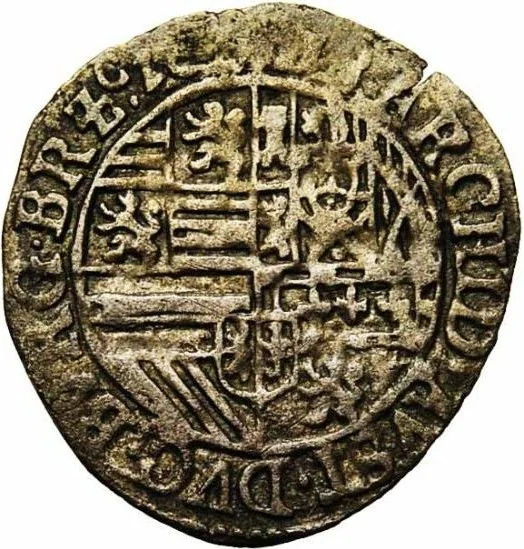
½ Patard – Spanish Netherlands
Netherlands
Context
Years: 1613–1619
Country: Netherlands 
Issuer: Spanish Netherlands
Currency:
(1506—1713)
Demonetized: Yes
Material
Diameter: 19 mm
Weight: 1 g
Shape: Irregular round
Technique: Hammered
Alignment: Coin alignment
flip
References
KM: #Click to copy to clipboard41
Numista: #96564
Obverse
Description:
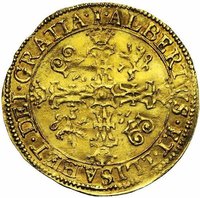
Floriate cross with central AE monogram in a quadrilobe, dividing the legend.
Inscription:
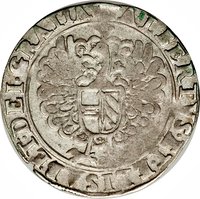
ALBERTVS ET ELISABET D G
Script: Latin
Reverse
Description:
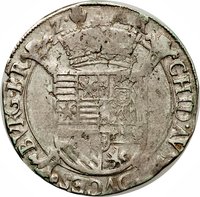
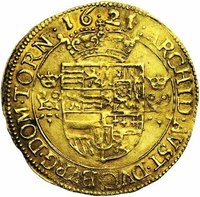
Eight-fold arms fill inner circle. Date, if present, is either at legend's end after mintmark or divided by mintmark at top.
Inscription:
ARCHID AVST DVC BVRG BR Zc
Script: Latin
Edge
Mints
| Name | Mark |
|---|---|
| 's-Hertogenbosch | — |
| Antwerp | — |
| Royal Mint of Belgium | — |
Mintings
| Year | Mint Mark | Mintage | Quality | Collection |
|---|---|---|---|---|
| — | — | — | ||
| 1614 | — | — | ||
| 1616 | — | — | ||
| 1617 | — | — | ||
| 1618 | — | — | ||
| 1619 | — | — |
Historical background
In 1613, the Spanish Netherlands, encompassing much of modern-day Belgium and Luxembourg, was grappling with a severe and chronic monetary crisis. The region, a hub of European commerce, suffered from a chaotic circulation of overvalued and debased coinage from numerous foreign states, alongside domestic issues. The ongoing Eighty Years' War (1568–1648) against the Dutch Republic strained Habsburg finances, leading to repeated official debasements of coinage to fund military campaigns. This state policy, combined with the influx of lightweight foreign coins and widespread clipping and counterfeiting, had shattered public confidence in the currency, disrupting trade and creating significant economic uncertainty.
The core of the problem was the disparity between the official patard or stuiver (the accounting unit) and the actual silver content of the physical coins in circulation. The government's own minting of "crying" or "light" money (moneda de vellón in Spanish, krijgstijdgeld in Dutch) with reduced precious metal content created a classic case of Gresham's Law: "bad money drives out good." Full-weight silver coins, like the popular patagon or rijksdaalder, were either hoarded or exported, leaving the economy flooded with inferior currency. This inflationary pressure drove up prices for goods and services, harming wage-earners and creating social tension.
Archdukes Albert and Isabella, the sovereign rulers, recognized the destabilizing effects and attempted reform. In 1613, they were actively engaged in consultations with merchant groups and provincial estates to find a solution, which would culminate in the monetary ordinance of 1616. The goal was to standardize and stabilize the coinage by defining fixed exchange rates between various circulating coins and the accounting florin, and to recall debased money. However, these efforts were a constant struggle against the financial demands of the war and the entrenched practices of the international bullion market, making lasting stability elusive during this period.
The core of the problem was the disparity between the official patard or stuiver (the accounting unit) and the actual silver content of the physical coins in circulation. The government's own minting of "crying" or "light" money (moneda de vellón in Spanish, krijgstijdgeld in Dutch) with reduced precious metal content created a classic case of Gresham's Law: "bad money drives out good." Full-weight silver coins, like the popular patagon or rijksdaalder, were either hoarded or exported, leaving the economy flooded with inferior currency. This inflationary pressure drove up prices for goods and services, harming wage-earners and creating social tension.
Archdukes Albert and Isabella, the sovereign rulers, recognized the destabilizing effects and attempted reform. In 1613, they were actively engaged in consultations with merchant groups and provincial estates to find a solution, which would culminate in the monetary ordinance of 1616. The goal was to standardize and stabilize the coinage by defining fixed exchange rates between various circulating coins and the accounting florin, and to recall debased money. However, these efforts were a constant struggle against the financial demands of the war and the entrenched practices of the international bullion market, making lasting stability elusive during this period.
✨ Legendary