

1 Crown – Spanish Netherlands
Netherlands
Context
Years: 1614–1621
Country: Netherlands 
Issuer: Spanish Netherlands
Currency:
(1506—1713)
Demonetized: Yes
Total mintage: 14,996
Material
Weight: 3.41 g
Gold weight: 3.01 g
Shape: Irregular round
Composition: 88.2% Gold
Magnetic: No
Technique: Hammered
References
KM: #Click to copy to clipboard26
Numista: #361742
Value
Bullion value: $501.66
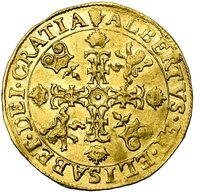
Obverse
Description:
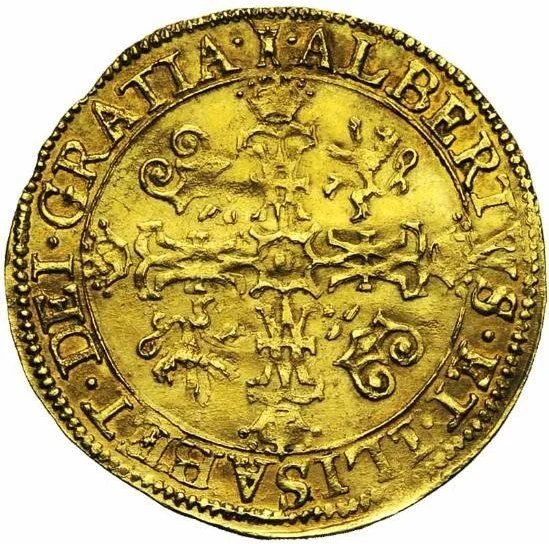
Cross of four crowned monograms with lions and crowns in the corners.
Inscription:
ALBERTVS · ET · ELISABET · DEI · GRATIA
Script: Latin
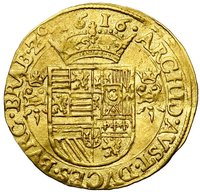
Reverse
Description:
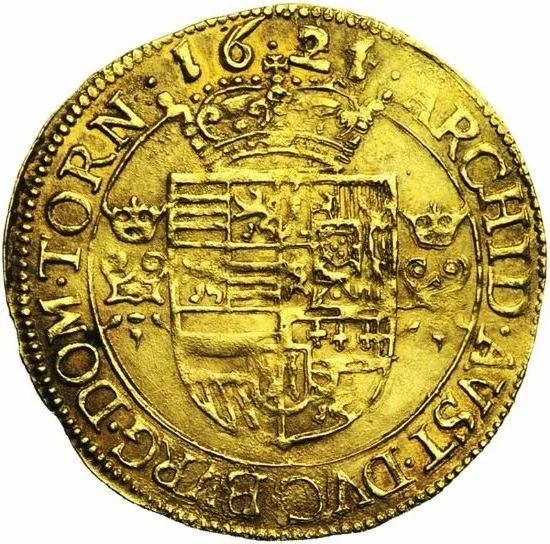
Shield divides Albert and Elizabeth's crowned monograms.
Inscription:
ARCHID · AVST · DVC · BVRG · DOM · TORN · 1621
Script: Latin
Edge
Mints
| Name | Mark |
|---|---|
| Tournai | — |
Mintings
| Year | Mint Mark | Mintage | Quality | Collection |
|---|---|---|---|---|
| 1614 | — | 9,082 | ||
| 1615 | — | — | ||
| 1616 | — | — | ||
| 1620 | — | — | ||
| 1621 | — | 5,914 |
Historical background
In 1614, the Spanish Netherlands, encompassing much of modern-day Belgium and Luxembourg, was grappling with a severe and protracted monetary crisis. The region, a hub of European commerce, suffered from a chaotic circulation of overvalued and debased coinage from neighbouring German states, the Dutch Republic, and its own mints. This "crying up" of coin values—officially raising their legal tender value above their intrinsic metal worth—led to Gresham's Law in action: good, full-weight Spanish silver reales were hoarded or exported, while poor-quality coins flooded the market, disrupting trade and eroding trust.
The core of the problem lay in the ongoing Eighty Years' War (1568-1648). The Southern Netherlands, remaining under Habsburg rule, was economically blockaded by the rebellious Northern Provinces (the Dutch Republic). This severed vital trade routes and created a desperate shortage of sound money to pay the enormous costs of the Spanish Army of Flanders. In response, the authorities repeatedly manipulated coin values to attract precious metal and finance the war, but this only accelerated the downward spiral of currency debasement and price inflation, causing widespread hardship for the populace.
Attempts at reform were piecemeal and largely ineffective. While the central government in Brussels issued ordinances to fix exchange rates and withdraw the worst debased coins, the provincial estates often resisted, fearing the deflationary impact. Furthermore, the lucrative illicit trade in clipped and counterfeit coins was entrenched. Consequently, the year 1614 represents a point within a prolonged period of monetary instability, where stopgap measures failed to address the structural issues of wartime finance and economic fragmentation, leaving the currency in a state of confusion that would persist for decades.
The core of the problem lay in the ongoing Eighty Years' War (1568-1648). The Southern Netherlands, remaining under Habsburg rule, was economically blockaded by the rebellious Northern Provinces (the Dutch Republic). This severed vital trade routes and created a desperate shortage of sound money to pay the enormous costs of the Spanish Army of Flanders. In response, the authorities repeatedly manipulated coin values to attract precious metal and finance the war, but this only accelerated the downward spiral of currency debasement and price inflation, causing widespread hardship for the populace.
Attempts at reform were piecemeal and largely ineffective. While the central government in Brussels issued ordinances to fix exchange rates and withdraw the worst debased coins, the provincial estates often resisted, fearing the deflationary impact. Furthermore, the lucrative illicit trade in clipped and counterfeit coins was entrenched. Consequently, the year 1614 represents a point within a prolonged period of monetary instability, where stopgap measures failed to address the structural issues of wartime finance and economic fragmentation, leaving the currency in a state of confusion that would persist for decades.
✨ Legendary