

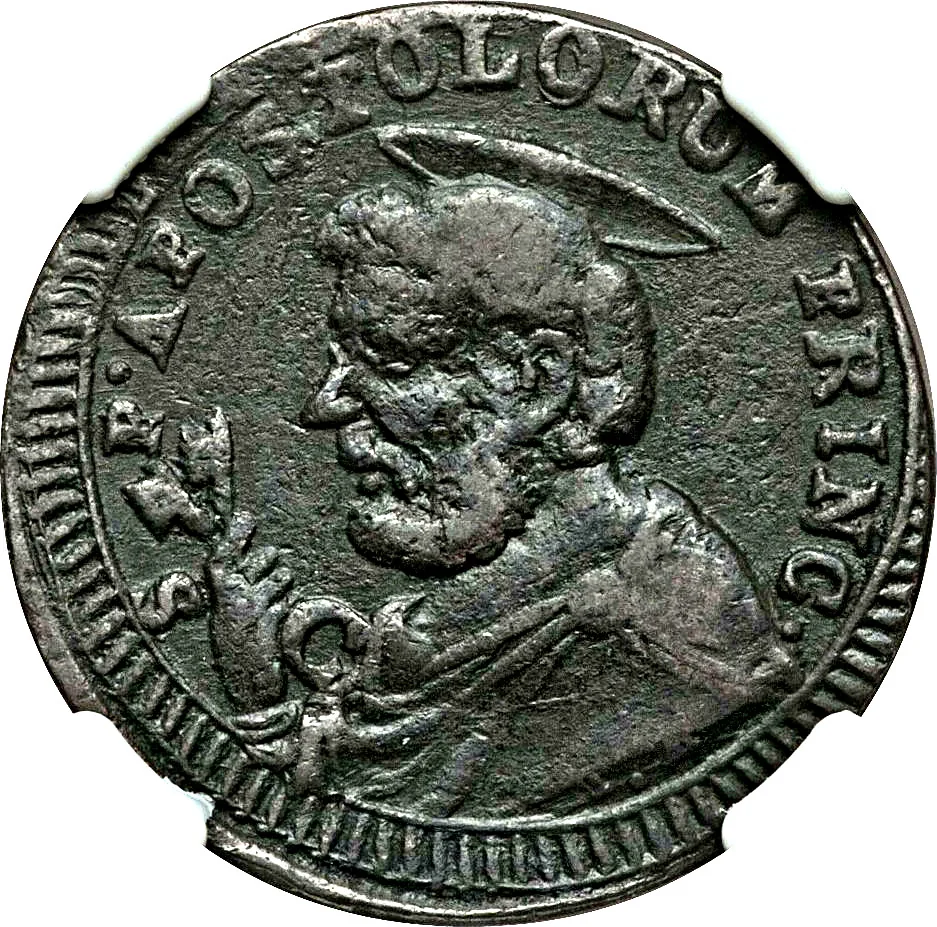
2½ Baiocchi – Viterbo
Italy
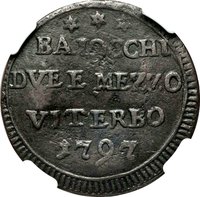
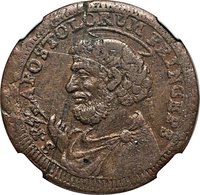
Obverse
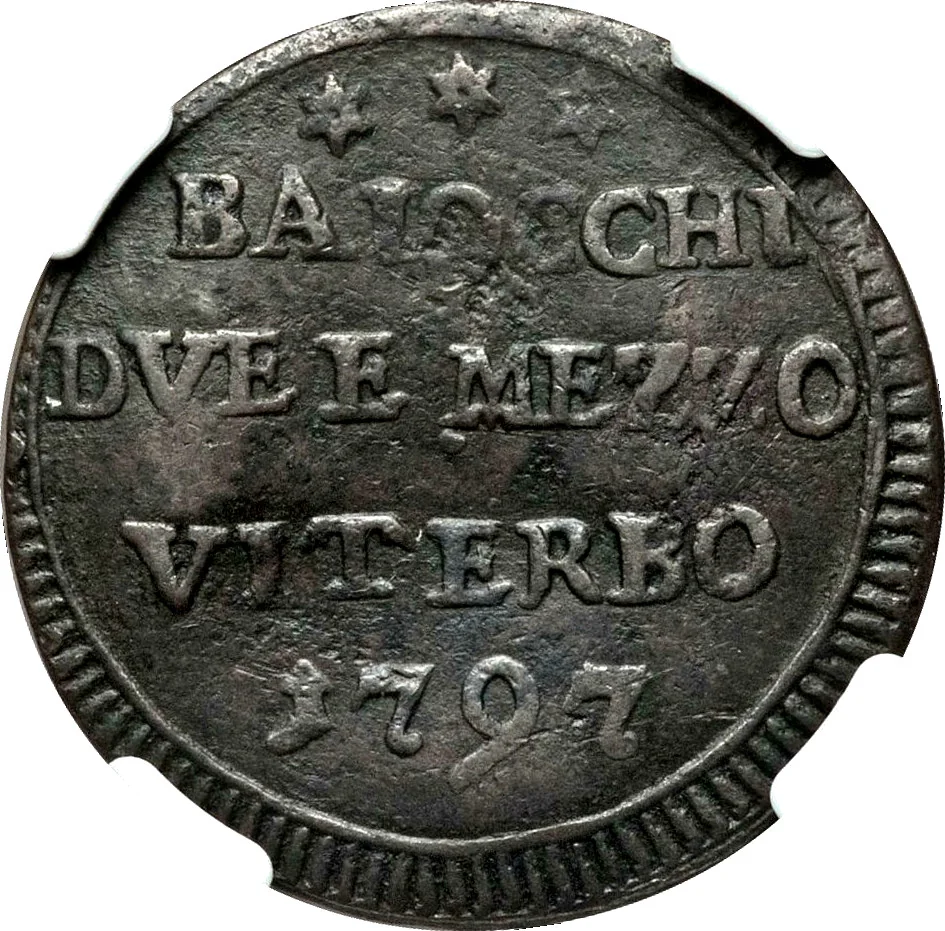
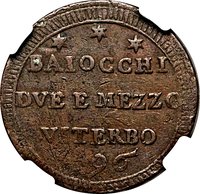
Reverse
Description:
City name below stars in circled written value.
Inscription:
BAIOCCHI
DVE E MEZZO
VITERBO
1797
DVE E MEZZO
VITERBO
1797
Script: Latin
Edge
Mints
| Name | Mark |
|---|---|
| Viterbo | — |
Mintings
| Year | Mint Mark | Mintage | Quality | Collection |
|---|---|---|---|---|
| 1797 | — | — | ||
| 1798 | — | — |
Historical background
In 1797, the city-state of Viterbo, like much of the Italian Peninsula, was caught in the turbulent wake of the French Revolutionary Wars. The previous year, French forces under Napoleon Bonaparte had swept through the region, leading to the establishment of the revolutionary Roman Republic in early 1798. While the formal change in government was imminent, 1797 was a year of transition and financial uncertainty. The local economy operated under the lingering structures of the Papal States, but was increasingly disrupted by French military demands for supplies and forced contributions, which drained specie and destabilized existing monetary systems.
The currency in circulation was a complex mosaic, reflecting Viterbo’s history as a papal territory. The official currency was the Papal scudo, divided into 100 baiocchi, each of 10 quattrini. However, in practice, a multitude of coins circulated, including those from other Italian states like the Tuscan fiorino and even older local issues. The French influx also introduced assignats (the French paper currency) and military mandates, which local merchants were often forced to accept at unfavorable rates. This created a chaotic multi-currency environment where values fluctuated wildly based on political rumors and the proximity of troops.
Ultimately, the monetary situation in Viterbo in 1797 was characterized by severe inflation and a crisis of confidence. The French extraction of precious metals to fund their campaign led to a scarcity of sound coinage (good money), leaving a proliferation of debased and foreign currencies (bad money) in daily use, in a stark example of Gresham's Law. This financial breakdown mirrored the collapse of the old political order, paving the way for the formal annexation into the Roman Republic and the subsequent imposition of a French-style monetary system, which would attempt, with limited local success, to replace the ancient papal currency.
The currency in circulation was a complex mosaic, reflecting Viterbo’s history as a papal territory. The official currency was the Papal scudo, divided into 100 baiocchi, each of 10 quattrini. However, in practice, a multitude of coins circulated, including those from other Italian states like the Tuscan fiorino and even older local issues. The French influx also introduced assignats (the French paper currency) and military mandates, which local merchants were often forced to accept at unfavorable rates. This created a chaotic multi-currency environment where values fluctuated wildly based on political rumors and the proximity of troops.
Ultimately, the monetary situation in Viterbo in 1797 was characterized by severe inflation and a crisis of confidence. The French extraction of precious metals to fund their campaign led to a scarcity of sound coinage (good money), leaving a proliferation of debased and foreign currencies (bad money) in daily use, in a stark example of Gresham's Law. This financial breakdown mirrored the collapse of the old political order, paving the way for the formal annexation into the Roman Republic and the subsequent imposition of a French-style monetary system, which would attempt, with limited local success, to replace the ancient papal currency.
💎 Extremely Rare