

1 Thaler – Austrian Empire
Austria
Context
Year: 1646
Country: Austria 
Issuer: Austrian Empire
Ruler: Ferdinand III
Currency:
(1520—1754)
Demonetized: Yes
References
KM: #Click to copy to clipboard930
Numista: #96354
Value
Bullion value: $82.37
Obverse
Description:
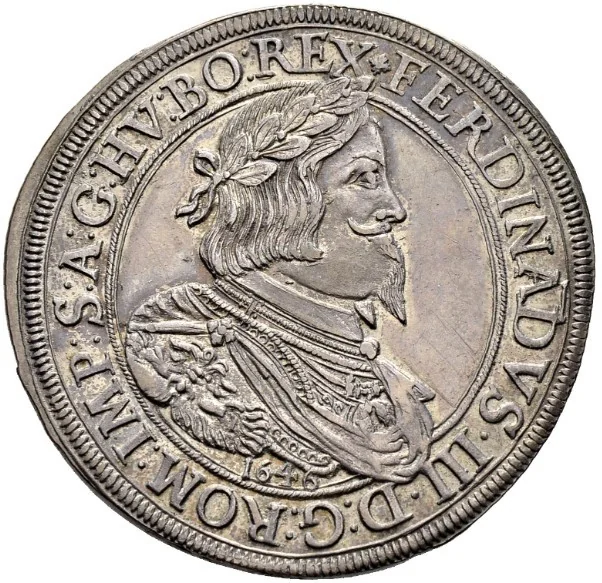
Laureate bust right, lion head on shoulder within double circle, legend around, date below.
Inscription:
FERDINANDVS III D G ROM IMP S A G HV BO REX
Script: Latin
Reverse
Description:
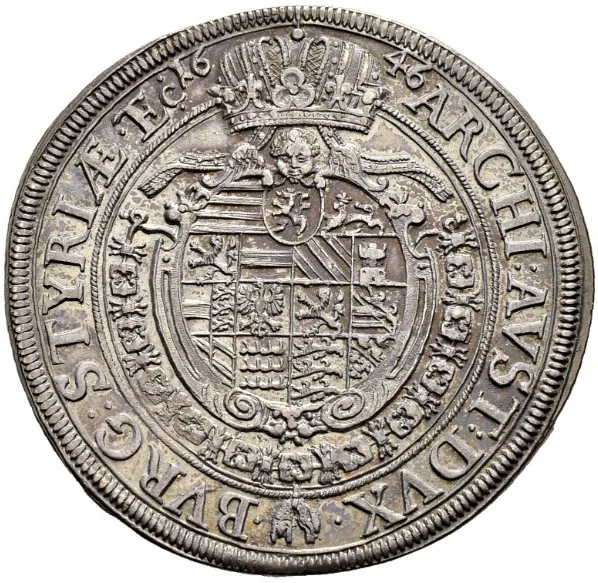
Arms in crowned oval shield with Styrian panther above, encircled by the Golden Fleece chain. The crown breaks the surrounding circle, separating the legend and date.
Inscription:
ARCHI AVST DVX // BVRG STYRIÆ ETc
Script: Latin
Edge
Mints
| Name | Mark |
|---|---|
| Graz | — |
Mintings
| Year | Mint Mark | Mintage | Quality | Collection |
|---|---|---|---|---|
| 1646 | — | — |
Historical background
In 1646, the Habsburg-ruled Austrian Empire was embroiled in the final, devastating stages of the Thirty Years' War (1618-1648). The financial demands of continuous, large-scale military conflict were catastrophic for the imperial treasury. To meet these exorbitant costs, the state resorted to repeated currency debasement, notably of the small-denomination Kreuzer and the Groschen, which were essential for daily transactions. This practice, where the silver content of coins was reduced while their face value was maintained, created a flood of unstable and untrusted currency, leading to rampant inflation and severe economic hardship for the population.
The monetary landscape was further complicated by extreme fragmentation. There was no single, unified imperial currency. While the large silver Reichsthaler served as a relatively stable accounting unit, actual circulation was a chaotic mix of domestic and foreign coins. Alongside debased Habsburg issues, Spanish Reales, Dutch Daalders, and various German state coins all circulated at fluctuating exchange rates. This chaos was exacerbated by the actions of opportunistic private minters and counterfeiters, who exploited the weak central control to produce even more inferior money, deepening the crisis of confidence.
Consequently, the year 1646 represents a peak of monetary disorder. The Habsburg state's fiscal desperation had directly fueled a vicious cycle of inflation, where the value of money could change rapidly, harming wage-earners, creditors, and market stability. This situation eroded trust not only in the currency but also in the financial authority of the Emperor. The profound economic damage of this period would leave a lasting legacy, highlighting the urgent need for monetary reform that would only be tentatively addressed in the war's aftermath under Leopold I.
The monetary landscape was further complicated by extreme fragmentation. There was no single, unified imperial currency. While the large silver Reichsthaler served as a relatively stable accounting unit, actual circulation was a chaotic mix of domestic and foreign coins. Alongside debased Habsburg issues, Spanish Reales, Dutch Daalders, and various German state coins all circulated at fluctuating exchange rates. This chaos was exacerbated by the actions of opportunistic private minters and counterfeiters, who exploited the weak central control to produce even more inferior money, deepening the crisis of confidence.
Consequently, the year 1646 represents a peak of monetary disorder. The Habsburg state's fiscal desperation had directly fueled a vicious cycle of inflation, where the value of money could change rapidly, harming wage-earners, creditors, and market stability. This situation eroded trust not only in the currency but also in the financial authority of the Emperor. The profound economic damage of this period would leave a lasting legacy, highlighting the urgent need for monetary reform that would only be tentatively addressed in the war's aftermath under Leopold I.

✨ Legendary