

1 Thaler – Austrian Empire
Austria
Context
Years: 1710–1711
Country: Austria 
Issuer: Austrian Empire
Ruler: Joseph I
Currency:
(1520—1754)
Demonetized: Yes
Material
References
KM: #Click to copy to clipboard1505
Numista: #95388
Value
Bullion value: $81.59
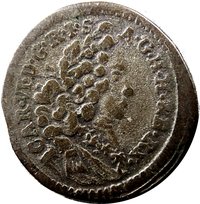
Obverse
Description:
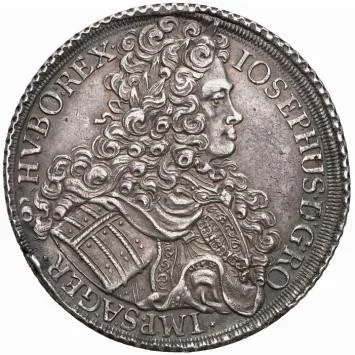
Armored bust right, three circles on arm armor, no inner circle.
Inscription:
IOSEPHUS D G RO // IMP S A GER // HV BO REX
Script: Latin
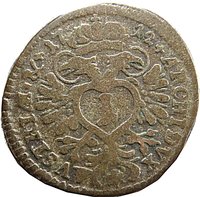
Reverse
Description:
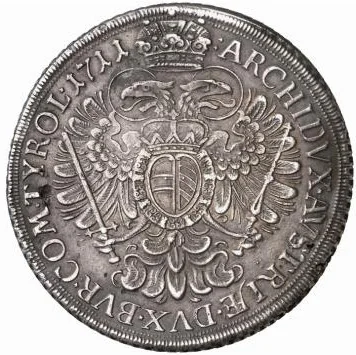
Imperial double eagle with Austrian and Burgundian arms on breast. No inner circle.
Inscription:
ARCHIDVX AVSTRIÆ DVX BVR COM TYROL 1711
Script: Latin
Edge
Mints
| Name | Mark |
|---|---|
| Münze Österreich | — |
Mintings
| Year | Mint Mark | Mintage | Quality | Collection |
|---|---|---|---|---|
| 1710 | IMH | — | ||
| 1711 | HMA | — | ||
| 1711 | MH | — |
Historical background
In 1710, the currency system of the Austrian Habsburg monarchy was in a state of profound crisis, a direct legacy of the immense financial strains of the War of the Spanish Succession (1701-1714). To fund the conflict, the state had resorted to massive debasement of the coinage, particularly the small-denomination kreuzer coins used in daily life. The Vienna Mint, under pressure from the court, dramatically reduced the silver content in these coins, flooding the economy with inferior money. This led to Gresham’s Law in action: "bad money drove out good," as older, full-value coins were hoarded or melted down, leaving only the debased currency in circulation.
The situation created economic chaos and social hardship. Prices for basic goods soared as the value of the currency plummeted, effectively imposing a harsh inflation tax on the population, especially those on fixed incomes or wages. Trade was severely disrupted, as the unstable currency undermined trust in transactions both within the Habsburg lands and with neighboring states. Furthermore, a confusing multiplicity of older, newer, domestic, and foreign coins circulated simultaneously, making commerce cumbersome. The government's own finances were also crippled, as it struggled to collect taxes in a stable medium of value.
Recognizing the destabilizing effects, authorities attempted reforms. In 1710, efforts were made to call in the debased coinage and issue new, properly valued money. However, these measures were only partially successful and often temporary, as the underlying fiscal pressure of the ongoing war made a full return to sound money impossible. Thus, the currency situation of 1710 represents a low point—a system degraded by fiscal desperation, causing widespread economic distress and highlighting the monarchy's urgent need for administrative and financial consolidation, a challenge that would persist for decades.
The situation created economic chaos and social hardship. Prices for basic goods soared as the value of the currency plummeted, effectively imposing a harsh inflation tax on the population, especially those on fixed incomes or wages. Trade was severely disrupted, as the unstable currency undermined trust in transactions both within the Habsburg lands and with neighboring states. Furthermore, a confusing multiplicity of older, newer, domestic, and foreign coins circulated simultaneously, making commerce cumbersome. The government's own finances were also crippled, as it struggled to collect taxes in a stable medium of value.
Recognizing the destabilizing effects, authorities attempted reforms. In 1710, efforts were made to call in the debased coinage and issue new, properly valued money. However, these measures were only partially successful and often temporary, as the underlying fiscal pressure of the ongoing war made a full return to sound money impossible. Thus, the currency situation of 1710 represents a low point—a system degraded by fiscal desperation, causing widespread economic distress and highlighting the monarchy's urgent need for administrative and financial consolidation, a challenge that would persist for decades.
✨ Legendary