

1 Ducat – Kingdom of Bohemia
Context
Years: 1716–1739
Country: Bohemia
Issuer: Kingdom of Bohemia
Ruler: Charles VI
Currency:
(1520—1754)
Demonetized: Yes
Total mintage: 37,264
Material
References
KM: #Click to copy to clipboard677
Numista: #94516
Value
Bullion value: $573.13
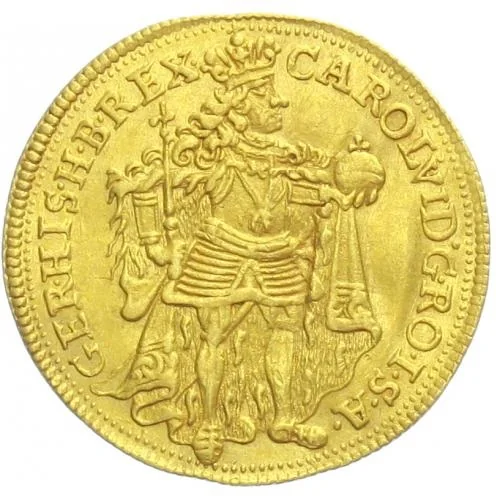
Obverse
Description:
Charles VI, right-facing, no inner circle.
Inscription:
CAROL VI D G RO I SA GER HIS H B REX
Script: Latin
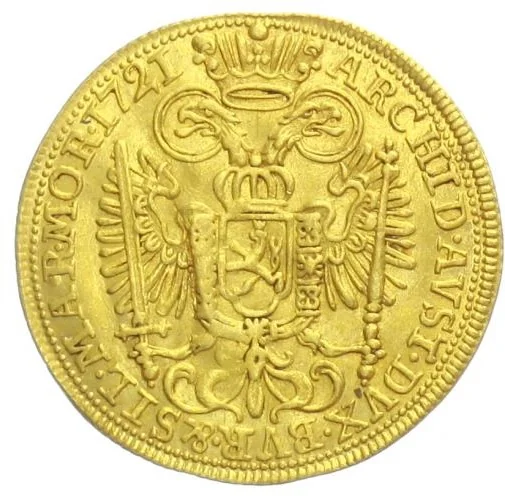
Reverse
Description:
Imperial eagle bearing the Bohemian shield.
Inscription:
ARCHID AVST DVX BVR & SIL MAR MOR 1721
Script: Latin
Edge
Mints
| Name | Mark |
|---|---|
| Prague | — |
Mintings
| Year | Mint Mark | Mintage | Quality | Collection |
|---|---|---|---|---|
| 1716 | — | — | ||
| 1718 | — | — | ||
| 1719 | — | — | ||
| 1720 | — | — | ||
| 1721 | — | — | ||
| 1722 | — | — | ||
| 1723 | — | — | ||
| 1724 | — | — | ||
| 1725 | — | — | ||
| 1726 | — | — | ||
| 1727 | — | — | ||
| 1728 | — | — | ||
| 1729 | — | — | ||
| 1731 | — | — | ||
| 1732 | — | 2,352 | ||
| 1733 | — | 3,265 | ||
| 1734 | — | 4,819 | ||
| 1736 | — | 9,641 | ||
| 1737 | — | 4,825 | ||
| 1738 | — | 4,508 | ||
| 1739 | — | 7,854 |
Historical background
In 1716, the Kingdom of Bohemia, a core crown land of the Habsburg Monarchy, operated within a complex and strained monetary system. The primary currency was the silver Konventionstaler, governed by the 1690 Imperial coinage standard which aimed to bring uniformity across the Holy Roman Empire. However, the reality in Bohemia was one of monetary duality. Alongside these large silver coins, a flood of small, chronically debased Kreuzer coins circulated for daily transactions. This divergence created significant economic friction, as the value relationship between large "specie" coins and small "current" coins was unstable and often manipulated.
The root of this instability lay in the aftermath of the costly wars against the Ottoman Empire and the War of the Spanish Succession. To finance these conflicts, the Habsburg state, through the Vienna Hofkammer, had repeatedly debased the small coinage, reducing its silver content to generate seigniorage profit. This practice led to a classic "bad money drives out good" (Gresham's Law) scenario, where full-value silver Talers were hoarded or exported, leaving the economy reliant on inferior coins. Consequently, prices in Kreuzer terms rose, causing inflation that disproportionately burdened the common population and complicated commercial accounting.
By 1716, the need for reform was acute. The monetary chaos hindered trade, tax collection, and economic recovery. While a major systemic reform—the 1717 Konventionsfuß which would create a new standard for the southern German and Austrian lands—was on the horizon, Bohemia in that specific year was still mired in the lingering difficulties of a bimetallic system plagued by debasement. The situation underscored the tension between central imperial fiscal demands and the need for a stable, trustworthy currency to facilitate economic life within the kingdom.
The root of this instability lay in the aftermath of the costly wars against the Ottoman Empire and the War of the Spanish Succession. To finance these conflicts, the Habsburg state, through the Vienna Hofkammer, had repeatedly debased the small coinage, reducing its silver content to generate seigniorage profit. This practice led to a classic "bad money drives out good" (Gresham's Law) scenario, where full-value silver Talers were hoarded or exported, leaving the economy reliant on inferior coins. Consequently, prices in Kreuzer terms rose, causing inflation that disproportionately burdened the common population and complicated commercial accounting.
By 1716, the need for reform was acute. The monetary chaos hindered trade, tax collection, and economic recovery. While a major systemic reform—the 1717 Konventionsfuß which would create a new standard for the southern German and Austrian lands—was on the horizon, Bohemia in that specific year was still mired in the lingering difficulties of a bimetallic system plagued by debasement. The situation underscored the tension between central imperial fiscal demands and the need for a stable, trustworthy currency to facilitate economic life within the kingdom.

✨ Legendary