

1 Silver Real – Spanish Netherlands
Netherlands
Context
Years: 1603–1610
Country: Netherlands 
Issuer: Spanish Netherlands
Currency:
(1506—1713)
Demonetized: Yes
Total mintage: 14,933
Material
Diameter: 26 mm
Weight: 3.06 g
Silver weight: 2.74 g
Shape: Irregular round
Composition: 89.6% Silver
Standard: Gold tenth ounce
Magnetic: No
Technique: Hammered
Alignment: Coin alignment
flip
References
KM: #Click to copy to clipboard25
Numista: #94006
Value
Bullion value: $7.95
Obverse
Description:
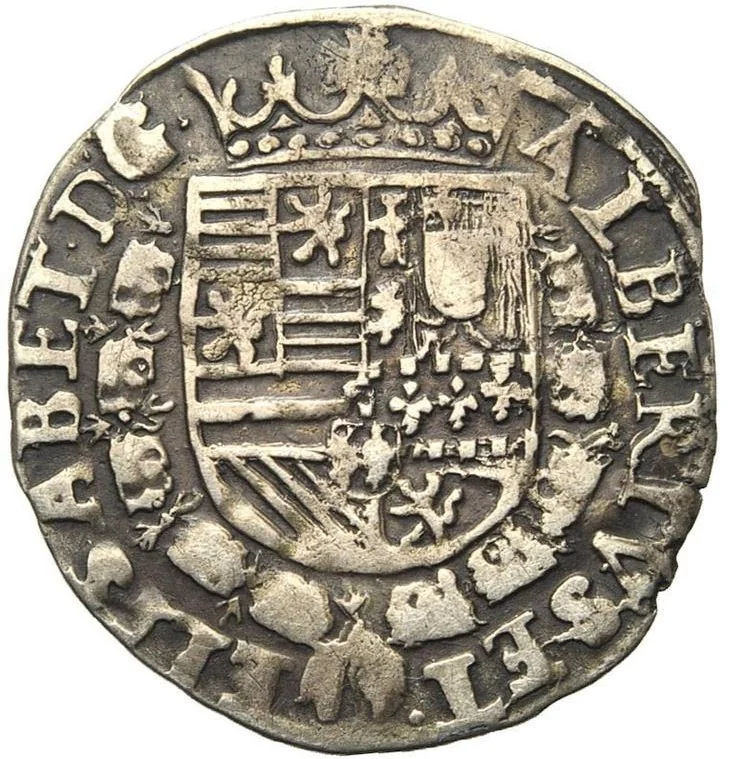
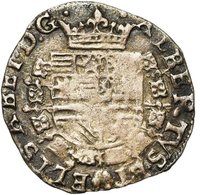
Eight-fold crowned arms encircled by the Golden Fleece collar.
Inscription:
ALBERTVS ET ELISABET D G
Script: Latin
Reverse
Description:
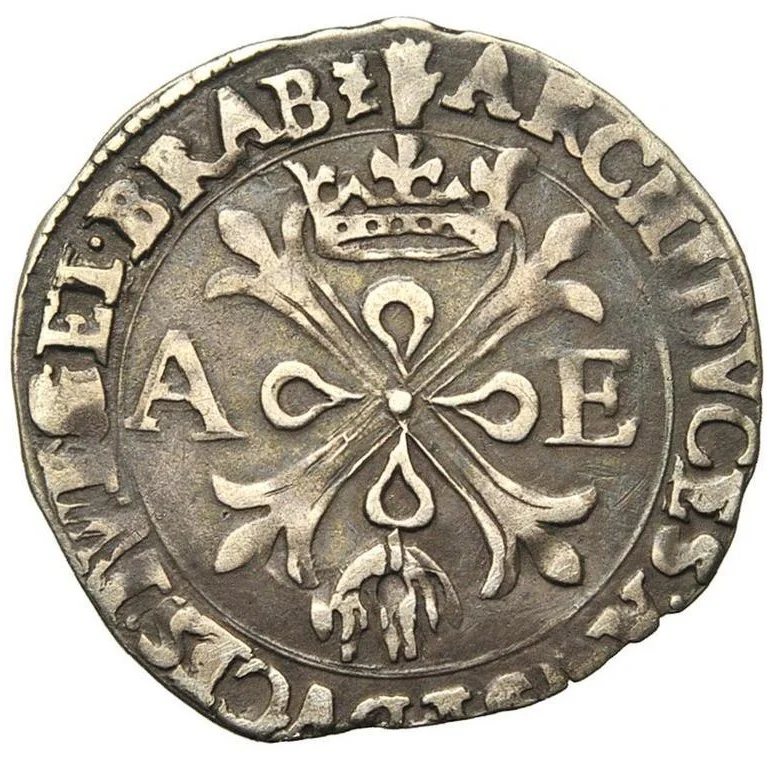
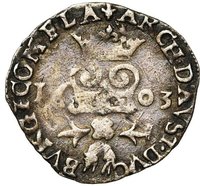
Crowned Burgundian cross with initials A E, its center a four-loop cross suspending Golden Fleece jewels.
Inscription:
ARCHIDVCES AVST DVCES BVRG ET BRAB Z
Script: Latin
Edge
Mints
| Name | Mark |
|---|---|
| Antwerp | Hand |
| Maastricht | Star |
| 's-Hertogenbosch | Tree |
Mintings
| Year | Mint Mark | Mintage | Quality | Collection |
|---|---|---|---|---|
| — | — | 14,933 |
Historical background
In 1603, the Spanish Netherlands found itself in the midst of a severe and protracted monetary crisis, a direct consequence of the ongoing Eighty Years' War (1568-1648). The region, a vital but war-ravaged hub of European commerce, was flooded with debased and foreign coinage. The Spanish government, desperate to finance its military campaigns, repeatedly engaged in inflationary practices such as reducing the silver content in its own coinage (like the real and the patagon) and authorizing the circulation of heavily adulterated "crisis coins." This deliberate devaluation, intended to stretch treasury funds, utterly destabilized the local economy.
The situation was exacerbated by the circulation of vast quantities of inferior coins from neighboring states, which flowed into the economically advanced Netherlands due to Gresham's Law ("bad money drives out good money"). Trust in the currency collapsed, leading to rampant price inflation, market disorder, and a crippling reluctance to conduct business. Merchants and cities faced daily confusion over exchange rates and the real value of payments, severely hampering the trade and textile industries that were the region's lifeblood. The Habsburg authorities in Brussels issued repeated ordinances and attempted currency reforms, but these were largely ineffective without political stability and fiscal restraint.
Therefore, the year 1603 represents a point of deep frustration within this chronic crisis. The monetary chaos was both a symptom and a cause of the wider conflict, undermining the Spanish Crown's control and fueling discontent among all classes. It highlighted the fundamental contradiction of trying to maintain a prosperous, tax-generating economy while simultaneously waging a costly war that required policies which destroyed that very prosperity. The search for a viable monetary standard would remain an elusive and central administrative challenge for years to come.
The situation was exacerbated by the circulation of vast quantities of inferior coins from neighboring states, which flowed into the economically advanced Netherlands due to Gresham's Law ("bad money drives out good money"). Trust in the currency collapsed, leading to rampant price inflation, market disorder, and a crippling reluctance to conduct business. Merchants and cities faced daily confusion over exchange rates and the real value of payments, severely hampering the trade and textile industries that were the region's lifeblood. The Habsburg authorities in Brussels issued repeated ordinances and attempted currency reforms, but these were largely ineffective without political stability and fiscal restraint.
Therefore, the year 1603 represents a point of deep frustration within this chronic crisis. The monetary chaos was both a symptom and a cause of the wider conflict, undermining the Spanish Crown's control and fueling discontent among all classes. It highlighted the fundamental contradiction of trying to maintain a prosperous, tax-generating economy while simultaneously waging a costly war that required policies which destroyed that very prosperity. The search for a viable monetary standard would remain an elusive and central administrative challenge for years to come.
💎 Extremely Rare