

1 Thaler – Austrian Empire
Austria
Context
Years: 1652–1655
Country: Austria 
Issuer: Austrian Empire
Ruler: Ferdinand III
Currency:
(1520—1754)
Demonetized: Yes
Material
References
KM: #Click to copy to clipboard977
Numista: #93705
Value
Bullion value: $81.92
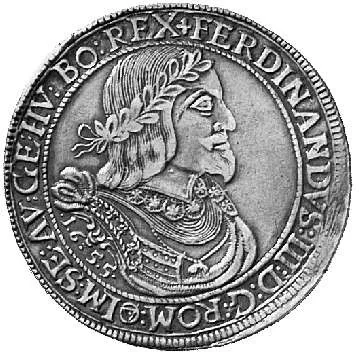
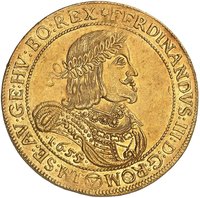
Obverse
Description:
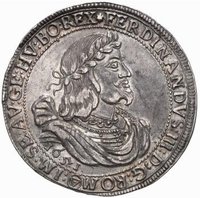
Armored laureate bust right, beaded border. Legend divided by mint mark below, date beneath bust.
Inscription:
FERDINANDVS III D G ROM ( Y) IM SE AV GE HV BO REX
Script: Latin
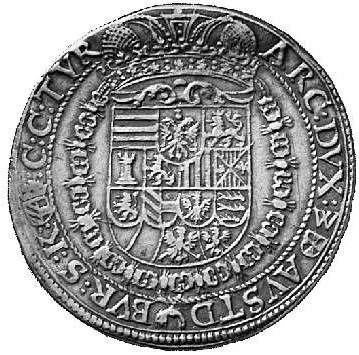
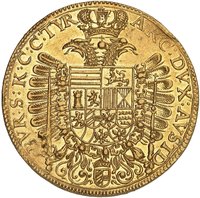
Reverse
Description:
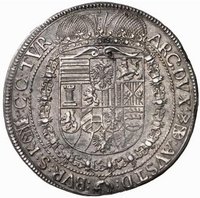
Arms with shield and imperial eagle. Legend between "DVX" and "AVST" shows a W and a shield; between "SK" and "CC", a crowned shield of Austria and Burgundy. Inscription: "Archi Dux Austriae Dux Burgundiae Styriae Karinthiae Carniolae Comes Tyrolis".
Inscription:
ARC DVX // AVST D // BVR S K // C C TYR
Script: Latin
Edge
Mints
| Name | Mark |
|---|---|
| Münze Österreich | — |
Mintings
| Year | Mint Mark | Mintage | Quality | Collection |
|---|---|---|---|---|
| 1652 | — | — | ||
| 1653 | — | — | ||
| 1654 | — | — | ||
| 1655 | — | — |
Historical background
In 1652, the Austrian Habsburg monarchy was grappling with a severe and protracted currency crisis, a direct legacy of the Thirty Years' War (1618-1648). The immense financial strain of funding decades of conflict had led to repeated debasements of the coinage, particularly the small-denomination Kreuzer and Groschen used in daily life. By the mid-17th century, the silver content in these coins had been drastically reduced, leading to a flood of "bad money" that drove older, full-value coins out of circulation (Gresham's Law). This resulted in a chaotic monetary landscape with wildly fluctuating values, rampant counterfeiting, and a deep loss of public trust in the currency.
The primary response to this crisis was the Wiener Münzvertrag (Vienna Coinage Treaty) of 1652, an agreement between the Emperor and the major Upper Austrian estates. This treaty aimed to standardize and restore order by introducing a new, high-quality silver coin: the Kronentaler. Valued at 90 Kreuzer, it was intended to serve as a stable large-denomination currency. More critically, the treaty attempted to systematically recall and remint the debased small change, a process known as Renovatio monetae.
However, the success of these measures was limited. The underlying fiscal pressures on the Habsburg state remained, and the costs of the reminting process were enormous. While the Kronentaler achieved some stability, the fundamental tension between the crown's need for revenue and the necessity of sound money was not resolved. Thus, the situation in 1652 represents a pivotal but only partially successful attempt at monetary reform within a fragile post-war economy, setting a pattern of financial challenges that would persist for the Habsburg monarchy throughout the century.
The primary response to this crisis was the Wiener Münzvertrag (Vienna Coinage Treaty) of 1652, an agreement between the Emperor and the major Upper Austrian estates. This treaty aimed to standardize and restore order by introducing a new, high-quality silver coin: the Kronentaler. Valued at 90 Kreuzer, it was intended to serve as a stable large-denomination currency. More critically, the treaty attempted to systematically recall and remint the debased small change, a process known as Renovatio monetae.
However, the success of these measures was limited. The underlying fiscal pressures on the Habsburg state remained, and the costs of the reminting process were enormous. While the Kronentaler achieved some stability, the fundamental tension between the crown's need for revenue and the necessity of sound money was not resolved. Thus, the situation in 1652 represents a pivotal but only partially successful attempt at monetary reform within a fragile post-war economy, setting a pattern of financial challenges that would persist for the Habsburg monarchy throughout the century.
✨ Legendary