

1 Thaler – Austrian Empire
Austria
Context
Year: 1693
Country: Austria 
Issuer: Austrian Empire
Ruler: Leopold I
Currency:
(1520—1754)
Demonetized: Yes
Material
References
KM: #Click to copy to clipboard1348.2
Numista: #93528
Value
Bullion value: $81.36
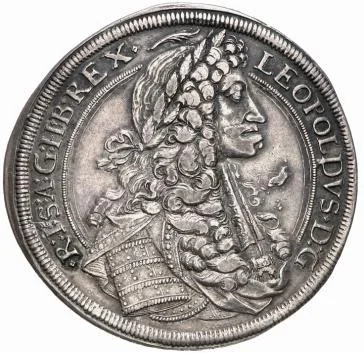
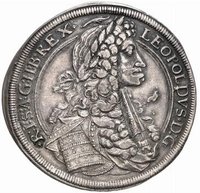
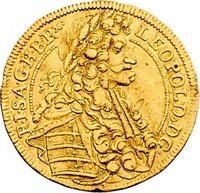
Obverse
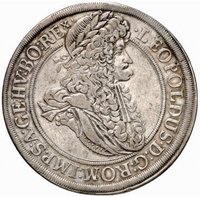
Description:
Portrait right, arm forward, legend above and below, within double circle.
Inscription:
LEOPOLDVS D G // R I S A G H B REX
Script: Latin
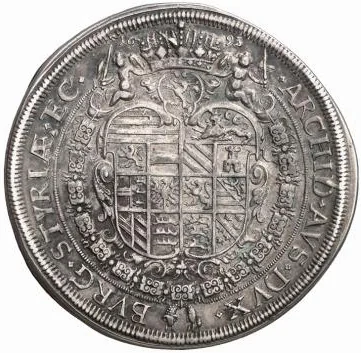
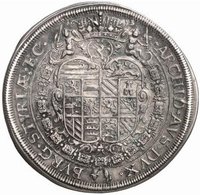
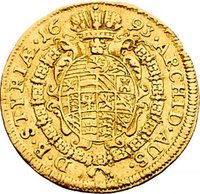
Reverse
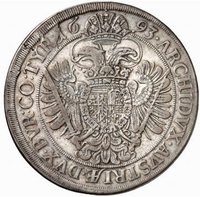
Description:
Shield with small Styrian arms under a crown, flanked by angels. Date in small digits above the crown.
Inscription:
ARCHID AVS DVX BVRG STYRIÆ ETC
Script: Latin
Edge
Mints
| Name | Mark |
|---|---|
| Graz | — |
Mintings
| Year | Mint Mark | Mintage | Quality | Collection |
|---|---|---|---|---|
| 1693 | — | — |
Historical background
In 1693, the currency system of the Habsburg Monarchy (often referred to as the Austrian Empire) was under severe strain due to the immense financial demands of the Great Turkish War (1683-1699) and the Nine Years' War (1688-1697). The state treasury, drained by decades of continuous conflict, resorted to the debasement of coinage as a primary means of raising funds. Authorities, particularly under Emperor Leopold I, reduced the precious metal content in silver coins like the Reichsthaler and its smaller denominations, while increasing the nominal number of coins minted from the same amount of silver. This practice created a short-term influx of cash to pay armies and suppliers but fundamentally undermined the currency's value.
The result was monetary chaos and a classic "bad money drives out good" scenario (Gresham's Law). Older, higher-quality coins were hoarded or melted down for their intrinsic metal value, while the new, inferior coins flooded the market, causing rapid inflation and a loss of public trust. This debasement was not uniform across the Habsburg lands, which included the Kingdom of Hungary and the Bohemian Crown lands, leading to complex exchange rates and hindering trade. The situation was exacerbated by the circulation of foreign coins and the activities of counterfeiters, who exploited the unstable system.
This crisis highlighted the monarchy's fragmented financial administration and the lack of a unified, centralized monetary policy. The chronic shortage of sound money stifled economic activity and became a major point of contention between the Emperor and the Estates of the various realms, who controlled taxation and were reluctant to grant further subsidies. The experience of the 1690s would eventually contribute to later attempts at reform, but in 1693, the currency situation was one of profound instability, reflecting the broader fiscal and administrative challenges of financing Habsburg imperial ambitions.
The result was monetary chaos and a classic "bad money drives out good" scenario (Gresham's Law). Older, higher-quality coins were hoarded or melted down for their intrinsic metal value, while the new, inferior coins flooded the market, causing rapid inflation and a loss of public trust. This debasement was not uniform across the Habsburg lands, which included the Kingdom of Hungary and the Bohemian Crown lands, leading to complex exchange rates and hindering trade. The situation was exacerbated by the circulation of foreign coins and the activities of counterfeiters, who exploited the unstable system.
This crisis highlighted the monarchy's fragmented financial administration and the lack of a unified, centralized monetary policy. The chronic shortage of sound money stifled economic activity and became a major point of contention between the Emperor and the Estates of the various realms, who controlled taxation and were reluctant to grant further subsidies. The experience of the 1690s would eventually contribute to later attempts at reform, but in 1693, the currency situation was one of profound instability, reflecting the broader fiscal and administrative challenges of financing Habsburg imperial ambitions.
✨ Legendary