

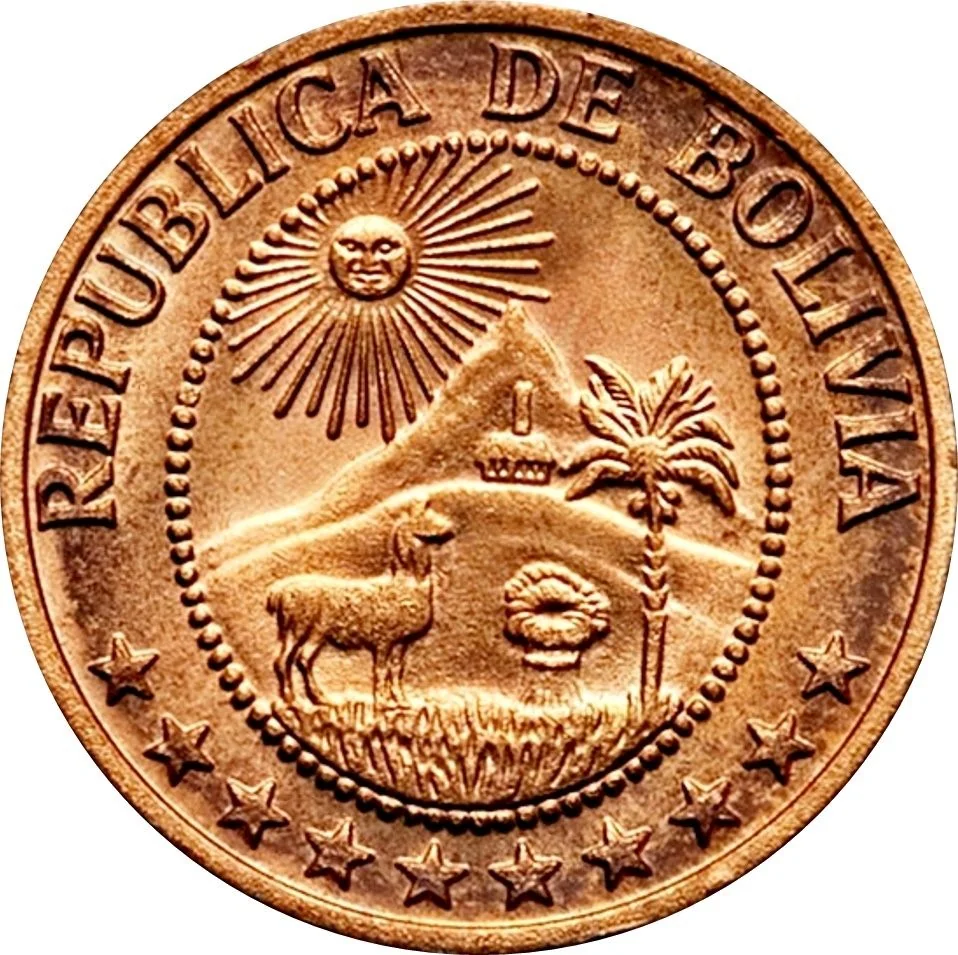
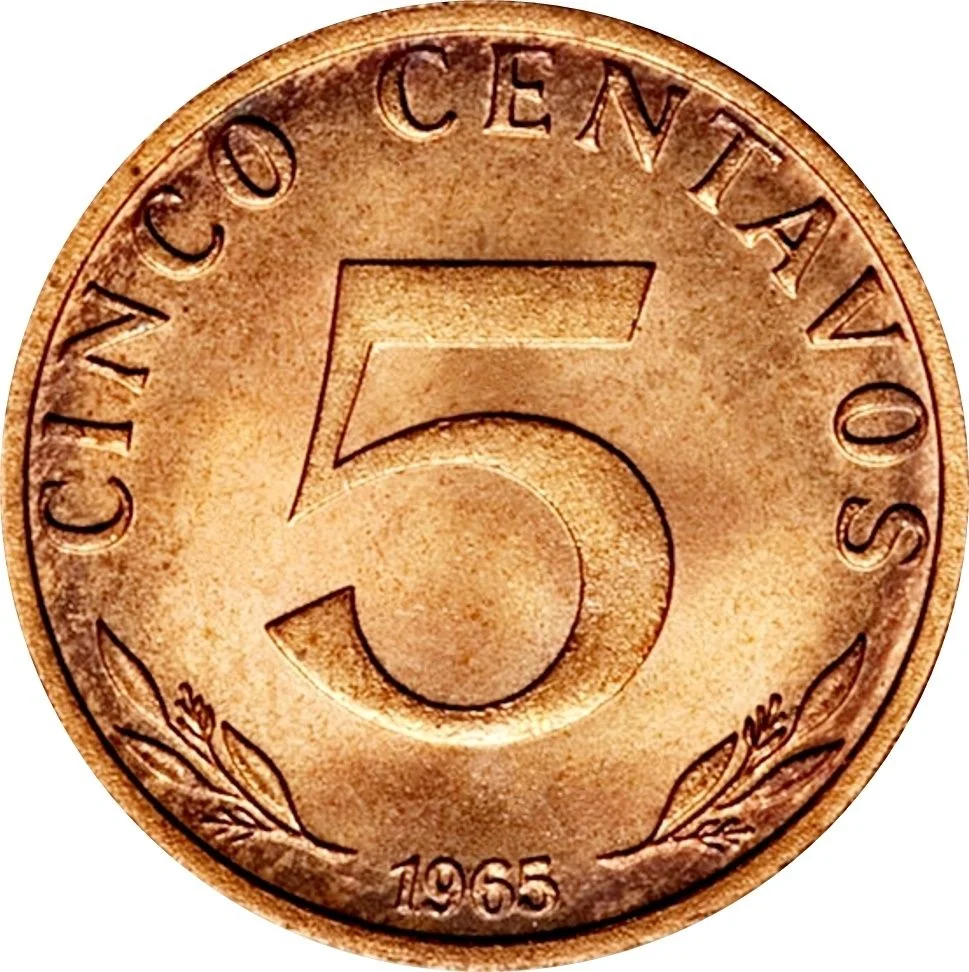
5 centavos – Bolivia
Add to wishlist
Bolivia
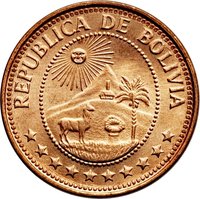
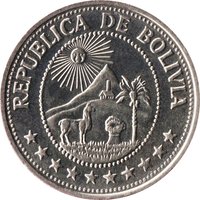
Obverse
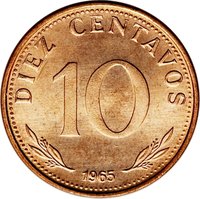
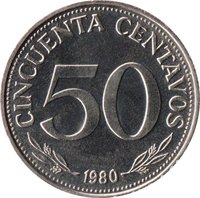
Reverse
Edge
Plain
Mints
| Name | Mark |
|---|---|
| VDM Metals / Vereinigte Deutsche Metallwerke | — |
Mintings
| Year | Mint Mark | Mintage | Quality | Collection |
|---|---|---|---|---|
| 1965 | — | 10,000,000 | ||
| 1970 | — | 100,000 |
Historical background
In 1965, Bolivia’s currency situation was defined by the aftermath of the 1952 National Revolution and the profound economic instability of the preceding decade. The revolutionary government had implemented sweeping reforms, including nationalizations and agrarian reform, but financed these largely through money creation by the Central Bank. This led to hyperinflation, which peaked in 1956 with an annual rate exceeding 600%. Although a drastic stabilization plan in 1956, backed by the International Monetary Fund and the United States, had tamed the worst of the inflation, the structural weaknesses of the Bolivian economy persisted into the mid-1960s.
The official currency, the Bolivian peso (boliviano), remained fragile and subject to significant pressure. The economy was overwhelmingly dependent on tin exports, which accounted for over 70% of foreign exchange earnings, making the currency highly vulnerable to volatile global commodity prices. Furthermore, decades of budget deficits and a large, inefficient state mining corporation (COMIBOL) continued to strain public finances. While not in hyperinflation, the period was marked by persistent inflationary tendencies and a lack of confidence in the peso, with many transactions unofficially referenced to the US dollar as a more stable store of value.
Politically, the currency’s stability was under the stewardship of President Víctor Paz Estenssoro, who had returned to power in 1964. His administration maintained the orthodox stabilization policies initiated earlier, prioritizing control of the money supply and seeking foreign investment. However, his rule became increasingly authoritarian, and in 1965 he faced growing social unrest and a struggling economy. The currency situation, therefore, reflected a tense calm—managed inflation but within an economy of limited diversification and deep-seated fiscal challenges, setting the stage for the major devaluation and monetary reform that would come with the introduction of the peso boliviano in 1966.
The official currency, the Bolivian peso (boliviano), remained fragile and subject to significant pressure. The economy was overwhelmingly dependent on tin exports, which accounted for over 70% of foreign exchange earnings, making the currency highly vulnerable to volatile global commodity prices. Furthermore, decades of budget deficits and a large, inefficient state mining corporation (COMIBOL) continued to strain public finances. While not in hyperinflation, the period was marked by persistent inflationary tendencies and a lack of confidence in the peso, with many transactions unofficially referenced to the US dollar as a more stable store of value.
Politically, the currency’s stability was under the stewardship of President Víctor Paz Estenssoro, who had returned to power in 1964. His administration maintained the orthodox stabilization policies initiated earlier, prioritizing control of the money supply and seeking foreign investment. However, his rule became increasingly authoritarian, and in 1965 he faced growing social unrest and a struggling economy. The currency situation, therefore, reflected a tense calm—managed inflation but within an economy of limited diversification and deep-seated fiscal challenges, setting the stage for the major devaluation and monetary reform that would come with the introduction of the peso boliviano in 1966.
Series: 1965 Bolivia circulation coins
🌱 Common