

2 skilling – Denmark
Add to wishlist
Denmark
Context
Material
References
KM: #
Numista: #92859
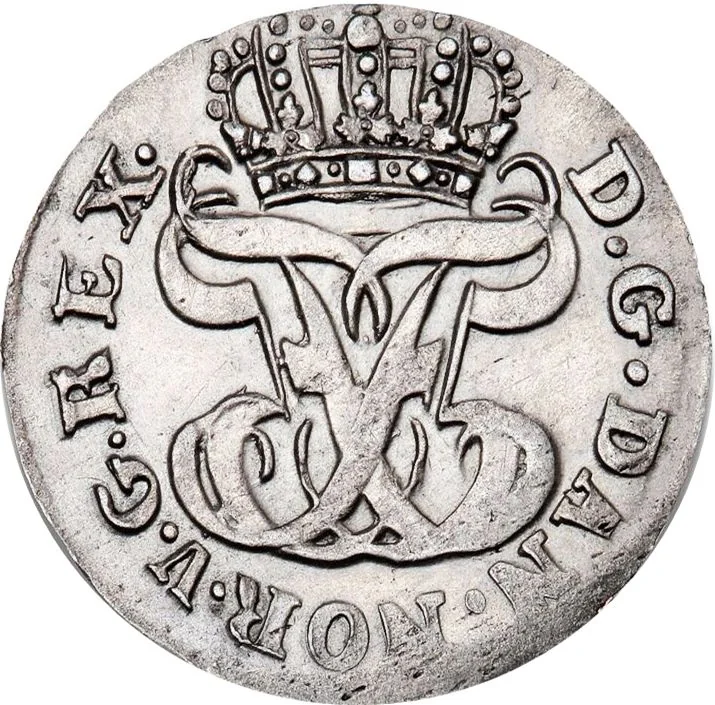
Obverse
Description:
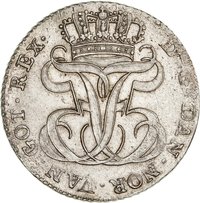
Crowned double monogram. Legend near rim.
Inscription:
5FF5
D.G.DAN.NOR.V.G.REX.
D.G.DAN.NOR.V.G.REX.
Script: Latin
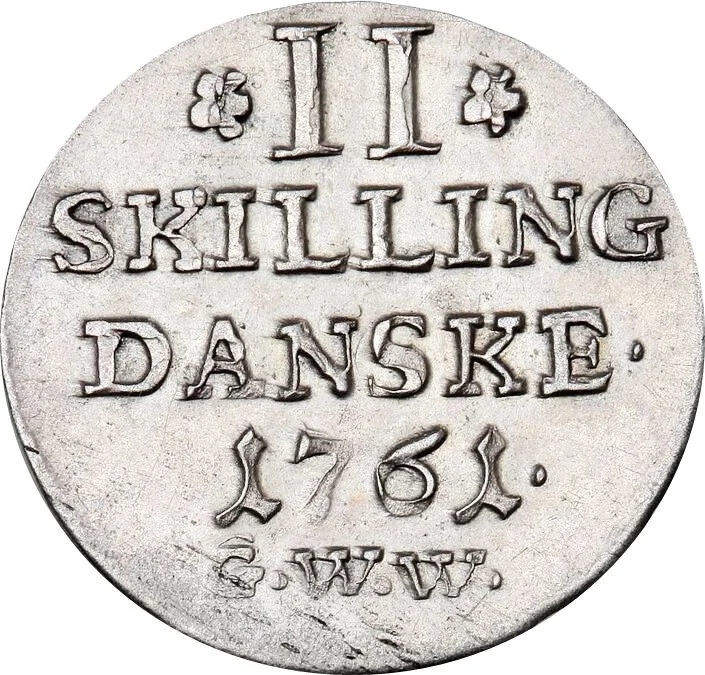
Reverse
Description:
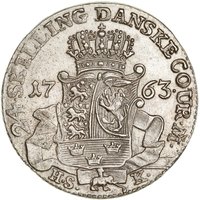
Value and date stacked.
Mintmark below.
Mintmark below.
Inscription:
*II*
SKILLING
DANSKE
1761.
H.S.K.
SKILLING
DANSKE
1761.
H.S.K.
Script: Latin
Edge
Mints
| Name | Mark |
|---|---|
| Royal Danish Mint | — |
Mintings
| Year | Mint Mark | Mintage | Quality | Collection |
|---|---|---|---|---|
| 1750 | PNVH | — | ||
| 1756 | PNVH | — | ||
| 1761 | — | — |
Historical background
In the mid-18th century, Denmark operated under a silver standard, but its currency system was complex and fragmented. The primary unit was the rigsdaler, subdivided into 96 skilling. However, the system was not unified; alongside the government-issued rigsdaler courant used for everyday transactions, there existed the more valuable rigsdaler specie, which was tied directly to silver content and used for international trade and large contracts. This created a dual-system where exchange rates between the two types of rigsdaler could fluctuate, causing confusion and inefficiency in commerce.
The period around 1750 was one of relative monetary stability following earlier turmoil. A significant reform in 1736 had introduced the kurant system, establishing a central bank, the Kurantbanken, which issued paper credit notes (kuranter). These notes were a precursor to modern banknotes and were intended to circulate alongside and be fully convertible into silver coin. This helped stimulate the economy by increasing the money supply, but it also required careful management to maintain public confidence in the paper currency's value and prevent inflation.
Despite this stability, underlying challenges persisted. The state finances were heavily burdened by the costs of maintaining an absolute monarchy and a large military, particularly following the Great Northern War. Furthermore, Denmark's economy was still predominantly agricultural, and the currency system remained susceptible to regional variations and the physical shortage of small-change copper coins (skilling), which hampered daily trade for the common people. Thus, while the 1750s did not see a major crisis, the system's complexity and fiscal pressures laid the groundwork for future monetary adjustments in the latter part of the century.
The period around 1750 was one of relative monetary stability following earlier turmoil. A significant reform in 1736 had introduced the kurant system, establishing a central bank, the Kurantbanken, which issued paper credit notes (kuranter). These notes were a precursor to modern banknotes and were intended to circulate alongside and be fully convertible into silver coin. This helped stimulate the economy by increasing the money supply, but it also required careful management to maintain public confidence in the paper currency's value and prevent inflation.
Despite this stability, underlying challenges persisted. The state finances were heavily burdened by the costs of maintaining an absolute monarchy and a large military, particularly following the Great Northern War. Furthermore, Denmark's economy was still predominantly agricultural, and the currency system remained susceptible to regional variations and the physical shortage of small-change copper coins (skilling), which hampered daily trade for the common people. Thus, while the 1750s did not see a major crisis, the system's complexity and fiscal pressures laid the groundwork for future monetary adjustments in the latter part of the century.
Series: 1750 Denmark circulation coins
💎 Very Rare