

1 Thaler – Kingdom of Bohemia
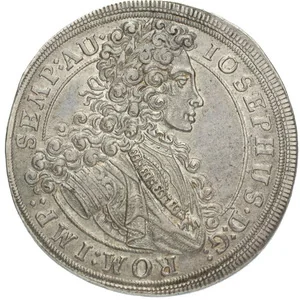
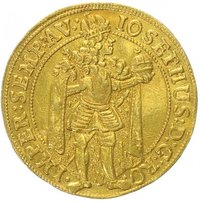
Obverse
Inscription:
IOSEPHUS. D: G: - ROM: IMP: - SEMP: AU
Script: Latin
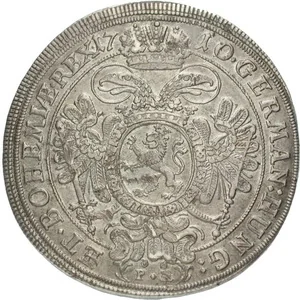
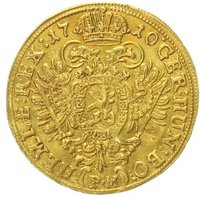
Reverse
Inscription:
GERMAN: HUNG: - ET. BOHEMIAE. REX 17 10
(P U)
(P U)
Script: Latin
Edge
Mints
| Name | Mark |
|---|---|
| Prague | — |
Mintings
| Year | Mint Mark | Mintage | Quality | Collection |
|---|---|---|---|---|
| 1709 | — | — | ||
| 1710 | PM | — |
Historical background
In 1709, the Kingdom of Bohemia, a core hereditary land of the Habsburg Monarchy, was grappling with a severe and complex currency crisis, deeply intertwined with the financial demands of the War of the Spanish Succession (1701-1714). The Habsburg state, under Emperor Joseph I, was engaged in a continent-wide conflict and resorted to drastic monetary debasement to fund its massive military expenditures. This involved striking and circulating vastly overvalued small-denomination coins, known as Klippen in German, which had a high face value but contained very little precious metal.
The situation was chaotic and destructive. While these debased coins flooded the market to pay soldiers and suppliers, older, full-value silver coins like the Reichsthaler were hoarded or melted down for their intrinsic metal worth, following Gresham's Law ("bad money drives out good money"). This led to a rapid inflation of prices, as merchants demanded more of the suspect coins for goods, and a crippling loss of confidence in the monetary system. The crisis caused widespread social hardship, particularly for peasants, laborers, and those on fixed incomes, whose purchasing power evaporated.
This turmoil was not merely economic but also political, highlighting the tensions between the central Vienna court and the Bohemian estates. The estates, representing the local nobility and towns, saw their economic interests harmed by the imperial policy. The crisis of 1709 was a pivotal moment that underscored the monarchy's fiscal desperation and directly precipitated a major monetary reform. Just two years later, in 1711, under the new Emperor Charles VI, the government initiated a sweeping recoinage and stabilization project, introducing a standardized Konventionsmünzfuß (Convention monetary standard) in 1714, which restored silver content and brought a period of much-needed stability to Bohemia's economy.
The situation was chaotic and destructive. While these debased coins flooded the market to pay soldiers and suppliers, older, full-value silver coins like the Reichsthaler were hoarded or melted down for their intrinsic metal worth, following Gresham's Law ("bad money drives out good money"). This led to a rapid inflation of prices, as merchants demanded more of the suspect coins for goods, and a crippling loss of confidence in the monetary system. The crisis caused widespread social hardship, particularly for peasants, laborers, and those on fixed incomes, whose purchasing power evaporated.
This turmoil was not merely economic but also political, highlighting the tensions between the central Vienna court and the Bohemian estates. The estates, representing the local nobility and towns, saw their economic interests harmed by the imperial policy. The crisis of 1709 was a pivotal moment that underscored the monarchy's fiscal desperation and directly precipitated a major monetary reform. Just two years later, in 1711, under the new Emperor Charles VI, the government initiated a sweeping recoinage and stabilization project, introducing a standardized Konventionsmünzfuß (Convention monetary standard) in 1714, which restored silver content and brought a period of much-needed stability to Bohemia's economy.
✨ Legendary