

1 Thaler – Austrian Empire
Austria
Context
Years: 1790–1792
Country: Austria 
Issuer: Austrian Empire
Ruler: Leopold II
Currency:
(1754—1857)
Demonetized: Yes
Material
References
KM: #Click to copy to clipboard2100
Numista: #9220
Value
Bullion value: $66.37
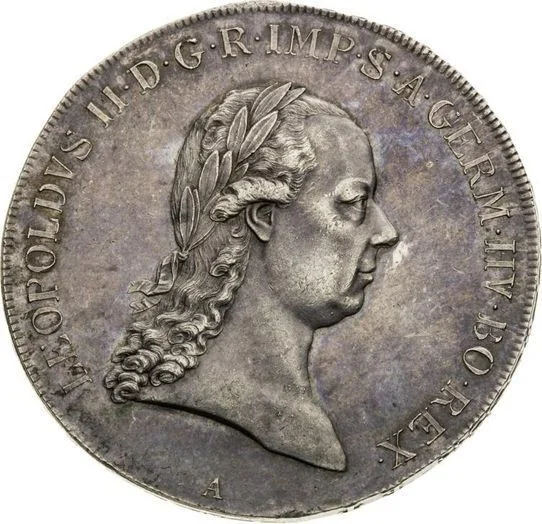
Obverse
Description:
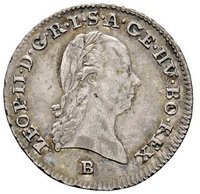
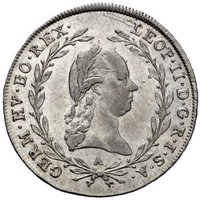
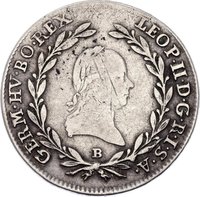
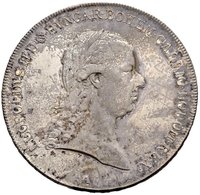
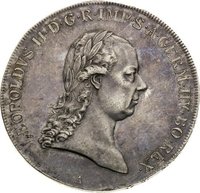
Portrait facing right. Legend: "Leopoldus II...Romanorum imperator...Germaniae Hungariae Bohemiae rex."
Inscription:
LEOPOLDVS II·D·G·R·IMP·S·A·GERM·HV·BO·REX·
A
A
Script: Latin
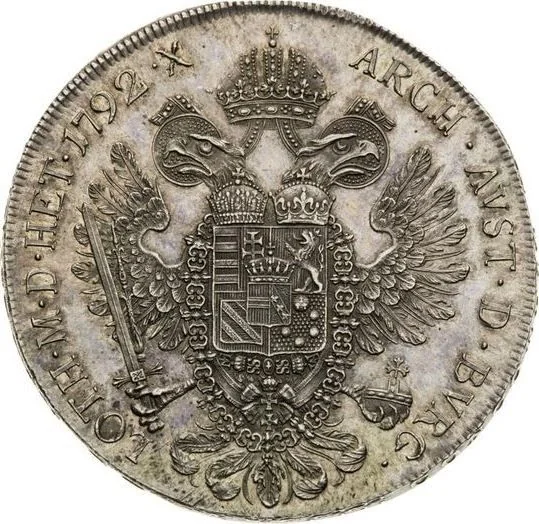
Reverse
Description:
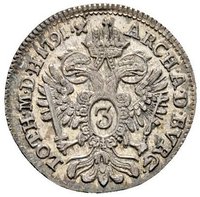
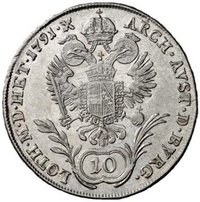
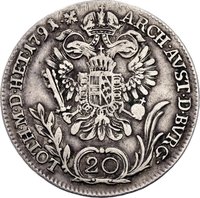
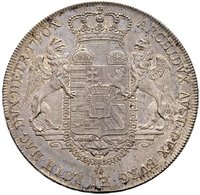
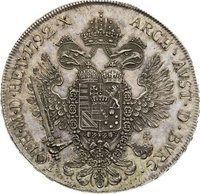
Imperial eagle with Habsburg-Lorraine shield, encircled by "Archidux Austriae, Dux Burgundiae Lotharingiaeque, Magnus Dux Hetruriae."
Inscription:
LOTH·M·D·HET·1790·X ARCH·AVST·D·BVRG·
Script: Latin
Edge
Mints
| Name | Mark |
|---|---|
| Münze Österreich | A |
Historical background
In 1790, the currency system of the Habsburg Monarchy, often referred to as the Austrian Empire, was a complex and unstable patchwork inherited from the reforms of Empress Maria Theresa. The primary unit was the Conventionsthaler (or Conventionstaler), established by the monetary convention of 1753, which aimed to create a stable silver standard across the Austrian and Bavarian lands. This system defined a fixed relationship between silver and the ubiquitous smaller coin, the kreuzer, with 1 Conventionsthaler = 2 Gulden = 120 kreuzer. However, this official "convention coinage" existed alongside a bewildering array of older regional currencies and debased coins, creating constant confusion in commerce.
The system was under severe strain due to the financial demands of near-constant warfare, particularly the expensive conflict with the Ottoman Empire (1787-1791) and the aftermath of the War of the Bavarian Succession. To meet these colossal expenses, the state, under Emperor Joseph II, had increasingly resorted to manipulating the currency. This involved issuing excessive amounts of low-quality subsidiary coinage (like copper and debased silver coins) and paper money, known as Bankozettel, from the Vienna City Bank. While not yet at the catastrophic levels seen during the Napoleonic Wars, this practice had already begun to erode confidence and create a gap between the official "convention" standard and the actual circulating medium.
Consequently, by 1790, a dual system was effectively in operation: stable accounting in Conventionsgeld for official contracts and large transactions, and fluctuating everyday transactions in Wiener Währung (Vienna currency), which was based on the depreciating Bankozettel and inferior coinage. This monetary disarray hampered internal trade, frustrated economic planning, and placed a burden on the lower classes, who handled the devalued coins daily. The death of Joseph II in 1790 left his successor, Leopold II, with a pressing need for fiscal and monetary reform, a challenge that would soon be vastly magnified by the wars of the French Revolutionary era.
The system was under severe strain due to the financial demands of near-constant warfare, particularly the expensive conflict with the Ottoman Empire (1787-1791) and the aftermath of the War of the Bavarian Succession. To meet these colossal expenses, the state, under Emperor Joseph II, had increasingly resorted to manipulating the currency. This involved issuing excessive amounts of low-quality subsidiary coinage (like copper and debased silver coins) and paper money, known as Bankozettel, from the Vienna City Bank. While not yet at the catastrophic levels seen during the Napoleonic Wars, this practice had already begun to erode confidence and create a gap between the official "convention" standard and the actual circulating medium.
Consequently, by 1790, a dual system was effectively in operation: stable accounting in Conventionsgeld for official contracts and large transactions, and fluctuating everyday transactions in Wiener Währung (Vienna currency), which was based on the depreciating Bankozettel and inferior coinage. This monetary disarray hampered internal trade, frustrated economic planning, and placed a burden on the lower classes, who handled the devalued coins daily. The death of Joseph II in 1790 left his successor, Leopold II, with a pressing need for fiscal and monetary reform, a challenge that would soon be vastly magnified by the wars of the French Revolutionary era.
✨ Legendary