

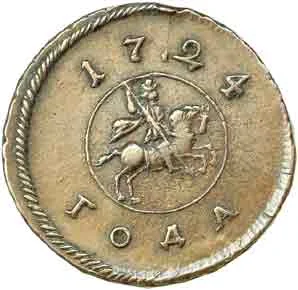
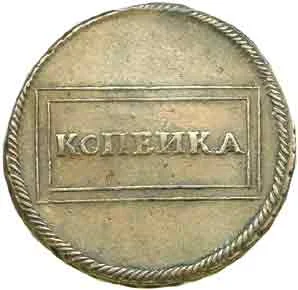
1 kopeck – Russian Empire
Add to wishlist
Russia
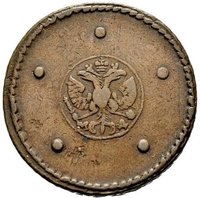
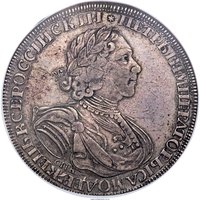
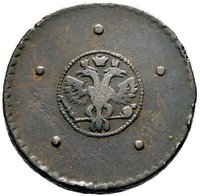
Obverse
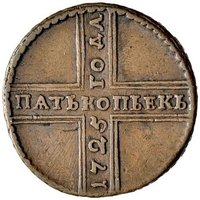
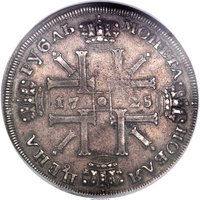
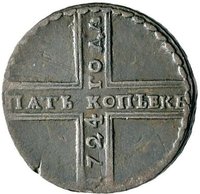
Reverse
Edge
Reticulated
Mints
| Name | Mark |
|---|---|
| Kadashevsky Mint | — |
Mintings
| Year | Mint Mark | Mintage | Quality | Collection |
|---|---|---|---|---|
| 1724 | — | — |
Historical background
By 1724, the currency system of the Russian Empire was in a state of profound crisis, a direct consequence of Peter the Great's ambitious and costly reforms, particularly the Great Northern War (1700-1721). To finance his modernizing military and state projects, Peter had resorted to a drastic and inflationary measure: the systematic debasement of the silver kopeck. The government repeatedly reduced the silver content of its coins while maintaining their face value, flooding the economy with lightweight currency. This led to severe inflation, a collapse in public trust, and the hoarding of older, full-weight coins, which disrupted trade and state finances at the very moment Russia was emerging as a European power.
Recognizing the unsustainable situation, Peter had already initiated a comprehensive monetary reform, with 1724 marking a critical year of implementation. The cornerstone of this reform was the introduction of a new, regulated decimal system based on the copper ruble and the silver ruble, which was subdivided into 100 kopecks. Crucially, the state mints, now under strict control, began producing new silver coins (rubles, poltinas, and grivenniks) with a fixed and reliable precious metal content. This was a deliberate move to restore confidence, stabilize the currency, and align Russia's monetary system with European standards, facilitating both domestic commerce and international trade.
However, the transition in 1724 was not yet complete. The old, debased silver coins remained in circulation alongside the new ones, creating a complex and awkward dual system. Furthermore, the heavy copper kopeck coins, introduced as a fractional currency, were cumbersome and often mistrusted. Thus, while 1724 represents a pivotal turning point—the year the new, stable system began to physically replace the old—the Empire was still grappling with the lingering effects of hyperinflation and the practical challenges of enforcing a uniform currency across its vast territories. Peter's reform laid the essential foundation for future stability, but full normalization would take several more years.
Recognizing the unsustainable situation, Peter had already initiated a comprehensive monetary reform, with 1724 marking a critical year of implementation. The cornerstone of this reform was the introduction of a new, regulated decimal system based on the copper ruble and the silver ruble, which was subdivided into 100 kopecks. Crucially, the state mints, now under strict control, began producing new silver coins (rubles, poltinas, and grivenniks) with a fixed and reliable precious metal content. This was a deliberate move to restore confidence, stabilize the currency, and align Russia's monetary system with European standards, facilitating both domestic commerce and international trade.
However, the transition in 1724 was not yet complete. The old, debased silver coins remained in circulation alongside the new ones, creating a complex and awkward dual system. Furthermore, the heavy copper kopeck coins, introduced as a fractional currency, were cumbersome and often mistrusted. Thus, while 1724 represents a pivotal turning point—the year the new, stable system began to physically replace the old—the Empire was still grappling with the lingering effects of hyperinflation and the practical challenges of enforcing a uniform currency across its vast territories. Peter's reform laid the essential foundation for future stability, but full normalization would take several more years.
✨ Legendary