

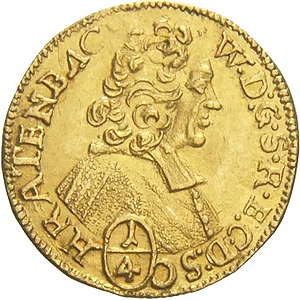
¼ Ducat – Bishopric of Olomouc
Context
Years: 1728–1730
Country: Bohemia
Issuer: Bishopric of Olomouc
Currency:
(1613—1748)
Demonetized: Yes
References
KM: #Click to copy to clipboard432
Numista: #91274
Value
Bullion value: $145.03
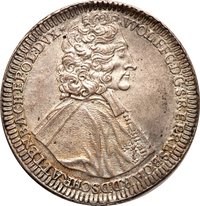
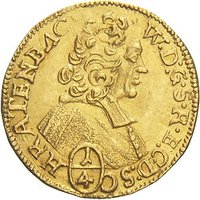
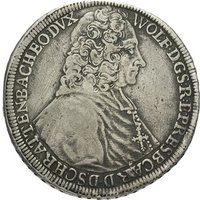
Obverse
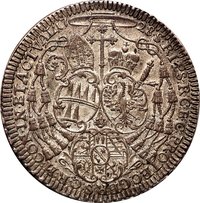
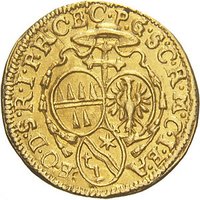
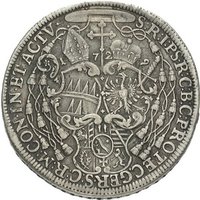
Reverse
Description:
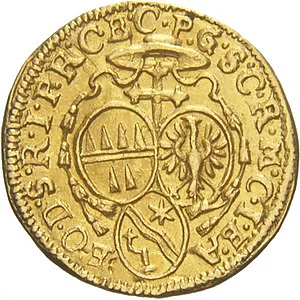
Cardinal’s hat over oval shield
Inscription:
EO D S R I P R C B C P G S C R M C I E A
Script: Latin
Edge
Mints
| Name | Mark |
|---|---|
| Kroměříž | — |
Mintings
| Year | Mint Mark | Mintage | Quality | Collection |
|---|---|---|---|---|
| — | — | — |
Historical background
In 1728, the currency situation within the Bishopric of Olomouc, a semi-autonomous ecclesiastical principality within the Habsburg Kingdom of Bohemia, was governed by the complex and often unstable monetary system of the wider Habsburg Monarchy. The primary currency in circulation was the Conventionsthaler, a large silver coin standardized across much of the Holy Roman Empire after 1753, but whose precursor, the Reichsthaler, set the standard. However, daily transactions were dominated by a plethora of smaller silver and copper coins, such as kreuzers and groschen, which were frequently debased. The bishopric did not mint its own coins; it used coins struck by the central Habsburg mints, but regional monetary conditions were heavily influenced by the policies of the Prince-Bishop's administration and the economic activity of the episcopal seat and its surroundings.
The period was marked by significant monetary stress across Central Europe, stemming from the immense costs of wars, particularly the War of the Spanish Succession (1701-1714) and the Great Northern War. To finance these conflicts, the Habsburg state often resorted to debasement—reducing the precious metal content in coins—which led to inflation, confusion in exchange rates, and a loss of public trust. While the worst episodes of the "Kipper und Wipper" crisis were a century past, the aftershocks and similar practices persisted. In Olomouc, a major administrative and trade center, merchants and citizens had to navigate fluctuating values between different types of coins, with foreign currencies like Polish and Saxon coins also circulating, further complicating commerce.
For the peasant majority and urban workers in the bishopric, this instability manifested in the rising cost of basic goods and the erosion of their purchasing power, as wages often lagged behind price increases. The authorities, both episcopal and imperial, issued repeated ordinances to fix exchange rates and combat counterfeiting, but with limited success. Thus, in 1728, the currency situation in the Bishopric of Olomouc was one of fragile dependency on a strained imperial system, characterized by a multiplicity of coins of uncertain value, posing an ongoing challenge to economic stability and daily life.
The period was marked by significant monetary stress across Central Europe, stemming from the immense costs of wars, particularly the War of the Spanish Succession (1701-1714) and the Great Northern War. To finance these conflicts, the Habsburg state often resorted to debasement—reducing the precious metal content in coins—which led to inflation, confusion in exchange rates, and a loss of public trust. While the worst episodes of the "Kipper und Wipper" crisis were a century past, the aftershocks and similar practices persisted. In Olomouc, a major administrative and trade center, merchants and citizens had to navigate fluctuating values between different types of coins, with foreign currencies like Polish and Saxon coins also circulating, further complicating commerce.
For the peasant majority and urban workers in the bishopric, this instability manifested in the rising cost of basic goods and the erosion of their purchasing power, as wages often lagged behind price increases. The authorities, both episcopal and imperial, issued repeated ordinances to fix exchange rates and combat counterfeiting, but with limited success. Thus, in 1728, the currency situation in the Bishopric of Olomouc was one of fragile dependency on a strained imperial system, characterized by a multiplicity of coins of uncertain value, posing an ongoing challenge to economic stability and daily life.
✨ Legendary