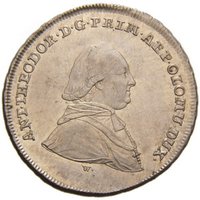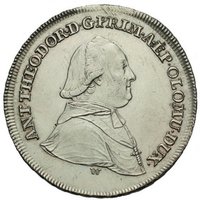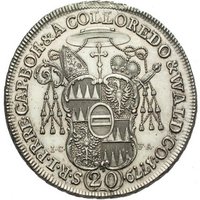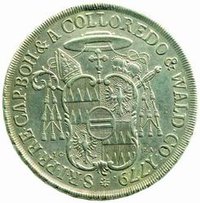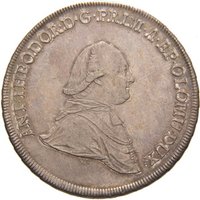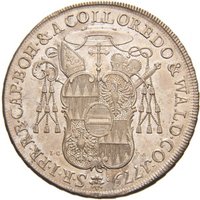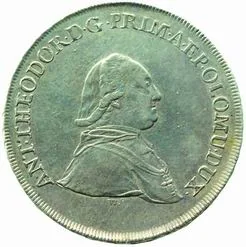
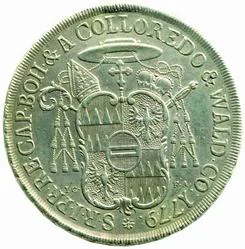
In 1779, the Bishopric of Olomouc, a semi-autonomous ecclesiastical principality within the Habsburg Monarchy, operated within a complex and standardized currency system imposed by the centralizing reforms of Empress Maria Theresa. The pivotal reform came with the
Münzpatent (Coinage Patent) of 1760/1762, which created a unified monetary convention across the Habsburg lands. This established the Conventionsthaler as the large silver standard, divided into 2 Gulden (florins), with each Gulden worth 60 Kreuzer. Consequently, Olomouc did not mint its own independent coinage but used the imperial currency, with coins struck at central mints like Vienna, Prague, or Kremnica bearing the effigy of the Habsburg monarch.
The local economic reality, however, was one of chronic small-change shortage and the persistent circulation of older, debased coins from earlier periods. While the Convention standard was official, older
Reichsthaler and regional
Kreuzer coins remained in use, causing occasional confusion in exchange. Furthermore, the economy was still partly bi-metallic, with gold ducats used for larger transactions and international trade. The bishopric's administration and markets had to constantly navigate between the official, high-quality Convention coins and a mixed pool of older, often inferior, subsidiary coinage.
This monetary landscape was fundamentally a reflection of Olomouc's political status: it was a distinct entity for administrative and ecclesiastical purposes, but its fiscal and monetary policy was entirely subsumed under the Habsburg state. The year 1779 itself, falling during the reign of Maria Theresa and just before the accession of Joseph II, saw no major monetary upheaval, but rather the continued enforcement of this imperial system. The stability of the currency was thus directly tied to the stability and credibility of the Habsburg treasury in Vienna, which sought to combat fragmentation and impose economic unity across its diverse territories.