

1 Rupee – Mughal Empire
India
Context
Years: 1756–1760
Country: India 
Issuer: Mughal Empire
Ruler: Alamgir II
Currency:
(1540—1842)
Demonetized: Yes
Material
References
KM: #Click to copy to clipboard457.1
Numista: #91040
Value
Bullion value: $31.68
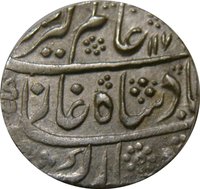
Obverse
Description:
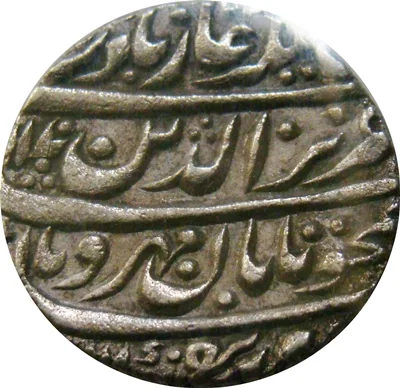
Alamgir’s couplet coin: “Badshah Ghazi,” radiant as sun and moon.
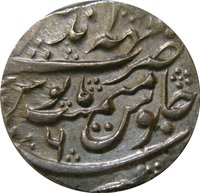
Reverse
Description:
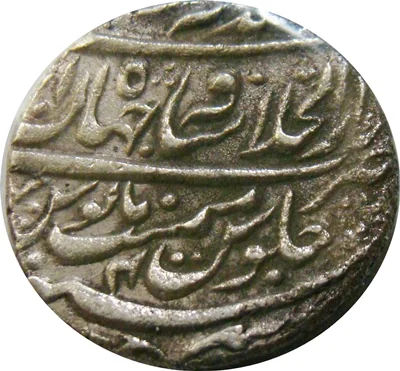
Capital of the Caliphate
Edge
Mintings
| Year | Mint Mark | Mintage | Quality | Collection |
|---|---|---|---|---|
| — | — | — | ||
| 1756 | — | — | ||
| 1757 | — | — | ||
| 1758 | — | — | ||
| 1759 | — | — | ||
| 1760 | — | — |
Historical background
By 1756, the Mughal Empire's currency system, once a pillar of its administrative and economic strength, was under severe strain, mirroring the political fragmentation of the realm. The imperial minting of silver rupees (the primary currency) and gold mohurs continued in major cities like Delhi, but their authority and uniformity were eroding. Provincial governors and emerging regional powers, such as the Nawabs of Bengal and Awadh, increasingly issued their own coins, often of varying weight and purity, which challenged the universal acceptability that had characterized Mughal currency at its zenith.
This period was marked by a critical shortage of silver, the lifeblood of the rupee. Decades of warfare—including Nadir Shah's devastating 1739 invasion, which looted the imperial treasury—had drained bullion reserves. Furthermore, the diversion of trade and its associated silver inflows to European East India Companies, particularly the British in Bengal, starved the central mint of essential raw material. The result was a debasement of coinage in some areas, where the silver content was reduced, undermining public trust in the currency's intrinsic value and fueling inflation.
The monetary landscape of 1756 was thus one of competing currencies and declining confidence. While the Mughal rupee remained a prestigious unit of account, its practical circulation was increasingly regionalized. The stage was set for a profound shift, as the British East India Company, victorious at the Battle of Plassey in 1757, would soon move to standardize and control the currency in its expanding territories, ultimately supplanting the Mughal monetary system with a colonial one. The currency situation, therefore, reflected the empire's final transition from a centralized power to a fractured polity on the brink of colonial subjugation.
This period was marked by a critical shortage of silver, the lifeblood of the rupee. Decades of warfare—including Nadir Shah's devastating 1739 invasion, which looted the imperial treasury—had drained bullion reserves. Furthermore, the diversion of trade and its associated silver inflows to European East India Companies, particularly the British in Bengal, starved the central mint of essential raw material. The result was a debasement of coinage in some areas, where the silver content was reduced, undermining public trust in the currency's intrinsic value and fueling inflation.
The monetary landscape of 1756 was thus one of competing currencies and declining confidence. While the Mughal rupee remained a prestigious unit of account, its practical circulation was increasingly regionalized. The stage was set for a profound shift, as the British East India Company, victorious at the Battle of Plassey in 1757, would soon move to standardize and control the currency in its expanding territories, ultimately supplanting the Mughal monetary system with a colonial one. The currency situation, therefore, reflected the empire's final transition from a centralized power to a fractured polity on the brink of colonial subjugation.
💎 Extremely Rare