

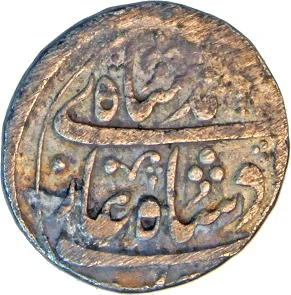
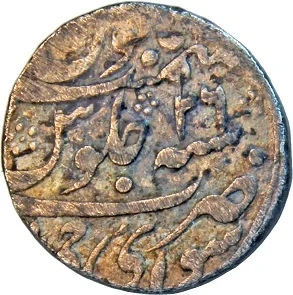
1 Rupee – Mughal Empire
India
Context
Years: 1741–1748
Country: India 
Issuer: Mughal Empire
Ruler: Muhammad Shah
Currency:
(1540—1842)
Demonetized: Yes
Material
References
KM: #Click to copy to clipboard436.31
Numista: #90560
Value
Bullion value: $31.84
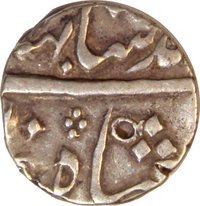
Obverse
Description:
Emperor's name and AH date.
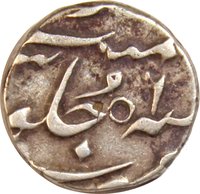
Reverse
Description:
RY Date & Mint
Edge
Plain
Mintings
| Year | Mint Mark | Mintage | Quality | Collection |
|---|---|---|---|---|
| 1741 | — | — | ||
| 1743 | — | — | ||
| 1744 | — | — | ||
| 1745 | — | — | ||
| 1746 | — | — | ||
| 1747 | — | — | ||
| 1748 | — | — |
Historical background
By 1741, the Mughal Empire's currency system, once a pillar of its centralized authority and economic integration, was under severe strain and showing clear signs of regional fragmentation. The official trimetallic system—gold mohurs, silver rupees, and copper dams—remained nominally in place, with the silver rupee of high purity as the primary currency for revenue and trade. However, the political decay following Emperor Muhammad Shah's long reign (1719-1748) meant that the imperial mints in Delhi and major provincial capitals were increasingly losing their monopoly. Powerful regional governors and emerging successor states like Bengal, Awadh, and Hyderabad began striking their own coins, often imitating Mughal designs but with reduced weight or purity to fund their independent treasuries and military expenditures.
This period saw a critical shortage of silver, the lifeblood of the empire's currency. The drain of bullion to finance wars, the decline in Central Asian silver imports, and the diversion of European-traded silver to coastal regions beyond Mughal control created a deflationary pressure. Consequently, the copper coinage, vital for small-scale transactions and the rural economy, became highly unstable. Local officials and moneyers issued low-quality copper tokens, leading to confusion, inflation in everyday markets, and a loss of public trust in the lower denominations. The uniformity and reliability that had characterized the Mughal sikka (coinage) were eroding rapidly.
Therefore, the currency situation in 1741 reflected the empire's broader political reality: a hollowed-out center struggling to maintain economic coherence while powerful regional entities asserted their financial autonomy. While the Mughal rupee still held prestige and was used in large-scale transactions and bookkeeping, the practical monetary landscape was becoming Balkanized. This fragmentation undermined inter-regional trade, complicated revenue collection for the central treasury, and signaled the irreversible shift from a unified imperial economy to a patchwork of competing regional monetary systems.
This period saw a critical shortage of silver, the lifeblood of the empire's currency. The drain of bullion to finance wars, the decline in Central Asian silver imports, and the diversion of European-traded silver to coastal regions beyond Mughal control created a deflationary pressure. Consequently, the copper coinage, vital for small-scale transactions and the rural economy, became highly unstable. Local officials and moneyers issued low-quality copper tokens, leading to confusion, inflation in everyday markets, and a loss of public trust in the lower denominations. The uniformity and reliability that had characterized the Mughal sikka (coinage) were eroding rapidly.
Therefore, the currency situation in 1741 reflected the empire's broader political reality: a hollowed-out center struggling to maintain economic coherence while powerful regional entities asserted their financial autonomy. While the Mughal rupee still held prestige and was used in large-scale transactions and bookkeeping, the practical monetary landscape was becoming Balkanized. This fragmentation undermined inter-regional trade, complicated revenue collection for the central treasury, and signaled the irreversible shift from a unified imperial economy to a patchwork of competing regional monetary systems.
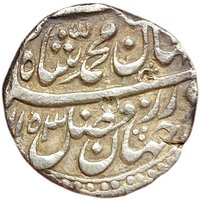
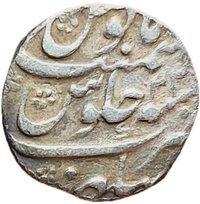
💎 Extremely Rare