

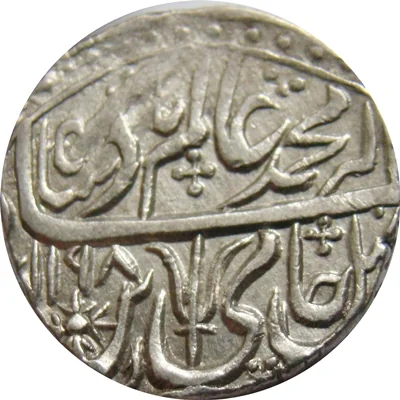

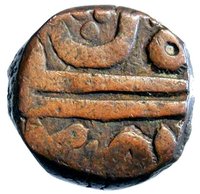
Obverse
Description:
Shah Alam II, AH date, first type with trishula.
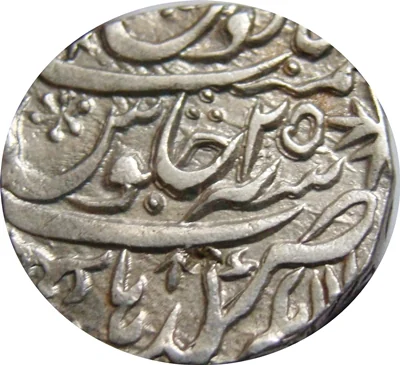
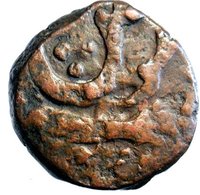
Reverse
Description:
Balanagar Gadha (Mandla) mint.
Edge
Mintings
| Year | Mint Mark | Mintage | Quality | Collection |
|---|---|---|---|---|
| — | — | — | ||
| 1784 | — | — | ||
| 1785 | — | — | ||
| 1786 | — | — | ||
| 1787 | — | — |
Historical background
By 1784, the Maratha Empire under Peshwa Madhavrao II was a vast but administratively decentralized confederacy, and its currency system reflected this political reality. There was no single, uniform coinage for the entire empire. Instead, the central Peshwa government in Pune, along with major feudatory chiefs like the Gaekwads in Baroda, the Holkars in Indore, and the Scindias in Gwalior, all exercised the right to mint their own coins. This resulted in a complex monetary landscape where various silver rupees (like the Ankushi rupee of Pune, the Chandori of the Holkars, and the Sanad rupees of the Scindias) circulated alongside a plethora of copper coins and older Mughal issues, all with fluctuating local values and acceptance.
The primary currency for large-scale trade and state revenue was the silver rupee, but its purity and weight varied between mints, causing constant exchange complications. The Peshwa’s administration attempted to maintain a standard, but the autonomy of the sardars often undermined central monetary authority. Furthermore, the economy was heavily reliant on a mix of agrarian revenue and long-distance trade, requiring the coexistence of high-value silver for official use and low-value copper paisa for everyday market transactions. The system was further burdened by the widespread circulation of foreign coins, particularly Mughal rupees and newer European issues from coastal trade, which added another layer of complexity to an already fragmented system.
This period also saw significant financial strain due to the aftermath of the First Anglo-Maratha War (1775-1782), which had drained the central treasury. While the Treaty of Salbai in 1782 brought peace, the financial demands of maintaining large armies and the costly Maratha court, coupled with the irregular tributes from feudatories, put pressure on the monetary system. Consequently, despite attempts at regulation, the currency situation in 1784 was characterized by regional diversity, competitive minting, and a lack of empire-wide standardization, which mirrored the empire's political structure of powerful satraps under a nominal central authority.
The primary currency for large-scale trade and state revenue was the silver rupee, but its purity and weight varied between mints, causing constant exchange complications. The Peshwa’s administration attempted to maintain a standard, but the autonomy of the sardars often undermined central monetary authority. Furthermore, the economy was heavily reliant on a mix of agrarian revenue and long-distance trade, requiring the coexistence of high-value silver for official use and low-value copper paisa for everyday market transactions. The system was further burdened by the widespread circulation of foreign coins, particularly Mughal rupees and newer European issues from coastal trade, which added another layer of complexity to an already fragmented system.
This period also saw significant financial strain due to the aftermath of the First Anglo-Maratha War (1775-1782), which had drained the central treasury. While the Treaty of Salbai in 1782 brought peace, the financial demands of maintaining large armies and the costly Maratha court, coupled with the irregular tributes from feudatories, put pressure on the monetary system. Consequently, despite attempts at regulation, the currency situation in 1784 was characterized by regional diversity, competitive minting, and a lack of empire-wide standardization, which mirrored the empire's political structure of powerful satraps under a nominal central authority.
✨ Legendary