

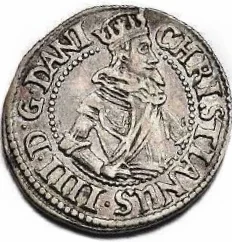
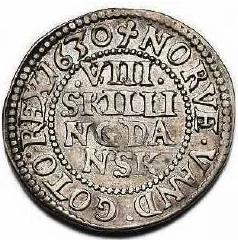
8 skilling – Denmark
Add to wishlist
Denmark
Context
Material
References
KM: #
Numista: #90016
Value
Bullion value: $5.36
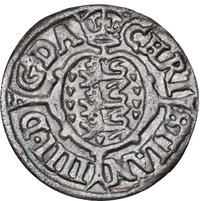
Obverse
Description:
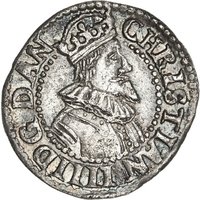
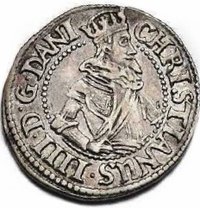
King Christian IV in armor, facing right within a beaded circle. Outer legend.
Inscription:
CHRISTIANUS · IIII · D · G · DANI
Script: Latin
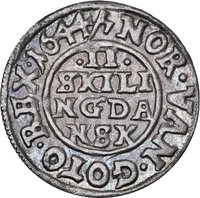
Reverse
Description:
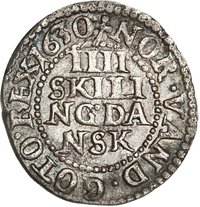
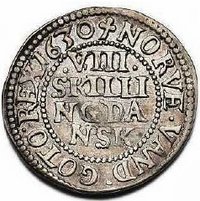
Four-line inscription in pearled circle; legend and date around rim. Mintmark follows date.
Inscription:
.VIII.
SKILLI
NG DA
NSK
NORVE.VAND.GOTO.REX 1630 ☘
SKILLI
NG DA
NSK
NORVE.VAND.GOTO.REX 1630 ☘
Script: Latin
Edge
Mints
| Name | Mark |
|---|---|
| Copenhagen | ☘ |
Mintings
| Year | Mint Mark | Mintage | Quality | Collection |
|---|---|---|---|---|
| 1630 | ☘ | — |
Historical background
In 1630, Denmark’s currency system was in a state of profound crisis, a direct consequence of the disruptive and costly intervention in the Thirty Years’ War (1618-1648). King Christian IV had entered the war in 1625 to defend Protestant interests and Danish hegemony, but the campaign was a financial and military disaster. The immense costs of raising and maintaining armies drained the royal treasury, forcing the crown to resort to repeated debasement of the coinage. By minting coins with reduced silver content but the same face value, the state created short-term revenue but triggered severe inflation and a collapse in public trust.
The domestic monetary system descended into chaos as "good" older coins with higher silver content were hoarded or exported, while the new, inferior coins flooded the market. This phenomenon, known as Gresham’s Law, meant that people used the poor coins for daily transactions and saved the good ones, effectively driving sound money out of circulation. The result was a dual system where prices in debased currency skyrocketed, creditors were repaid in worthless coin, and foreign trade was hampered because merchants demanded payment in stable foreign currency or bullion. The economic distress was felt at all levels of society, eroding the king’s popularity and the kingdom’s economic stability.
This currency instability was a key factor leading to the 1630 Peace of Lübeck, which ended Denmark’s involvement in the war. While the treaty removed the immense wartime expenditures, it did not immediately resolve the monetary chaos. The aftermath left the Danish state with the arduous task of restoring confidence in its currency, a process that would require significant monetary reforms in the following decades to re-establish a stable and unified coinage system, ultimately laying the groundwork for the later establishment of the Danish central bank.
The domestic monetary system descended into chaos as "good" older coins with higher silver content were hoarded or exported, while the new, inferior coins flooded the market. This phenomenon, known as Gresham’s Law, meant that people used the poor coins for daily transactions and saved the good ones, effectively driving sound money out of circulation. The result was a dual system where prices in debased currency skyrocketed, creditors were repaid in worthless coin, and foreign trade was hampered because merchants demanded payment in stable foreign currency or bullion. The economic distress was felt at all levels of society, eroding the king’s popularity and the kingdom’s economic stability.
This currency instability was a key factor leading to the 1630 Peace of Lübeck, which ended Denmark’s involvement in the war. While the treaty removed the immense wartime expenditures, it did not immediately resolve the monetary chaos. The aftermath left the Danish state with the arduous task of restoring confidence in its currency, a process that would require significant monetary reforms in the following decades to re-establish a stable and unified coinage system, ultimately laying the groundwork for the later establishment of the Danish central bank.
💎 Extremely Rare