

4 skilling – Denmark
Add to wishlist
Denmark
Context
References
KM: #
Numista: #89932
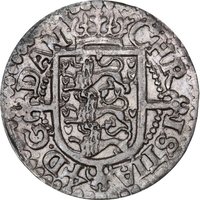
Obverse
Description:
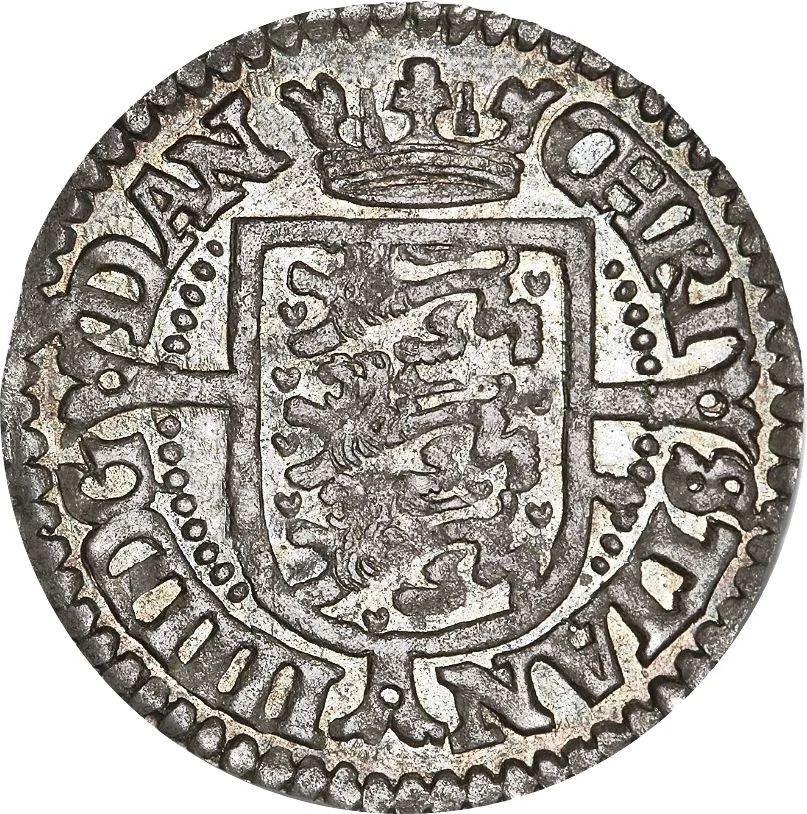
Danish crowned arms over long cross within beaded circle. Outer legend divided by cross arms.
Inscription:
CHRI | STIAN | IIII D G | DAN
Script: Latin
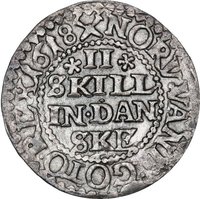
Reverse
Description:
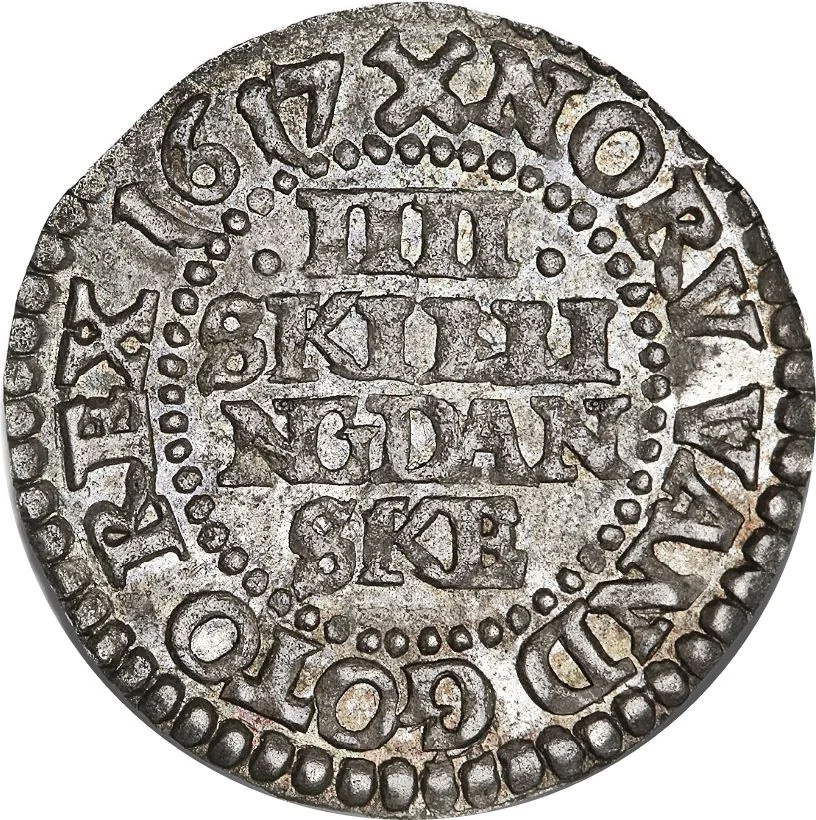
Pearled circle with value in four lines; legend and date around rim. Mintmark: crossed swords.
Inscription:
.IIII.
SKILLI
NG DAN
SKE
..................................................
NORV VAND GOTO REX 1617
SKILLI
NG DAN
SKE
..................................................
NORV VAND GOTO REX 1617
Script: Latin
Edge
Mintings
| Year | Mint Mark | Mintage | Quality | Collection |
|---|---|---|---|---|
| 1616 | — | — | ||
| 1617 | — | — | ||
| 1618 | — | — | ||
| 1619 | — | — |
Historical background
In 1616, Denmark was navigating a complex and deteriorating currency situation rooted in the European-wide phenomenon known as the "Kipper- und Wipperzeit" (the clipping and culling period). This was a time of rampant currency debasement, where numerous states across the Holy Roman Empire and beyond were reducing the precious metal content in their coinage to generate short-term profit from seigniorage, often to finance military conflicts. Denmark, under King Christian IV, was deeply embroiled in the costly Kalmar War (1611-1613) against Sweden and subsequent ambitious domestic projects, leading to significant royal debt and a strained treasury. The state responded by minting and circulating coins with a lower intrinsic silver value than their face value, a practice that eroded public trust.
The consequences were severe and economically disruptive. The debased Danish coins drove older, full-value coins out of circulation, as people hoarded the "good" money (Gresham's Law in action). This led to a dual crisis: a shortage of reliable currency for everyday commerce and rampant inflation as the value of the circulating money fell. Merchants, particularly in key trading cities like Copenhagen and Malmö, faced uncertainty and loss, while the general population suffered from rising prices. The situation created tension between the crown's fiscal needs and the stability required for a healthy economy, undermining both domestic trade and Denmark's financial credibility abroad.
Recognising the crisis, 1616 fell within a period of attempted reform. Christian IV had already issued stricter currency ordinances in 1615, and efforts continued into 1616 and beyond to stabilise the monetary system. These measures aimed to recall debased coins, standardise minting practices, and restore confidence by tying the currency value more firmly to its silver content. However, these corrective actions were painful and only partially successful in the short term, as the crown's financial pressures persisted. Thus, the currency situation in 1616 was a critical point in an ongoing struggle between fiscal expediency and monetary stability, highlighting the economic vulnerabilities of an ambitious early modern monarchy.
The consequences were severe and economically disruptive. The debased Danish coins drove older, full-value coins out of circulation, as people hoarded the "good" money (Gresham's Law in action). This led to a dual crisis: a shortage of reliable currency for everyday commerce and rampant inflation as the value of the circulating money fell. Merchants, particularly in key trading cities like Copenhagen and Malmö, faced uncertainty and loss, while the general population suffered from rising prices. The situation created tension between the crown's fiscal needs and the stability required for a healthy economy, undermining both domestic trade and Denmark's financial credibility abroad.
Recognising the crisis, 1616 fell within a period of attempted reform. Christian IV had already issued stricter currency ordinances in 1615, and efforts continued into 1616 and beyond to stabilise the monetary system. These measures aimed to recall debased coins, standardise minting practices, and restore confidence by tying the currency value more firmly to its silver content. However, these corrective actions were painful and only partially successful in the short term, as the crown's financial pressures persisted. Thus, the currency situation in 1616 was a critical point in an ongoing struggle between fiscal expediency and monetary stability, highlighting the economic vulnerabilities of an ambitious early modern monarchy.
✨ Legendary