

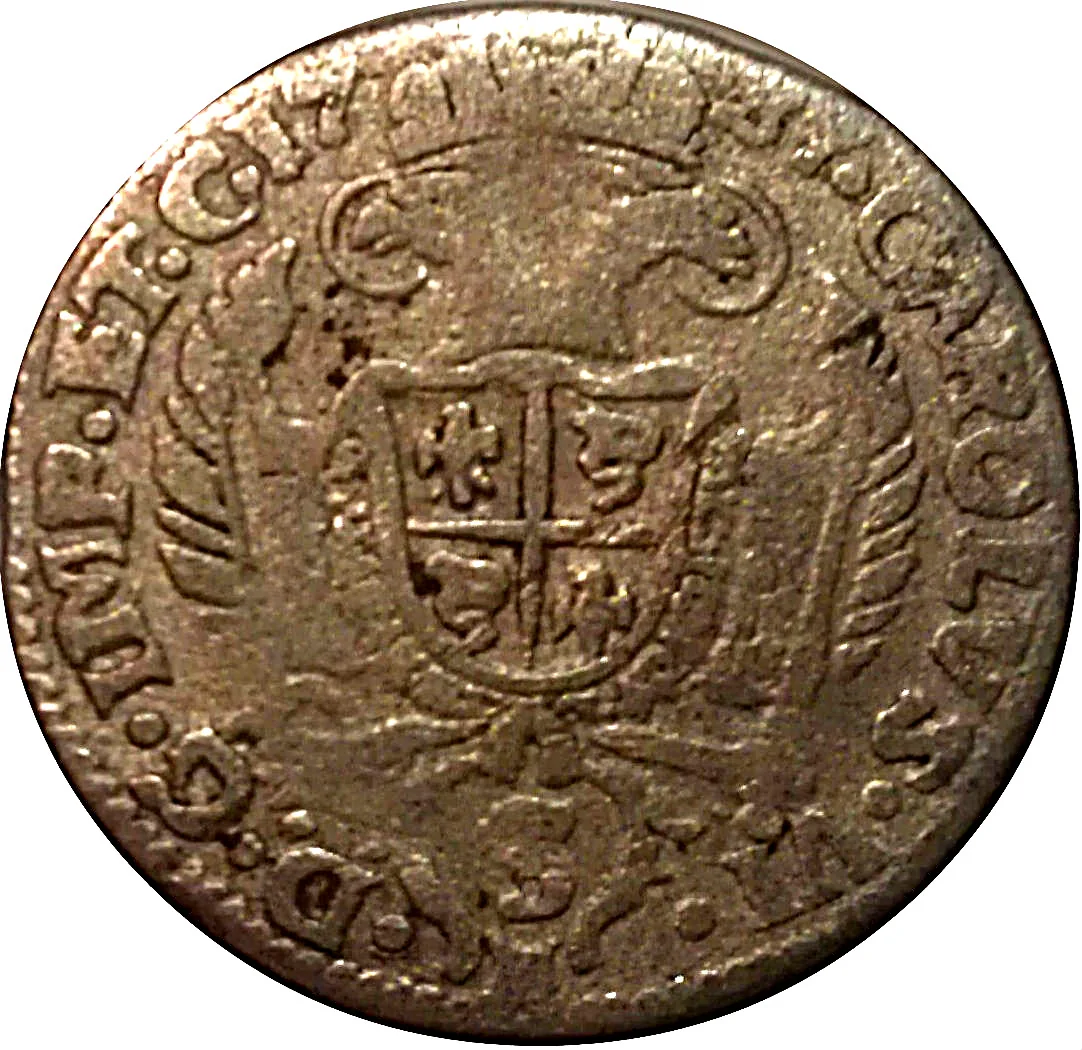
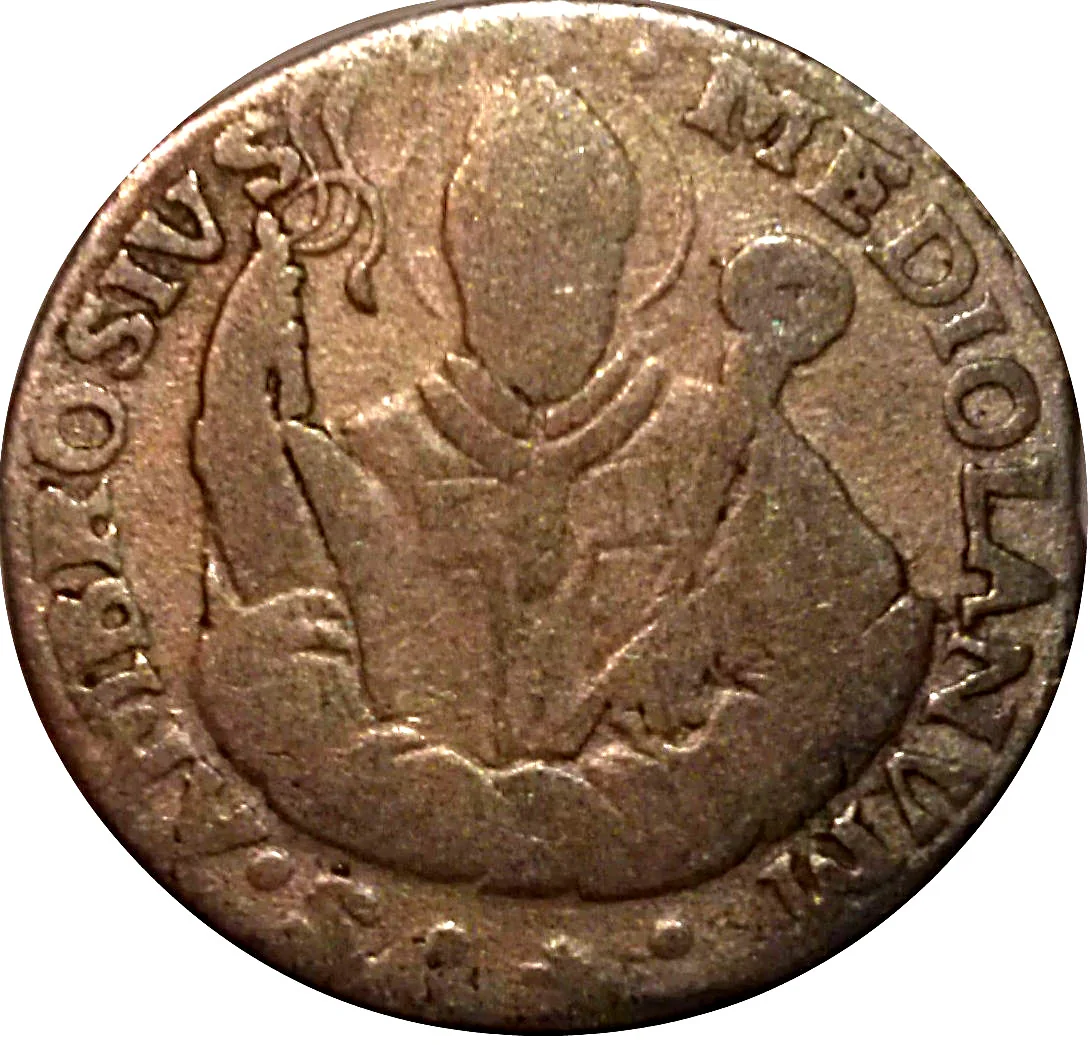
5 Soldi – Milan
Italy
Context
Years: 1722–1737
Country: Italy 
Issuer: Milan
Ruler: Charles III
Currency:
(1515—1796)
Demonetized: Yes
Material
References
KM: #Click to copy to clipboard135
Numista: #89730
Obverse
Description:
Imperial eagle with crown, quartered shield on chest, date above.
Inscription:
37·CAROLVS·VI· ·D·G·IMP·ET·C·17
Script: Latin
Reverse
Description:
Bust of St. Ambrose, frontal view.
Inscription:
· MEDIOLANVM · · S·AMBROSIVS.
Script: Latin
Edge
Plain
Mints
| Name | Mark |
|---|---|
| Milan | — |
Mintings
| Year | Mint Mark | Mintage | Quality | Collection |
|---|---|---|---|---|
| 1722 | — | — | ||
| 1724 | — | — | ||
| 1737 | — | — |
Historical background
In 1722, Milan found itself at a complex monetary crossroads, governed by the Austrian Habsburgs after the War of the Spanish Succession. The currency system was a tangled legacy of Spanish rule, characterized by a bewildering variety of coins circulating simultaneously. These included local Milanese silver scudi and lire, Spanish silver reales, and a plethora of gold coins from other Italian states and beyond, each with fluctuating values. This chaotic bimetallic system, with no fixed exchange rate between gold and silver, created constant confusion for merchants and fostered widespread opportunities for arbitrage and clipping of coins.
The Habsburg administration, under Emperor Charles VI, recognized this monetary disorder as a hindrance to commerce, tax collection, and state authority. While a comprehensive reform was being planned in Vienna, the immediate situation in 1722 was one of transition and assessment. Authorities grappled with the practical challenges of standardizing value in a key financial centre of Lombardy, where market exchanges often relied on the subjective "cry" of money-changers (banchieri) who set daily rates. Counterfeiting was also a persistent problem, further eroding trust in the already unstable circulating medium.
Therefore, the currency situation in 1722 was not one of stability but of mounting pressure for change. It was a period of economic friction between the old Spanish-Italian monetary order and the impending centralizing reforms of the Habsburg state. This backdrop set the stage for the significant monetary reforms that would follow later in the decade, notably the conventions of 1725-1726, which aimed to impose a uniform silver-based currency and assert greater imperial control over the minting and valuation of money in the Duchy.
The Habsburg administration, under Emperor Charles VI, recognized this monetary disorder as a hindrance to commerce, tax collection, and state authority. While a comprehensive reform was being planned in Vienna, the immediate situation in 1722 was one of transition and assessment. Authorities grappled with the practical challenges of standardizing value in a key financial centre of Lombardy, where market exchanges often relied on the subjective "cry" of money-changers (banchieri) who set daily rates. Counterfeiting was also a persistent problem, further eroding trust in the already unstable circulating medium.
Therefore, the currency situation in 1722 was not one of stability but of mounting pressure for change. It was a period of economic friction between the old Spanish-Italian monetary order and the impending centralizing reforms of the Habsburg state. This backdrop set the stage for the significant monetary reforms that would follow later in the decade, notably the conventions of 1725-1726, which aimed to impose a uniform silver-based currency and assert greater imperial control over the minting and valuation of money in the Duchy.
✨ Legendary