

1 Dollar – Scotland
United Kingdom
Context
Years: 1676–1682
Country: United Kingdom 
Issuer: Scotland 
Ruler: Charles II
Currency:
(1136—1707)
Demonetized: Yes
Total mintage: 18,115
Material
References
KM: #Click to copy to clipboard14
Numista: #89726
Obverse
Description:
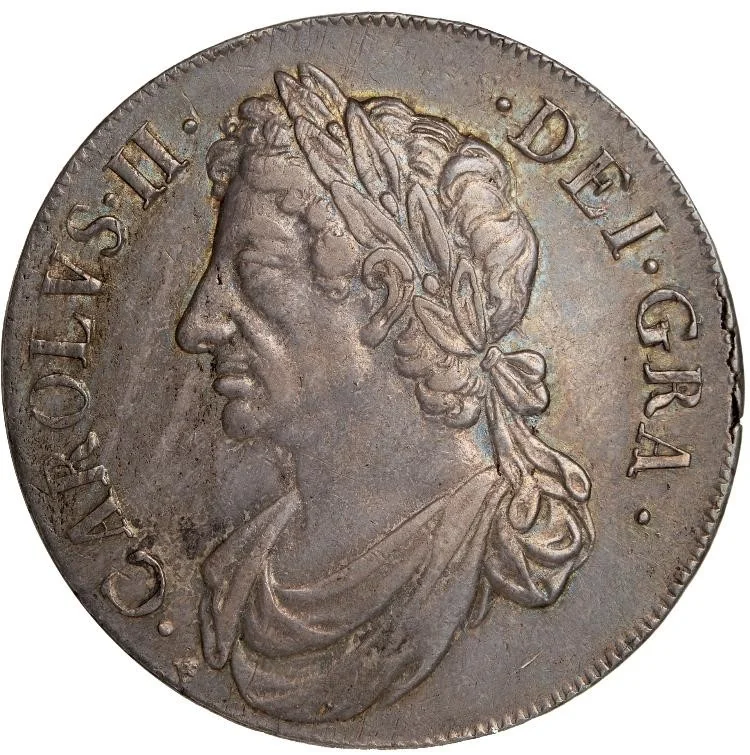
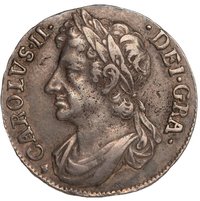
Charles II left-facing bust, F beneath.
Inscription:
· CAROLVS · II · · DEI · GRA ·
Script: Latin
Reverse
Description:
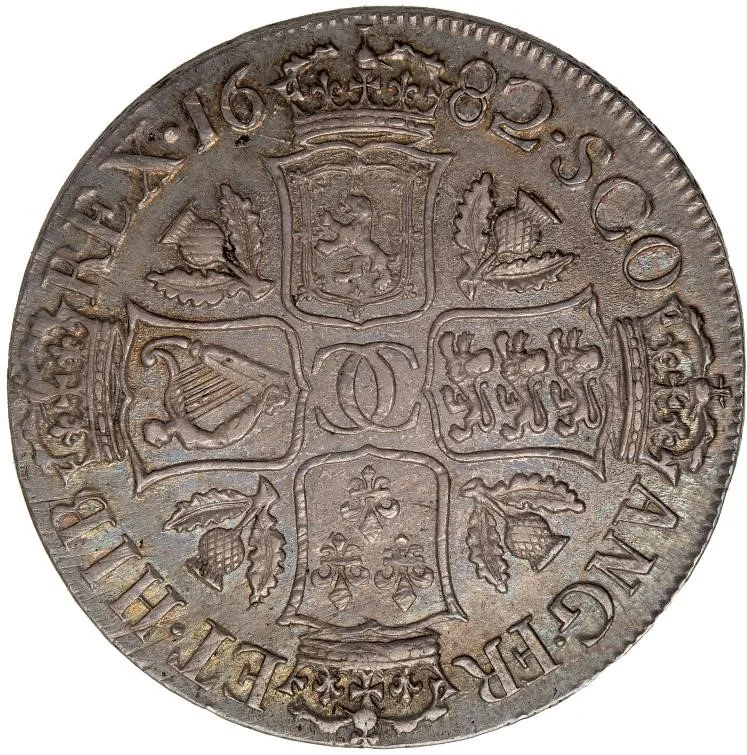
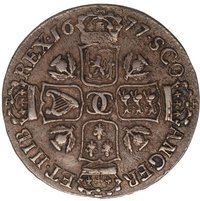
Crowned arms of Scotland, England, France, and Ireland in a cross, with thistles in the quarters.
Inscription:
· SCO ANG · FR ET · HIB REX · 1682
Script: Latin
Edge
Mints
| Name | Mark |
|---|---|
| Edinburgh | — |
Mintings
| Year | Mint Mark | Mintage | Quality | Collection |
|---|---|---|---|---|
| 1676 | — | 2,368 | ||
| 1678 | — | 794 | ||
| 1679 | — | 7,679 | ||
| 1680 | — | 1,357 | ||
| 1681 | — | 5,917 | ||
| 1682 | — | — |
Historical background
In 1676, Scotland operated under a distinct and complex monetary system, separate from its southern neighbour, England. The official currency was the Scottish pound (£ Scots), which had been established centuries earlier and existed in a fixed exchange rate of 12:1 with the English pound sterling. This meant that £12 Scots was equal to £1 sterling, a reflection of Scotland's weaker economy and lower silver content in its coinage. The system included a range of coins like merks, marks, and bawbees, but the period was characterised by a critical shortage of physical specie, especially low-denomination coins needed for everyday trade.
This scarcity was a legacy of centuries of economic difficulty and was exacerbated by the fact that much of Scotland's limited foreign trade resulted in an outflow of silver to pay for imports. Consequently, a significant portion of domestic commerce relied on inefficient methods such as barter, the use of foreign coins (particularly Dutch and French), and the circulation of "promissory notes" or tokens issued by burghs, merchants, and even landlords. These substitute currencies created a fragmented and often unreliable monetary environment, hindering economic growth and causing practical difficulties for both merchants and the general population.
The situation in 1676 was one of stagnation, awaiting significant reform. Discussions about recoinage and monetary union with England were ongoing in intellectual and mercantile circles, inspired by the economic theories of writers like John Law, a Scotsman who would later gain infamy in France. However, no decisive state action had yet been taken. Thus, Scotland's currency landscape remained a patchwork of under-valued official coinage, foreign specie, and local credit instruments, all functioning within a struggling economy that keenly felt the need for a stable and unified monetary system.
This scarcity was a legacy of centuries of economic difficulty and was exacerbated by the fact that much of Scotland's limited foreign trade resulted in an outflow of silver to pay for imports. Consequently, a significant portion of domestic commerce relied on inefficient methods such as barter, the use of foreign coins (particularly Dutch and French), and the circulation of "promissory notes" or tokens issued by burghs, merchants, and even landlords. These substitute currencies created a fragmented and often unreliable monetary environment, hindering economic growth and causing practical difficulties for both merchants and the general population.
The situation in 1676 was one of stagnation, awaiting significant reform. Discussions about recoinage and monetary union with England were ongoing in intellectual and mercantile circles, inspired by the economic theories of writers like John Law, a Scotsman who would later gain infamy in France. However, no decisive state action had yet been taken. Thus, Scotland's currency landscape remained a patchwork of under-valued official coinage, foreign specie, and local credit instruments, all functioning within a struggling economy that keenly felt the need for a stable and unified monetary system.
✨ Legendary