

5 Ducats – Austrian Empire
Austria
Context
Year: 1659
Country: Austria 
Issuer: Austrian Empire
Ruler: Leopold I
Currency:
(1520—1754)
Demonetized: Yes
Material
References
KM: #Click to copy to clipboard1163
Numista: #89711
Value
Bullion value: $2842.29
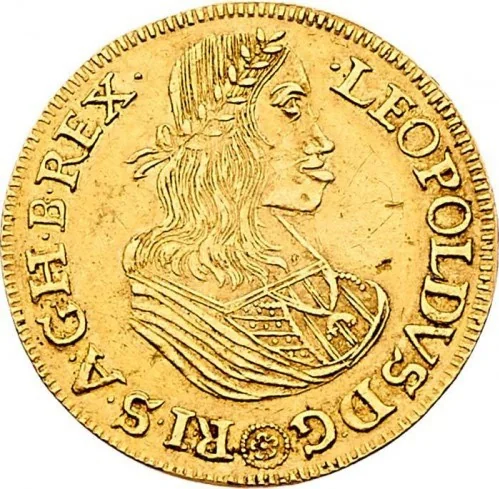
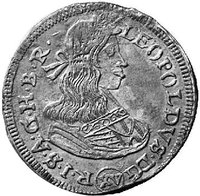
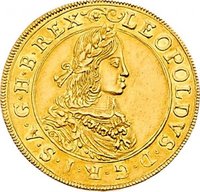
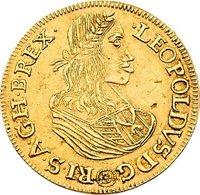
Obverse
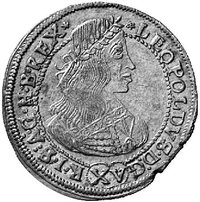
Description:
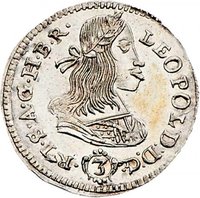
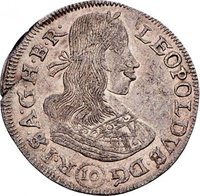
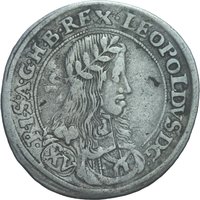
Laureate bust right. Legend around (starting at 1h). Mint mark in legend below.
Inscription:
LEOPOLDVS D G // R I S A G H B REX
Script: Latin
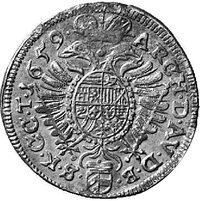
Reverse
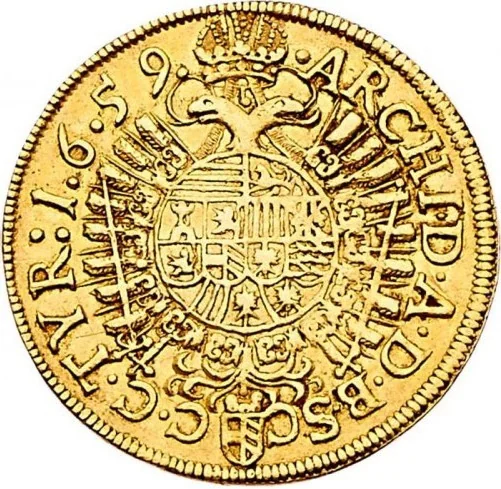
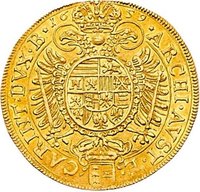
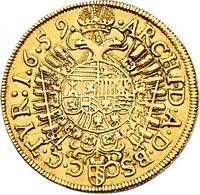
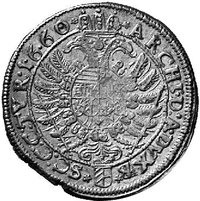
Description:
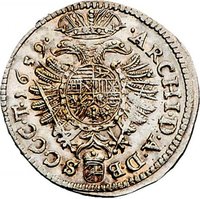
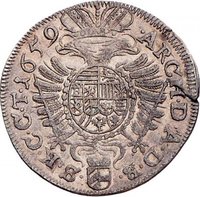
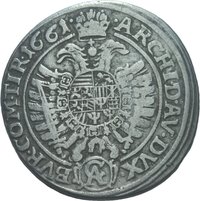
Double-headed eagle with composite arms on an oval shield, crowned above dividing the date, with the shield of Niederösterreich below. Legend: "ARCHIDUX AUSTRIAE DUX BURGUNDIAE STYRIAE CARINTHIAE CARNIOLAE COMES TYROLIS".
Inscription:
ARCHI D A D B S C // C C TYR :1.6.5.9.
Script: Latin
Edge
Mints
| Name | Mark |
|---|---|
| Münze Österreich | — |
Mintings
| Year | Mint Mark | Mintage | Quality | Collection |
|---|---|---|---|---|
| 1659 | — | — |
Historical background
In 1659, the Austrian Habsburg monarchy was grappling with a severe and protracted currency crisis, a legacy of the immense financial strain of the Thirty Years' War (1618-1648). To fund the conflict, the state had repeatedly debased its silver coinage, notably the Reichsthaler and its smaller denominations, by reducing their precious metal content while maintaining their face value. This practice, combined with the widespread circulation of foreign and counterfeit coins, led to a classic "bad money drives out good" scenario (Gresham's Law), where sound money was hoarded or melted down, leaving an unstable and depreciated currency in everyday use.
The situation was exacerbated by the decentralized nature of Habsburg finance. While the Imperial court in Vienna sought to assert control, individual territories within the hereditary lands (like Austria, Bohemia, and Hungary) and the autonomous Imperial Estates often minted their own coinage with varying standards. This fragmentation created a chaotic monetary landscape where exchange rates fluctuated wildly, harming trade and creating uncertainty. The primary response in the preceding decade had been a series of failed imperial ordinances (Münzordnungen) that attempted to fix exchange rates and mandate the acceptance of debased coins at inflated values, which were largely ignored by the public and financiers.
Consequently, by 1659, the empire faced rampant inflation, a deep loss of public trust in the coinage, and crippling difficulties in raising revenue for the ongoing wars against the Ottoman Empire in the east. The year fell within a period of urgent but struggling reform, as authorities sought to restore a unified and stable silver-based currency system. The crisis underscored the fundamental challenge of Habsburg rule: the need to centralize financial policy in a politically fragmented realm, a struggle that would continue for centuries.
The situation was exacerbated by the decentralized nature of Habsburg finance. While the Imperial court in Vienna sought to assert control, individual territories within the hereditary lands (like Austria, Bohemia, and Hungary) and the autonomous Imperial Estates often minted their own coinage with varying standards. This fragmentation created a chaotic monetary landscape where exchange rates fluctuated wildly, harming trade and creating uncertainty. The primary response in the preceding decade had been a series of failed imperial ordinances (Münzordnungen) that attempted to fix exchange rates and mandate the acceptance of debased coins at inflated values, which were largely ignored by the public and financiers.
Consequently, by 1659, the empire faced rampant inflation, a deep loss of public trust in the coinage, and crippling difficulties in raising revenue for the ongoing wars against the Ottoman Empire in the east. The year fell within a period of urgent but struggling reform, as authorities sought to restore a unified and stable silver-based currency system. The crisis underscored the fundamental challenge of Habsburg rule: the need to centralize financial policy in a politically fragmented realm, a struggle that would continue for centuries.
✨ Legendary