

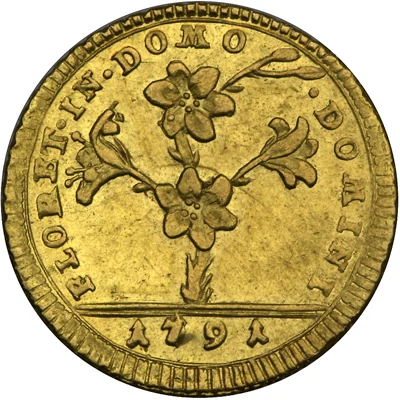
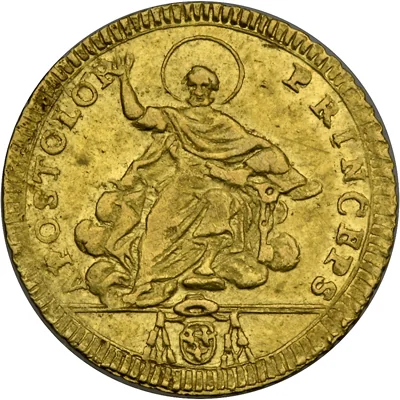
1 Doppia – Papal States
Vatican City
Context
Years: 1786–1793
Country: Vatican City 
Issuer: Papal States
Ruler: Pius VI
Currency:
(1534—1835)
Demonetized: Yes
Material
References
KM: #Click to copy to clipboard1049
Numista: #89435
Value
Bullion value: $840.82
Obverse
Reverse
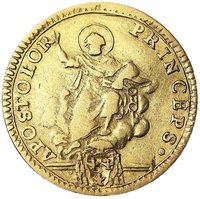
Description:
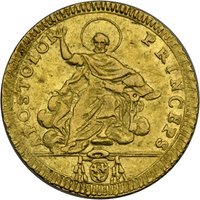
Seated saint facing, value 30 in exergue.
Inscription:
APOSTOLOR PRINCEPS
Script: Latin
Edge
Stringed
Mints
| Name | Mark |
|---|---|
| Rome | — |
Mintings
| Year | Mint Mark | Mintage | Quality | Collection |
|---|---|---|---|---|
| 1786 | — | — | ||
| 1787 | — | — | ||
| 1788 | — | — | ||
| 1790 | — | — | ||
| 1791 | — | — | ||
| 1792 | — | — | ||
| 1793 | — | — |
Historical background
In 1786, the Papal States' currency system was a complex and fragmented relic of medieval and early modern practices, reflecting the political and economic disunity of the territories under papal rule. There was no single, unified papal currency. Instead, a multitude of different coins circulated, issued by various papal mints (such as those in Rome, Bologna, and Ancona) and even by individual cities with ancient minting rights. The most prominent silver coin was the scudo, divided into 100 baiochi, but its value and purity could vary. Alongside these, foreign coins, particularly Spanish pieces of eight and Tuscan florins, were widely used in commerce, further complicating transactions and exchange rates.
This monetary confusion created significant obstacles to trade and economic stability. Exchange rates between the different regional issues and foreign coins fluctuated, and the system was prone to debasement, where the precious metal content of coins was reduced to generate short-term revenue for the treasury. Counterfeiting was also a persistent problem. For travelers and merchants moving between cities like Rome, Bologna, and Ferrara, navigating these currencies required expert knowledge and incurred exchange losses, stifling internal commerce and integration with broader European markets.
Pope Pius VI, reigning from 1775 to 1799, was aware of these issues and had undertaken some efforts at reform, including attempts to standardize weights and measures. However, by 1786, no comprehensive monetary overhaul had been achieved. The papal administration, often financially strained and conservative, struggled to impose a uniform system across its diverse and historically autonomous provinces. Consequently, the currency situation remained a tangible symbol of the ancien régime's inefficiencies, persisting until the dramatic upheavals of the French Revolutionary Wars and the Napoleonic invasion of 1796, which would ultimately sweep the old papal monetary system away.
This monetary confusion created significant obstacles to trade and economic stability. Exchange rates between the different regional issues and foreign coins fluctuated, and the system was prone to debasement, where the precious metal content of coins was reduced to generate short-term revenue for the treasury. Counterfeiting was also a persistent problem. For travelers and merchants moving between cities like Rome, Bologna, and Ferrara, navigating these currencies required expert knowledge and incurred exchange losses, stifling internal commerce and integration with broader European markets.
Pope Pius VI, reigning from 1775 to 1799, was aware of these issues and had undertaken some efforts at reform, including attempts to standardize weights and measures. However, by 1786, no comprehensive monetary overhaul had been achieved. The papal administration, often financially strained and conservative, struggled to impose a uniform system across its diverse and historically autonomous provinces. Consequently, the currency situation remained a tangible symbol of the ancien régime's inefficiencies, persisting until the dramatic upheavals of the French Revolutionary Wars and the Napoleonic invasion of 1796, which would ultimately sweep the old papal monetary system away.
✨ Legendary