

1 Ducat – Austrian Empire
Austria
Context
Years: 1722–1740
Country: Austria 
Issuer: Austrian Empire
Ruler: Charles VI
Currency:
(1520—1754)
Demonetized: Yes
Material
References
KM: #Click to copy to clipboard1559
Numista: #89332
Value
Bullion value: $570.22
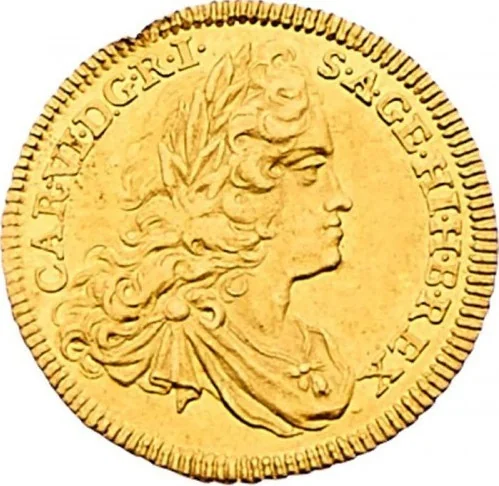
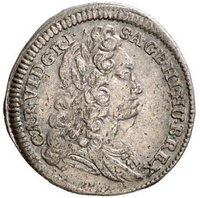
Obverse
Description:
Laureate bust right, legend divided above head, no inscription below.
Inscription:
CAR VI D G R I // S A GE HI H B REX
Script: Latin
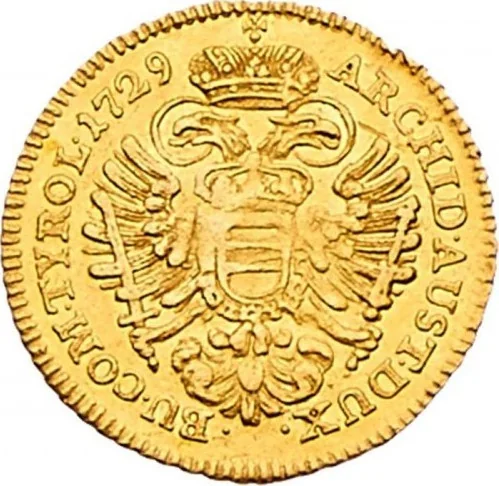
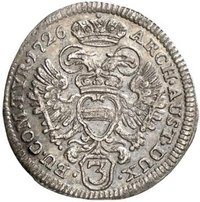
Reverse
Description:
Imperial double-headed eagle with Austrian arms. Legend around (begins at 1 o'clock).
Inscription:
ARCHID AUST DUX // BU COM TYROL 1729
Script: Latin
Edge
Mints
| Name | Mark |
|---|---|
| Münze Österreich | — |
Mintings
| Year | Mint Mark | Mintage | Quality | Collection |
|---|---|---|---|---|
| 1722 | — | — | ||
| 1723 | — | — | ||
| 1724 | — | — | ||
| 1726 | — | — | ||
| 1727 | — | — | ||
| 1729 | — | — | ||
| 1731 | — | — | ||
| 1734 | — | — | ||
| 1735 | — | — | ||
| 1737 | — | — | ||
| 1739 | — | — | ||
| 1740 | — | — |
Historical background
In 1722, the currency situation within the Habsburg-ruled Austrian Empire was complex and fraught with instability, a direct legacy of the enormous financial strains of the War of the Spanish Succession (1701-1714) and the recent conclusion of the Austro-Turkish War (1716-1718). To fund these conflicts, the state had heavily debased its silver coinage, notably the Reichsthaler and the ubiquitous Kreuzer, by reducing their precious metal content. This practice led to a severe divergence between the official face value of coins and their intrinsic bullion worth, causing widespread confusion, loss of public trust, and rampant inflation, particularly affecting the common populace who used small-denomination coins for daily transactions.
The monetary landscape was a patchwork of different standards and authorities. While the central Hofkammer (Treasury) in Vienna attempted to set policy, numerous constituent lands and even individual cities within the Empire often minted their own subsidiary coinage, further complicating trade and exchange. A key feature of this period was the circulation of overvalued "bank money" – the Bancozettel issued by the Vienna City Bank – alongside debased "current money" (Courantmünze), with a fluctuating exchange rate between them. This created a two-tiered system advantageous to the state and large creditors but detrimental to a stable economy.
Consequently, 1722 fell within a period of attempted, but still fragile, stabilization under Emperor Charles VI. The government recognized the need for reform to facilitate commerce and restore fiscal order, but comprehensive solutions were slow to materialize. The primary economic focus remained on managing the massive state debt and servicing war loans, with monetary policy often being reactive rather than strategic. Thus, the currency situation remained a persistent weakness, characterized by depreciated coinage, complex exchange rates, and an underlying tension between the crown's urgent financial needs and the long-term health of the imperial economy.
The monetary landscape was a patchwork of different standards and authorities. While the central Hofkammer (Treasury) in Vienna attempted to set policy, numerous constituent lands and even individual cities within the Empire often minted their own subsidiary coinage, further complicating trade and exchange. A key feature of this period was the circulation of overvalued "bank money" – the Bancozettel issued by the Vienna City Bank – alongside debased "current money" (Courantmünze), with a fluctuating exchange rate between them. This created a two-tiered system advantageous to the state and large creditors but detrimental to a stable economy.
Consequently, 1722 fell within a period of attempted, but still fragile, stabilization under Emperor Charles VI. The government recognized the need for reform to facilitate commerce and restore fiscal order, but comprehensive solutions were slow to materialize. The primary economic focus remained on managing the massive state debt and servicing war loans, with monetary policy often being reactive rather than strategic. Thus, the currency situation remained a persistent weakness, characterized by depreciated coinage, complex exchange rates, and an underlying tension between the crown's urgent financial needs and the long-term health of the imperial economy.

✨ Legendary