

3 Kreuzer – Austrian Empire
Austria
Context
Years: 1721–1740
Country: Austria 
Issuer: Austrian Empire
Ruler: Charles VI
Currency:
(1520—1754)
Demonetized: Yes
Material
References
KM: #Click to copy to clipboard1606
Numista: #78459
Value
Bullion value: $4.65
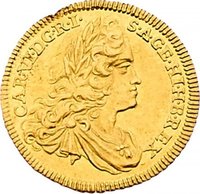
Obverse
Description:
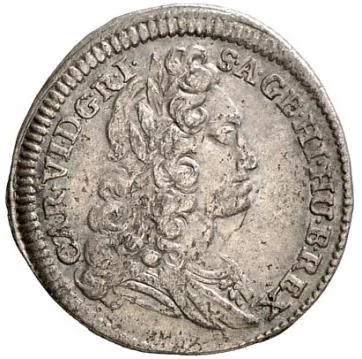
Portrait of Karl VI facing right, dividing the legend above and below: CAROLUS VI DEI GRATIA ROMANORUM IMPERATOR SEMPER AUGUSTUS, GERMANIAE, HISPANIAE, HUNGARIAE, BOHEMIAE REX.
Inscription:
CAR VI D G R I / S A GE HI HV B REX
Script: Latin
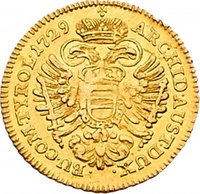
Reverse
Description:
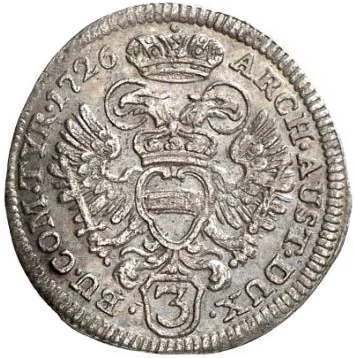
Double-headed imperial eagle with Austrian arms, value below. Legend begins at 1 o'clock: "Archidux Austriae Dux Burgundiae Comes Tyrolis".
Inscription:
ARCH AUST DUX / BU COM TYR 1726
Script: Latin
Edge
Mints
| Name | Mark |
|---|---|
| Münze Österreich | — |
Mintings
| Year | Mint Mark | Mintage | Quality | Collection |
|---|---|---|---|---|
| 1721 | — | — | ||
| 1722 | — | — | ||
| 1723 | — | — | ||
| 1724 | — | — | ||
| 1725 | — | — | ||
| 1726 | — | — | ||
| 1727 | — | — | ||
| 1728 | — | — | ||
| 1729 | — | — | ||
| 1730 | — | — | ||
| 1731 | — | — | ||
| 1732 | — | — | ||
| 1733 | — | — | ||
| 1734 | — | — | ||
| 1735 | — | — | ||
| 1736 | — | — | ||
| 1737 | — | — | ||
| 1738 | — | — | ||
| 1739 | — | — | ||
| 1740 | — | — |
Historical background
In 1721, the currency situation within the Habsburg Austrian Empire was characterized by profound complexity and instability, a legacy of decades of near-continuous warfare, most recently the War of the Spanish Succession (1701-1714) and the Austro-Turkish War (1716-1718). The state's desperate need for revenue led to repeated debasements of the coinage, particularly the small-denomination kreuzer coins used in daily life. This created a chaotic monetary landscape where the official, minted value of coins diverged sharply from their actual metal content, leading to widespread confusion, hoarding of older, purer coins, and a deep erosion of public trust in the currency.
The Empire lacked a unified monetary system. While the official unit of account was the Guiden (gulden), divided into 60 kreuzer, in practice a multitude of different coins circulated. These included not only domestic issues from various Habsburg mints (like Vienna, Graz, and Prague) but also a flood of foreign coins, especially from the German states and the Netherlands. The critical problem was the chronic shortage of high-quality, large-denomination specie (silver thalers and gold coins), which were essential for state finance and international trade. This vacuum was filled by an unstable mix of debased small change and foreign currency, making large transactions cumbersome and hindering economic integration across the Empire's diverse lands.
Authorities were aware of the crisis, and the early 18th century saw several abortive attempts at reform. However, a comprehensive solution remained elusive in 1721. The financial apparatus was still geared towards funding the military and servicing war debts, leaving little capacity for systemic monetary overhaul. Consequently, the year represents a point within a prolonged period of monetary distress, where the pressures of imperial ambition and fiscal exhaustion directly manifested in a disordered and unreliable currency, placing a heavy burden on commerce and the populace alike. True stabilization would only begin with the more concerted reforms initiated under Empress Maria Theresa decades later.
The Empire lacked a unified monetary system. While the official unit of account was the Guiden (gulden), divided into 60 kreuzer, in practice a multitude of different coins circulated. These included not only domestic issues from various Habsburg mints (like Vienna, Graz, and Prague) but also a flood of foreign coins, especially from the German states and the Netherlands. The critical problem was the chronic shortage of high-quality, large-denomination specie (silver thalers and gold coins), which were essential for state finance and international trade. This vacuum was filled by an unstable mix of debased small change and foreign currency, making large transactions cumbersome and hindering economic integration across the Empire's diverse lands.
Authorities were aware of the crisis, and the early 18th century saw several abortive attempts at reform. However, a comprehensive solution remained elusive in 1721. The financial apparatus was still geared towards funding the military and servicing war debts, leaving little capacity for systemic monetary overhaul. Consequently, the year represents a point within a prolonged period of monetary distress, where the pressures of imperial ambition and fiscal exhaustion directly manifested in a disordered and unreliable currency, placing a heavy burden on commerce and the populace alike. True stabilization would only begin with the more concerted reforms initiated under Empress Maria Theresa decades later.
⭐ Rare