

10 Ducats – Austrian Empire
Austria
Context
Year: 1614
Country: Austria 
Issuer: Austrian Empire
Ruler: Matthias
Currency:
(1520—1754)
Demonetized: Yes
References
KM: #Click to copy to clipboard192
Numista: #89305
Value
Bullion value: $5758.42
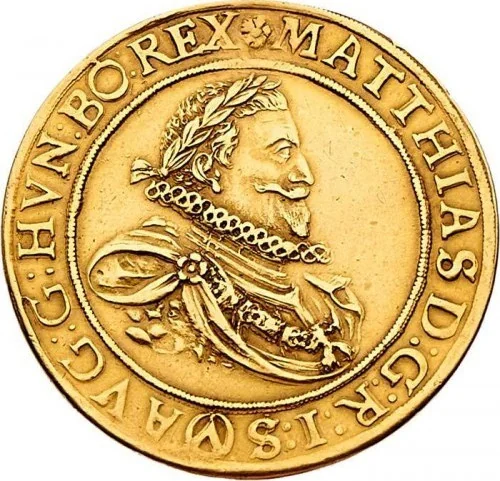
Obverse
Description:
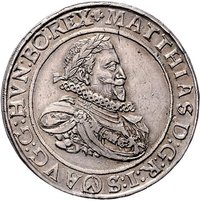
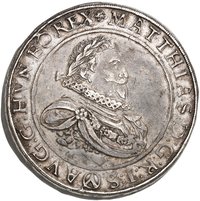
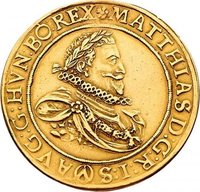
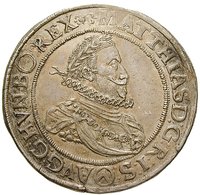
Laureate portrait right, ruffled collar, lion on shoulder, within beaded circle. Mint mark in legend below.
Inscription:
MATTHIAS D: G: R: I: S // AVG: G: HVN: BO: REX
Script: Latin
Engraver: Fellner von Feldegg
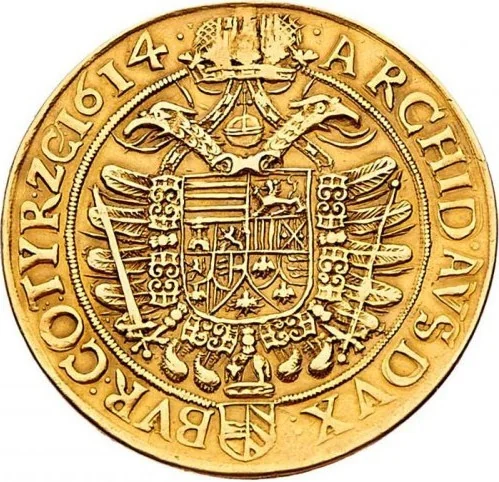
Reverse
Description:
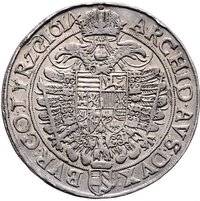
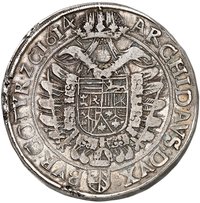
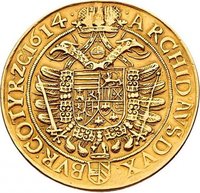
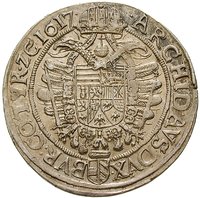
Imperial double-headed eagle with composite arms, orb between heads, within beaded circle. Small shield of Austria and Burgundy below, dividing legend.
Inscription:
ARCHID. AVS: DVX: // BVR: CO: TYR: ZC' 1614
Script: Latin
Edge
Mints
| Name | Mark |
|---|---|
| Münze Österreich | — |
Mintings
| Year | Mint Mark | Mintage | Quality | Collection |
|---|---|---|---|---|
| 1614 | — | — |
Historical background
In 1614, the Habsburg-ruled Austrian Empire was not a unified monetary state but a complex mosaic of territories, each with its own coinage rights and circulating currencies. The primary unit of account was the Gulden (florin), divided into 60 Kreuzer. However, the actual coins in circulation were incredibly diverse, stemming from imperial mints, regional estates, and neighboring states like the Holy Roman Empire's Reichsthaler. This fragmentation created a chaotic and inefficient system where the value and silver content of coins from different issuers varied widely, leading to constant difficulties in trade and taxation.
The period was marked by a severe and ongoing debasement of the coinage, a practice known as Kipper- und Wipperzeit (clipping and tipping), which would reach its peak in the early 1620s. Facing immense financial pressure from the ongoing Long Turkish War (1593-1606) and the looming Thirty Years' War (which began in 1618), the Habsburg treasury and various provincial authorities increasingly minted coins with reduced precious metal content. This created a vicious cycle: bad money drove out good (Gresham's Law), as people hoarded older, full-value coins, further destabilizing the economy and causing inflation.
Despite this turmoil, 1614 fell within a brief, tense calm before the storm. Emperor Matthias (r. 1612-1619) was struggling with familial discord, religious tensions, and empty coffers, but the empire was not yet in full-scale war. Efforts to impose monetary order, like the Imperial Minting Ordinance of 1559, were largely ignored. Thus, the currency situation was one of latent crisis—a deteriorating system of multiple, competing coins, widespread debasement, and a lack of central control, all set against a backdrop of deepening political and financial strain that would soon erupt into continental conflict.
The period was marked by a severe and ongoing debasement of the coinage, a practice known as Kipper- und Wipperzeit (clipping and tipping), which would reach its peak in the early 1620s. Facing immense financial pressure from the ongoing Long Turkish War (1593-1606) and the looming Thirty Years' War (which began in 1618), the Habsburg treasury and various provincial authorities increasingly minted coins with reduced precious metal content. This created a vicious cycle: bad money drove out good (Gresham's Law), as people hoarded older, full-value coins, further destabilizing the economy and causing inflation.
Despite this turmoil, 1614 fell within a brief, tense calm before the storm. Emperor Matthias (r. 1612-1619) was struggling with familial discord, religious tensions, and empty coffers, but the empire was not yet in full-scale war. Efforts to impose monetary order, like the Imperial Minting Ordinance of 1559, were largely ignored. Thus, the currency situation was one of latent crisis—a deteriorating system of multiple, competing coins, widespread debasement, and a lack of central control, all set against a backdrop of deepening political and financial strain that would soon erupt into continental conflict.
✨ Legendary