

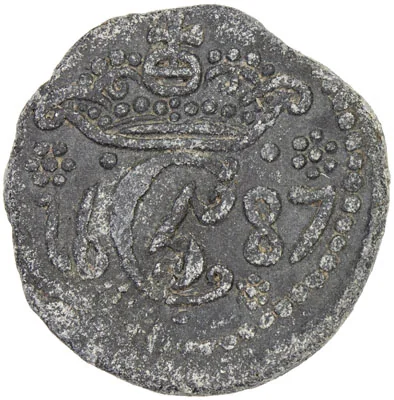
2 cash – Danish India
Add to wishlist
India
Context
Year: 1687
Country: India
Issuer: Danish India
Ruler: Christian V
Currency:
(1730—1818)
Demonetized: Yes
Material
References
KM: #
Numista: #119791
Obverse
Reverse
Description:
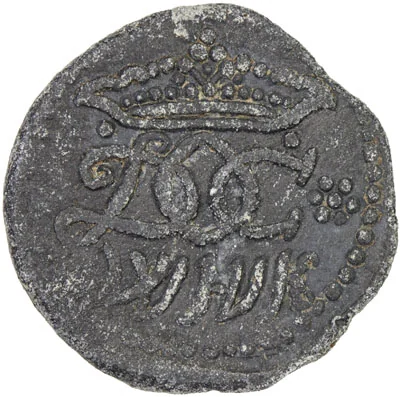
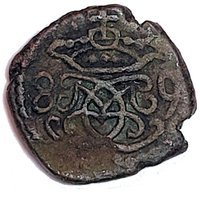
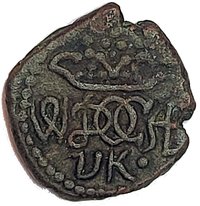
DOC monogram, crowned, with WHVK (governor W.H. van Kalnein) below, flanked by rosettes.
Inscription:
WHVK
Script: Latin
Edge
Mintings
| Year | Mint Mark | Mintage | Quality | Collection |
|---|---|---|---|---|
| 1687 | — | — |
Historical background
In 1687, the currency situation in Danish India was characterized by practical complexity and local adaptation, despite the theoretical authority of the Danish crown. The primary Danish settlements of Tranquebar (Tharangambadi) on the Coromandel Coast and the later fort of Dannemarksnagore near Calcutta operated within a vast and sophisticated Indian Ocean trading economy. Officially, the Danish Asiatic Company sought to impose a system based on Danish rigsdaler, but these European coins held little sway in local markets. Instead, the real circulation was dominated by a multitude of foreign and regional currencies, reflecting the colony's role as a commercial hub.
The daily monetary landscape was a mosaic of coins from various empires. The most influential were silver rupees from the powerful Mughal Empire, which served as the dominant high-value currency for larger transactions and trade. Alongside these, Portuguese xerafins and tangas, Dutch stuivers and fanams, and a variety of South Indian gold pagodas and silver fanams circulated freely. This proliferation was driven by necessity; to procure Indian textiles, spices, and other goods for both the regional trade and the Europe-bound voyages, the Danes had to engage with the existing monetary networks, accepting payment in whatever currencies their partners provided.
Consequently, the Danish administration functioned less as a currency issuer and more as a currency exchanger and authenticator. The company's treasury in Tranquebar would assay the weight and purity of incoming coins, stamping them with a "T" to verify their value for use in company dealings and local payments. This practice, essentially a recognition of monetary reality over imperial ambition, ensured the colony's commercial survival. Thus, in 1687, Danish India's currency situation was one of de facto pluralism, where official Danish policy was subordinated to the practical demands of operating within the vibrant and multi-currency bazaars of the Indian subcontinent.
The daily monetary landscape was a mosaic of coins from various empires. The most influential were silver rupees from the powerful Mughal Empire, which served as the dominant high-value currency for larger transactions and trade. Alongside these, Portuguese xerafins and tangas, Dutch stuivers and fanams, and a variety of South Indian gold pagodas and silver fanams circulated freely. This proliferation was driven by necessity; to procure Indian textiles, spices, and other goods for both the regional trade and the Europe-bound voyages, the Danes had to engage with the existing monetary networks, accepting payment in whatever currencies their partners provided.
Consequently, the Danish administration functioned less as a currency issuer and more as a currency exchanger and authenticator. The company's treasury in Tranquebar would assay the weight and purity of incoming coins, stamping them with a "T" to verify their value for use in company dealings and local payments. This practice, essentially a recognition of monetary reality over imperial ambition, ensured the colony's commercial survival. Thus, in 1687, Danish India's currency situation was one of de facto pluralism, where official Danish policy was subordinated to the practical demands of operating within the vibrant and multi-currency bazaars of the Indian subcontinent.
✨ Legendary