

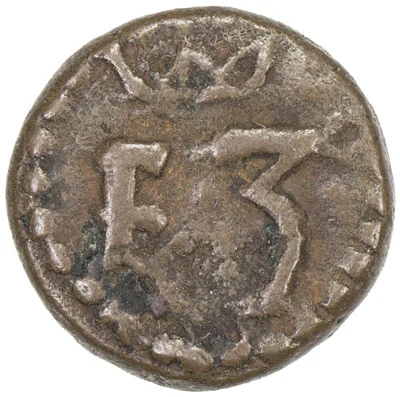
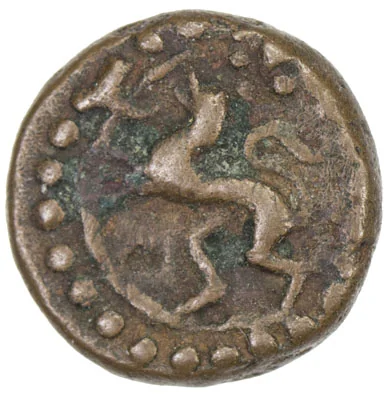
1 Cash – Danish India
India
Context
Years: 1648–1670
Country: India 
Issuer: Danish India
Ruler: Frederick III
Currency:
(1730—1818)
Demonetized: Yes
Material
References
KM: #Click to copy to clipboard82
Numista: #119671
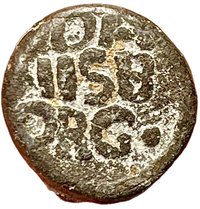
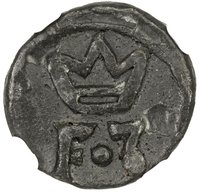
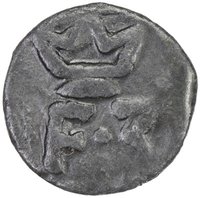
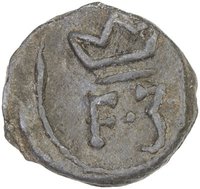
Obverse
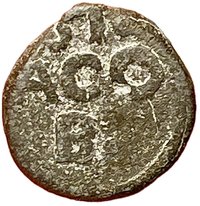
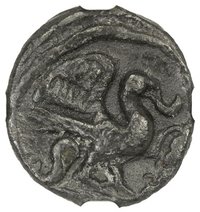
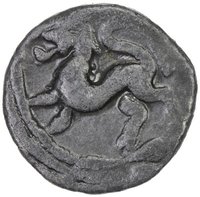
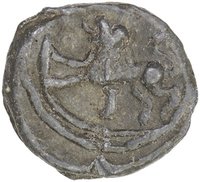
Reverse
Edge
Mintings
| Year | Mint Mark | Mintage | Quality | Collection |
|---|---|---|---|---|
| — | — | — |
Historical background
In 1648, Danish India was a modest but strategically engaged colonial enterprise, centered on the fortified settlement of Tranquebar (Tharangambadi) on the Coromandel Coast, with a factory at Serampore (Frederiksnagore) in Bengal established later. The currency situation was inherently complex and pluralistic, reflecting Denmark's minor commercial position within the vast and economically sophisticated Indian Ocean world. The Danish East India Company, operating under royal charter, did not possess the power to impose a unified monetary system. Instead, trade and daily transactions were conducted using a multitude of existing coins that were already in regional circulation, accepted for their intrinsic metallic value.
The primary currencies in use were those of the dominant regional powers and long-distance trade networks. This included various silver rupees minted by the Mughal Empire and its subordinate rulers, which were the key high-value coins for substantial trade. Portuguese cruzados and a plethora of silver coins from other European companies, especially Dutch leeuwendaalders (lion dollars) and Spanish reales (pieces of eight), were also common mediums of exchange. For smaller, local transactions, a fragmented system of lower-value copper and lead coins, such as cash (kāsu), was essential. This created a constant need for assayers and money-changers to verify weights, purity, and conversion rates.
Consequently, the Danish Company’s primary monetary challenge was not one of issuance but of arbitrage and management. Profits depended on carefully acquiring these accepted foreign coins, often through complex multilateral trade, to pay for Indian textiles and spices. There was no minting of distinct "Danish Indian" coins at this early stage; the economy operated on a pragmatic, borrowed monetary standard. The currency landscape was thus one of competitive adaptation, where Danish traders navigated a pre-existing bazaar of currencies to secure a foothold in the lucrative trade between India and Europe.
The primary currencies in use were those of the dominant regional powers and long-distance trade networks. This included various silver rupees minted by the Mughal Empire and its subordinate rulers, which were the key high-value coins for substantial trade. Portuguese cruzados and a plethora of silver coins from other European companies, especially Dutch leeuwendaalders (lion dollars) and Spanish reales (pieces of eight), were also common mediums of exchange. For smaller, local transactions, a fragmented system of lower-value copper and lead coins, such as cash (kāsu), was essential. This created a constant need for assayers and money-changers to verify weights, purity, and conversion rates.
Consequently, the Danish Company’s primary monetary challenge was not one of issuance but of arbitrage and management. Profits depended on carefully acquiring these accepted foreign coins, often through complex multilateral trade, to pay for Indian textiles and spices. There was no minting of distinct "Danish Indian" coins at this early stage; the economy operated on a pragmatic, borrowed monetary standard. The currency landscape was thus one of competitive adaptation, where Danish traders navigated a pre-existing bazaar of currencies to secure a foothold in the lucrative trade between India and Europe.

✨ Legendary