

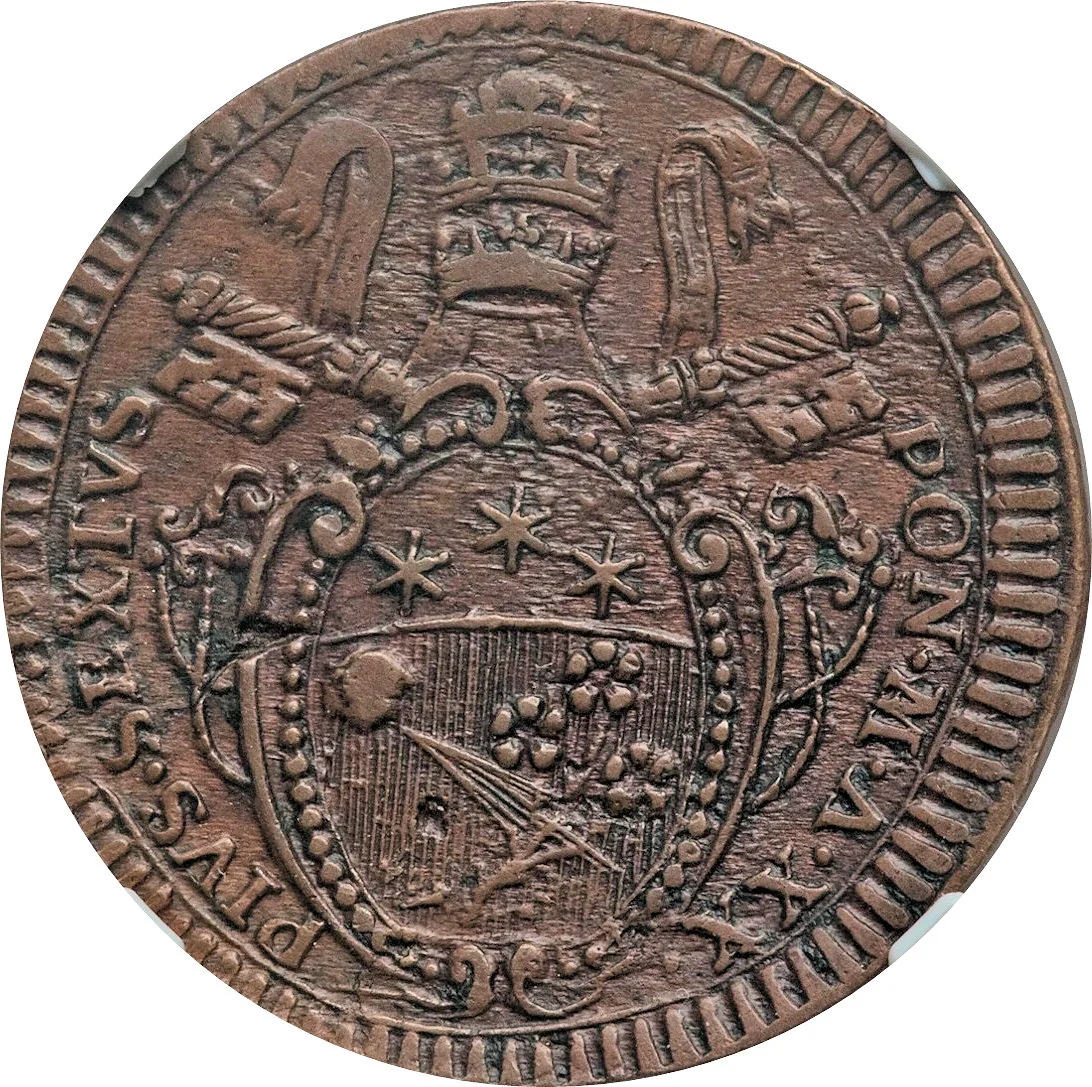
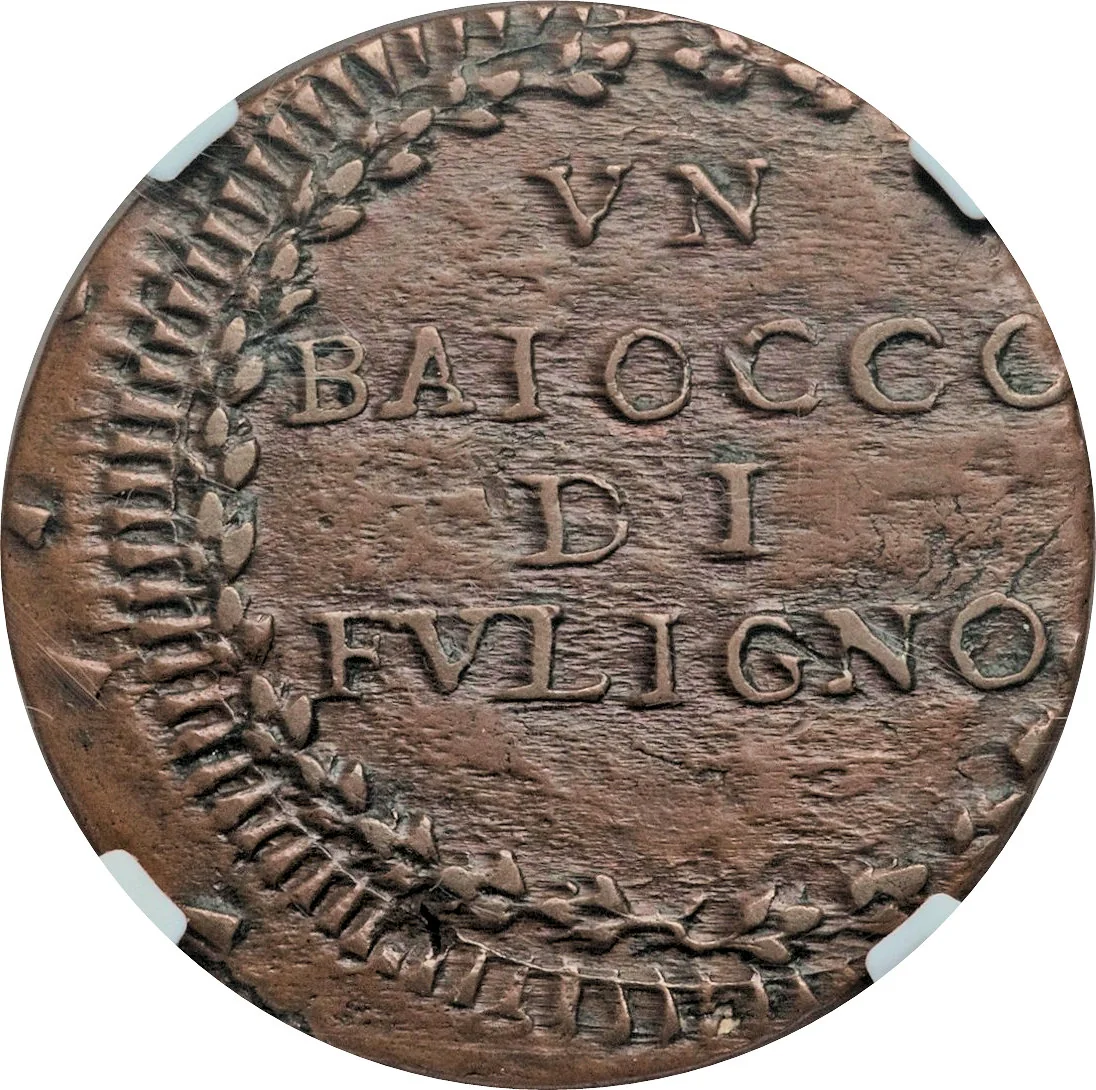
1 baiocco – Foligno
Add to wishlist
Italy
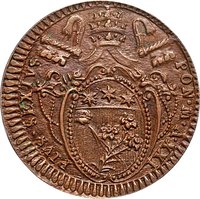
Obverse
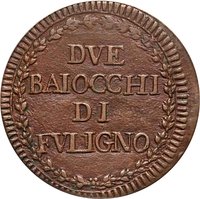
Reverse
Edge
Mints
| Name | Mark |
|---|---|
| Foligno | — |
Mintings
| Year | Mint Mark | Mintage | Quality | Collection |
|---|---|---|---|---|
| 1794 | — | — | ||
| 1795 | — | — |
Historical background
In 1794, Foligno, like much of the Italian peninsula, was caught in the turbulent monetary aftermath of the French Revolutionary Wars. The city was then part of the Papal States, which operated on a complex bimetallic system of scudi (gold) and baiochi (silver). However, the period was marked by severe instability. The French invasion of northern Italy in 1792-93 disrupted trade routes, caused hoarding of precious metal coinage, and led to widespread counterfeiting, which eroded public trust in the currency's value. This created a chronic shortage of sound money in circulation, particularly small-denomination coins needed for daily market transactions.
The local economy in Foligno grappled with the practical consequences of this scarcity. Merchants and citizens increasingly relied on a patchwork of older, worn coins, locally minted tokens, and even barter to facilitate trade. The uncertainty over the real value of coins from different issuances and states stifled commerce and exacerbated inflation for basic goods. Furthermore, the political anxiety stemming from the advancing French armies and the potential collapse of Papal authority added a layer of speculative pressure, as people sought to convert currency into tangible assets.
While full French annexation and the introduction of the franc would not reach Foligno until the Napoleonic establishment of the Roman Republic in 1798, the monetary chaos of 1794 was a direct precursor. It represented the early disintegration of the old Papal monetary order under the strain of war and revolution. Thus, the currency situation in Foligno that year was one of fragmented authority, economic distress, and a slow, forced transition away from centuries-old financial systems toward the uncertain new order heralded by revolutionary France.
The local economy in Foligno grappled with the practical consequences of this scarcity. Merchants and citizens increasingly relied on a patchwork of older, worn coins, locally minted tokens, and even barter to facilitate trade. The uncertainty over the real value of coins from different issuances and states stifled commerce and exacerbated inflation for basic goods. Furthermore, the political anxiety stemming from the advancing French armies and the potential collapse of Papal authority added a layer of speculative pressure, as people sought to convert currency into tangible assets.
While full French annexation and the introduction of the franc would not reach Foligno until the Napoleonic establishment of the Roman Republic in 1798, the monetary chaos of 1794 was a direct precursor. It represented the early disintegration of the old Papal monetary order under the strain of war and revolution. Thus, the currency situation in Foligno that year was one of fragmented authority, economic distress, and a slow, forced transition away from centuries-old financial systems toward the uncertain new order heralded by revolutionary France.
Series: 1794 Foligno circulation coins

✨ Legendary