

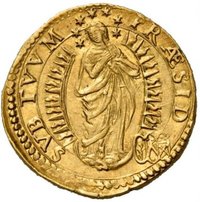
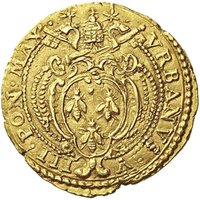
Obverse
Description:
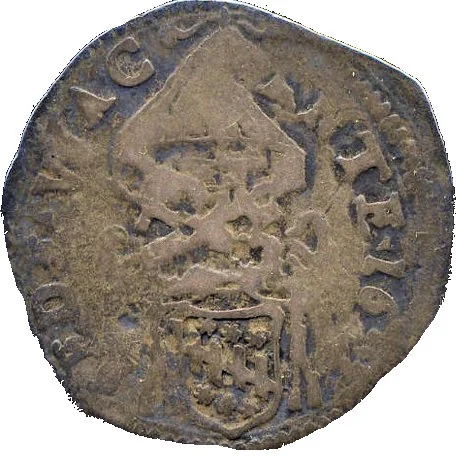
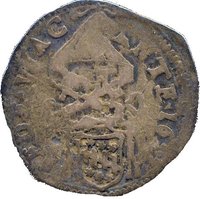
Cardinal Ippolito Aldobrandini's coat of arms.
Inscription:
SEDE·VAC ANTE·1623
Script: Latin
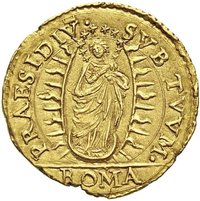
Reverse
Edge
Categories
| Person> Religious figure |
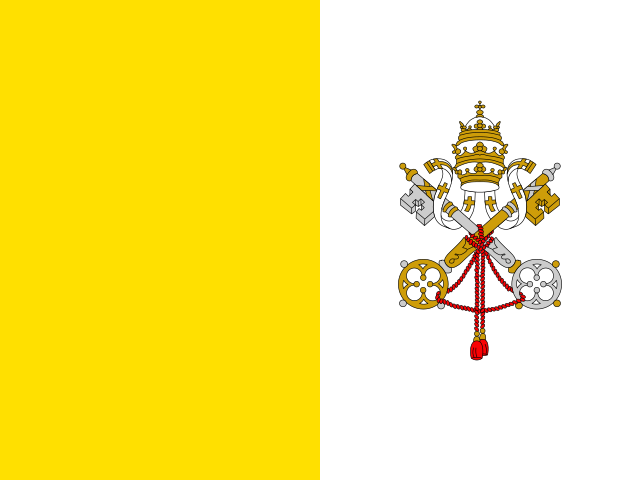
| Symbol> Flag |
| Symbols> Coat of Arms |
Mintings
| Year | Mint Mark | Mintage | Quality | Collection |
|---|---|---|---|---|
| 1623 | — | — |
Historical background
In 1623, the Papal States, under Pope Gregory XV (who died that year) and his successor Pope Urban VIII, faced a complex and deteriorating currency situation typical of many Italian states in the early 17th century. The primary unit was the Papal scudo, a silver coin, but the monetary system was a chaotic bimetallic mix of gold scudi, silver giuli, and copper baiocchi. The core problem was chronic debasement: to finance significant expenditures on art, architecture, and the ongoing Thirty Years' War, the Apostolic Chamber repeatedly reduced the silver content in its coinage. This created a fiscal short-term boost but eroded public trust and the currency's intrinsic value, leading to inflation and economic uncertainty.
The situation was exacerbated by the widespread circulation of foreign coins, particularly Spanish silver reales and gold escudos, which often held more reliable value than the debased local issues. This effectively created a dual currency system where stable foreign coins were hoarded or used for large transactions (Gresham's Law in action), while poorer-quality papal coinage circulated for everyday use. The Papal Mint struggled to control this influx and compete, further undermining its own monetary authority and complicating trade and taxation.
Ultimately, the currency instability of 1623 was a symptom of deeper fiscal pressures. The Papacy's ambitions as a sovereign state and spiritual capital required immense revenue, but its economic base was limited. Debasement became a tempting, though destructive, tool. While not yet in full crisis, the monetary fragility of this period foreshadowed more severe problems under Urban VIII, whose lavish patronage and military costs would lead to even more aggressive debasement, accumulating massive debt and significantly devaluing the Papal States' currency over his long pontificate.
The situation was exacerbated by the widespread circulation of foreign coins, particularly Spanish silver reales and gold escudos, which often held more reliable value than the debased local issues. This effectively created a dual currency system where stable foreign coins were hoarded or used for large transactions (Gresham's Law in action), while poorer-quality papal coinage circulated for everyday use. The Papal Mint struggled to control this influx and compete, further undermining its own monetary authority and complicating trade and taxation.
Ultimately, the currency instability of 1623 was a symptom of deeper fiscal pressures. The Papacy's ambitions as a sovereign state and spiritual capital required immense revenue, but its economic base was limited. Debasement became a tempting, though destructive, tool. While not yet in full crisis, the monetary fragility of this period foreshadowed more severe problems under Urban VIII, whose lavish patronage and military costs would lead to even more aggressive debasement, accumulating massive debt and significantly devaluing the Papal States' currency over his long pontificate.
✨ Legendary