

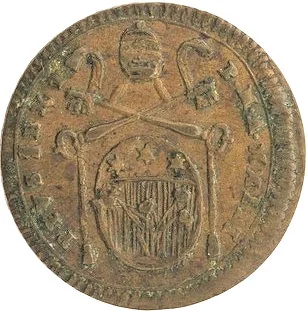
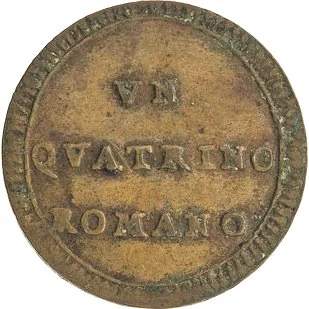
1 Quattrino – Papal States
Vatican City
Context
Years: 1797–1798
Country: Vatican City 
Issuer: Papal States
Ruler: Pius VI
Currency:
(1534—1835)
Demonetized: Yes
Material
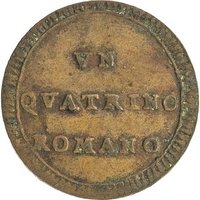
References
KM: #Click to copy to clipboard1242
Numista: #119551
Categories
| Symbol> Crown |
| Symbols> Coat of Arms |
Mintings
| Year | Mint Mark | Mintage | Quality | Collection |
|---|---|---|---|---|
| — | — | — |
Historical background
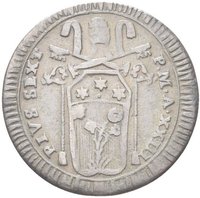
By 1797, the currency situation in the Papal States was one of profound crisis and confusion, directly resulting from the military and political upheavals of the French Revolutionary Wars. In February 1797, the Treaty of Tolentino imposed a massive indemnity of 30 million lire on Pope Pius VI, draining the papal treasury of specie (gold and silver coin). To meet these crushing obligations, the government was forced to authorize the melting of church plate and precious objects, further destabilizing the monetary supply. This financial hemorrhage occurred alongside the circulation of occupation currencies introduced by French armies, which disrupted the established system.
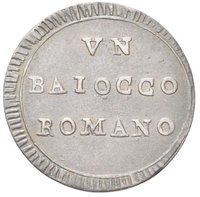
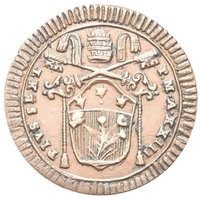
The domestic coinage itself was a complex mosaic, reflecting the Papal States' ancient and regionalist structure. The standard unit was the scudo, divided into 100 baiocchi, each of 5 quattrini. However, alongside papal-issued scudi, coins from other Italian states and foreign currencies circulated freely, their values fluctuating based on metal content and trust. The critical shortage of precious metals led to a sharp decline in the production of full-value silver and gold coins, while the reliance on fractional copper and billon (debased silver) coinage increased, causing inflation and public distrust in the currency's worth.
This precarious system collapsed entirely by the end of the year. Following a fabricated incident, French troops under General Berthier occupied Rome in February 1798, declaring the Roman Republic. The papal government was dissolved, and its monetary authority ceased. The new republic introduced a decimalized currency based on the lira, akin to the French franc, in an attempt to modernize the economy. Thus, 1797 represents the final, desperate year of the ancient papal monetary regime, ending not with reform but with abolition under the weight of revolutionary invasion and financial exhaustion.
The domestic coinage itself was a complex mosaic, reflecting the Papal States' ancient and regionalist structure. The standard unit was the scudo, divided into 100 baiocchi, each of 5 quattrini. However, alongside papal-issued scudi, coins from other Italian states and foreign currencies circulated freely, their values fluctuating based on metal content and trust. The critical shortage of precious metals led to a sharp decline in the production of full-value silver and gold coins, while the reliance on fractional copper and billon (debased silver) coinage increased, causing inflation and public distrust in the currency's worth.
This precarious system collapsed entirely by the end of the year. Following a fabricated incident, French troops under General Berthier occupied Rome in February 1798, declaring the Roman Republic. The papal government was dissolved, and its monetary authority ceased. The new republic introduced a decimalized currency based on the lira, akin to the French franc, in an attempt to modernize the economy. Thus, 1797 represents the final, desperate year of the ancient papal monetary regime, ending not with reform but with abolition under the weight of revolutionary invasion and financial exhaustion.
✨ Legendary