

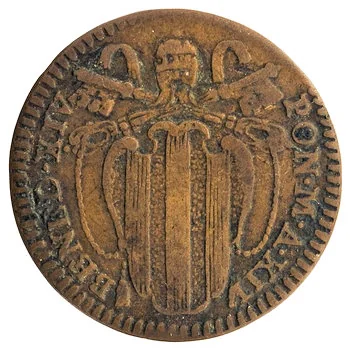
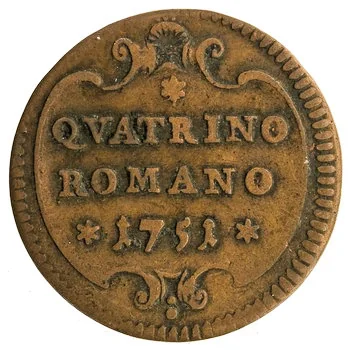
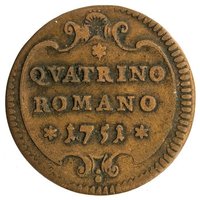
1 Quattrino – Papal States
Vatican City
Context
Year: 1751
Country: Vatican City 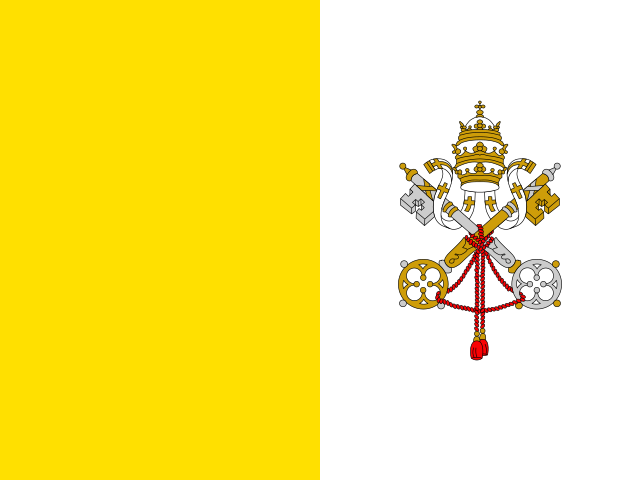
Issuer: Papal States
Ruler: Benedict XIV
Currency:
(1534—1835)
Demonetized: Yes
Material
References
KM: #Click to copy to clipboard1174
Numista: #119534
Obverse
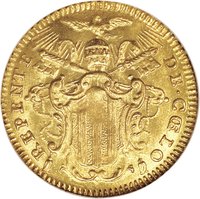
Reverse
Edge
Plain
Categories
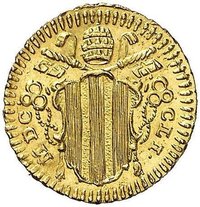
| Symbol> Crown |
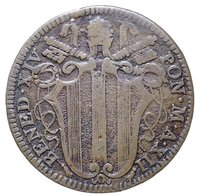
| Symbols> Coat of Arms |
Mints
| Name | Mark |
|---|---|
| Rome | — |
Mintings
| Year | Mint Mark | Mintage | Quality | Collection |
|---|---|---|---|---|
| 1751 | — | — |
Historical background
In 1751, the Papal States, a mosaic of central Italian territories under the temporal rule of the Pope, operated within a complex and often chaotic monetary system. The primary unit was the Papal Scudo, a silver coin, which was divided into 100 Baiocchi. However, the reality of daily commerce was far more fragmented. Numerous local mints in cities like Bologna, Ancona, and Avignon (a papal enclave in France) produced their own coinage, leading to a proliferation of circulating coins with varying weights, purities, and exchange rates. Furthermore, older coins from previous papal reigns and even foreign currencies, particularly Spanish pieces of eight, circulated freely, creating a bewildering marketplace where trust in a coin's intrinsic metal value was paramount.
This monetary fragmentation was a direct reflection of the Papal States' weak central administration and its reliance on local feudal and municipal structures. The financial health of the state was perpetually strained by a reliance on indirect taxes, venal offices, and borrowing, leaving little capital for consistent monetary reform. While the central mint in Rome, the Zecca, produced coins bearing the image of the reigning Pope, Benedict XIV (1740-1758), its output could not standardize the monetary landscape. Consequently, exchange was often slow and contentious, requiring the expertise of money-changers and notaries, and hindering both internal trade and the state's ability to collect revenues efficiently.
Pope Benedict XIV, a reform-minded intellectual, was aware of these economic shortcomings. The year 1751 fell within a period where he was actively addressing papal finances and administration, though major, sweeping monetary unification would not be achieved in his lifetime. His reign saw attempts to curb clerical excesses and improve infrastructure, which indirectly touched upon economic stability. However, the fundamental issues of monetary disunity persisted, emblematic of the broader challenges of governing a theocratic state in an age of growing economic centralization elsewhere in Europe. The situation would remain largely unchanged until the Napoleonic invasions half a century later forcibly swept the old system away.
This monetary fragmentation was a direct reflection of the Papal States' weak central administration and its reliance on local feudal and municipal structures. The financial health of the state was perpetually strained by a reliance on indirect taxes, venal offices, and borrowing, leaving little capital for consistent monetary reform. While the central mint in Rome, the Zecca, produced coins bearing the image of the reigning Pope, Benedict XIV (1740-1758), its output could not standardize the monetary landscape. Consequently, exchange was often slow and contentious, requiring the expertise of money-changers and notaries, and hindering both internal trade and the state's ability to collect revenues efficiently.
Pope Benedict XIV, a reform-minded intellectual, was aware of these economic shortcomings. The year 1751 fell within a period where he was actively addressing papal finances and administration, though major, sweeping monetary unification would not be achieved in his lifetime. His reign saw attempts to curb clerical excesses and improve infrastructure, which indirectly touched upon economic stability. However, the fundamental issues of monetary disunity persisted, emblematic of the broader challenges of governing a theocratic state in an age of growing economic centralization elsewhere in Europe. The situation would remain largely unchanged until the Napoleonic invasions half a century later forcibly swept the old system away.
✨ Legendary