

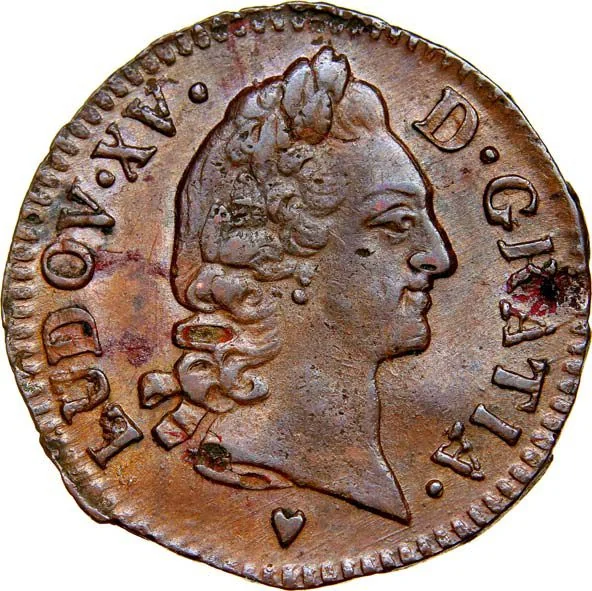
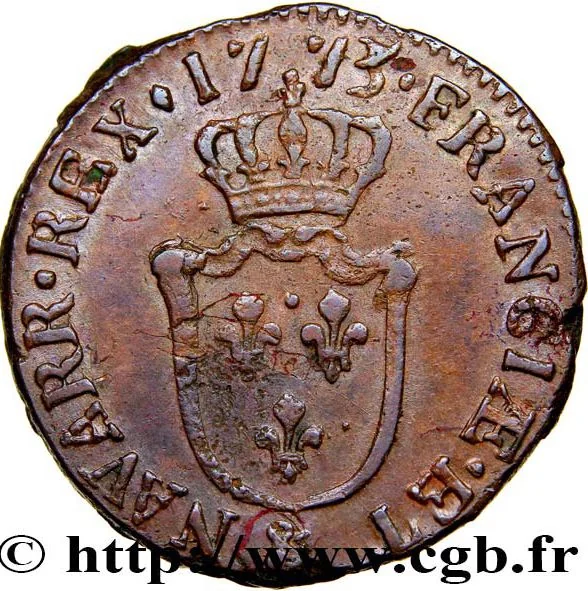
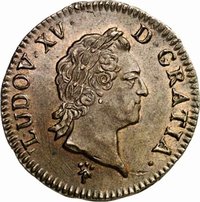
Obverse
Description:
Elderly laureate head of Louis XV right.
Inscription:
LUDOV• XV• D• GRATIA•
Script: Latin
Engraver: Joseph-Charles Röettiers
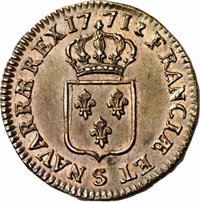
Reverse
Description:
Azure, a fleur-de-lis Or.
Inscription:
•FRANCIÆ• ET & NAVARR• REX • (millésime)
Script: Latin
Engraver: Joseph-Charles Röettiers
Edge
Plain.
Categories
| Symbol> Fleur-de-lis |
| Symbol> Crown |
| Person> Monarch |
| Symbols> Coat of Arms |
Mints
| Name | Mark |
|---|---|
| Aix-en-Provence | & |
Mintings
Historical background
In 1767, France was operating under a complex and strained monetary system that was a legacy of Louis XIV's costly wars and the financial experiments of the previous decades. The official currency was the livre tournois, a unit of account, but physical circulation consisted of both gold louis d'or and silver écus, whose market values fluctuated against the livre. This created a dual-currency system where prices in livres often differed from the actual metallic value of the coins used for payment, leading to confusion and frequent royal edicts to adjust official exchange rates. Furthermore, the state faced a chronic shortage of specie (hard coin), particularly small-denomination coins for everyday transactions, which hampered commerce and bred public distrust.
The underlying crisis was fundamentally one of state finance. France was burdened by enormous debt, and to raise funds, the monarchy had increasingly resorted to devaluing the currency—officially lowering the metal content in coins or arbitrarily raising their face value in livres. This practice, while providing short-term liquidity for the treasury, was highly inflationary and eroded confidence in the currency. By 1767, the Controller-General of Finances, Étienne de Silhouette (whose name ironically became synonymous with cost-cutting), had attempted reforms, but his efforts were short-lived. The more lasting minister, René de Maupeou, was focused on judicial reforms, leaving the monetary system unstable and vulnerable to speculative attacks.
Consequently, the currency situation in 1767 was a symptom of the Ancien Régime's deeper structural weaknesses. It reflected a failing absolutist state that lacked a central bank (unlike Britain) and reliable public credit, forcing it to manipulate the coinage to meet obligations. This monetary instability directly impacted the economy, frustrating merchants and exacerbating social tensions, particularly as bad harvests could trigger sharp price increases. While not yet at the explosive point it would reach in the 1780s, the fragile currency of 1767 was a persistent economic grievance, contributing to the simmering discontent that would later help fuel the French Revolution.
The underlying crisis was fundamentally one of state finance. France was burdened by enormous debt, and to raise funds, the monarchy had increasingly resorted to devaluing the currency—officially lowering the metal content in coins or arbitrarily raising their face value in livres. This practice, while providing short-term liquidity for the treasury, was highly inflationary and eroded confidence in the currency. By 1767, the Controller-General of Finances, Étienne de Silhouette (whose name ironically became synonymous with cost-cutting), had attempted reforms, but his efforts were short-lived. The more lasting minister, René de Maupeou, was focused on judicial reforms, leaving the monetary system unstable and vulnerable to speculative attacks.
Consequently, the currency situation in 1767 was a symptom of the Ancien Régime's deeper structural weaknesses. It reflected a failing absolutist state that lacked a central bank (unlike Britain) and reliable public credit, forcing it to manipulate the coinage to meet obligations. This monetary instability directly impacted the economy, frustrating merchants and exacerbating social tensions, particularly as bad harvests could trigger sharp price increases. While not yet at the explosive point it would reach in the 1780s, the fragile currency of 1767 was a persistent economic grievance, contributing to the simmering discontent that would later help fuel the French Revolution.
🌟 Uncommon