

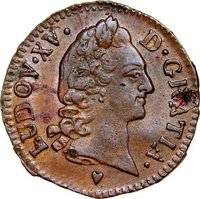
Obverse
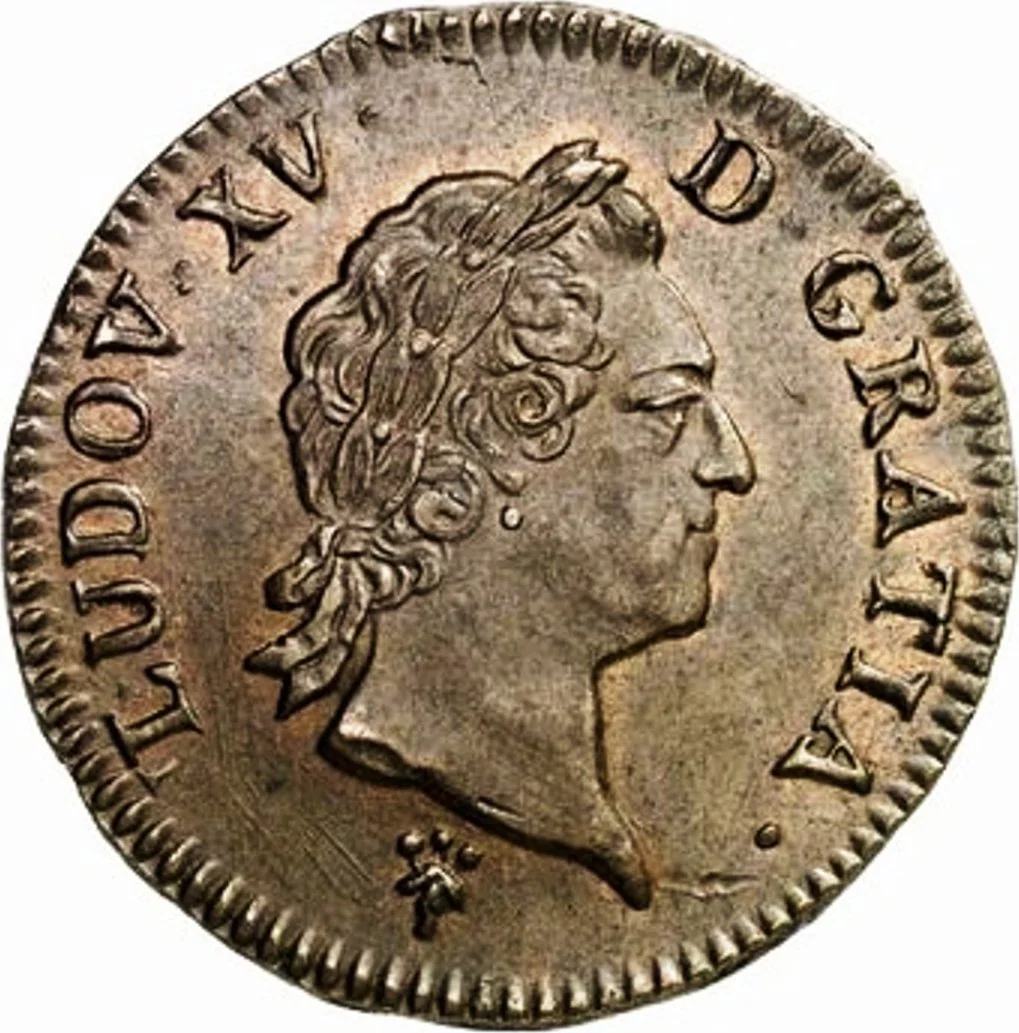
Description:
Louis XV, facing right.
Inscription:
LUDOV۰XV۰ D۰GRATIA۰
Script: Latin
Engraver: Norbert Roettiers
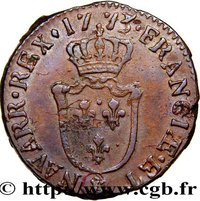
Reverse
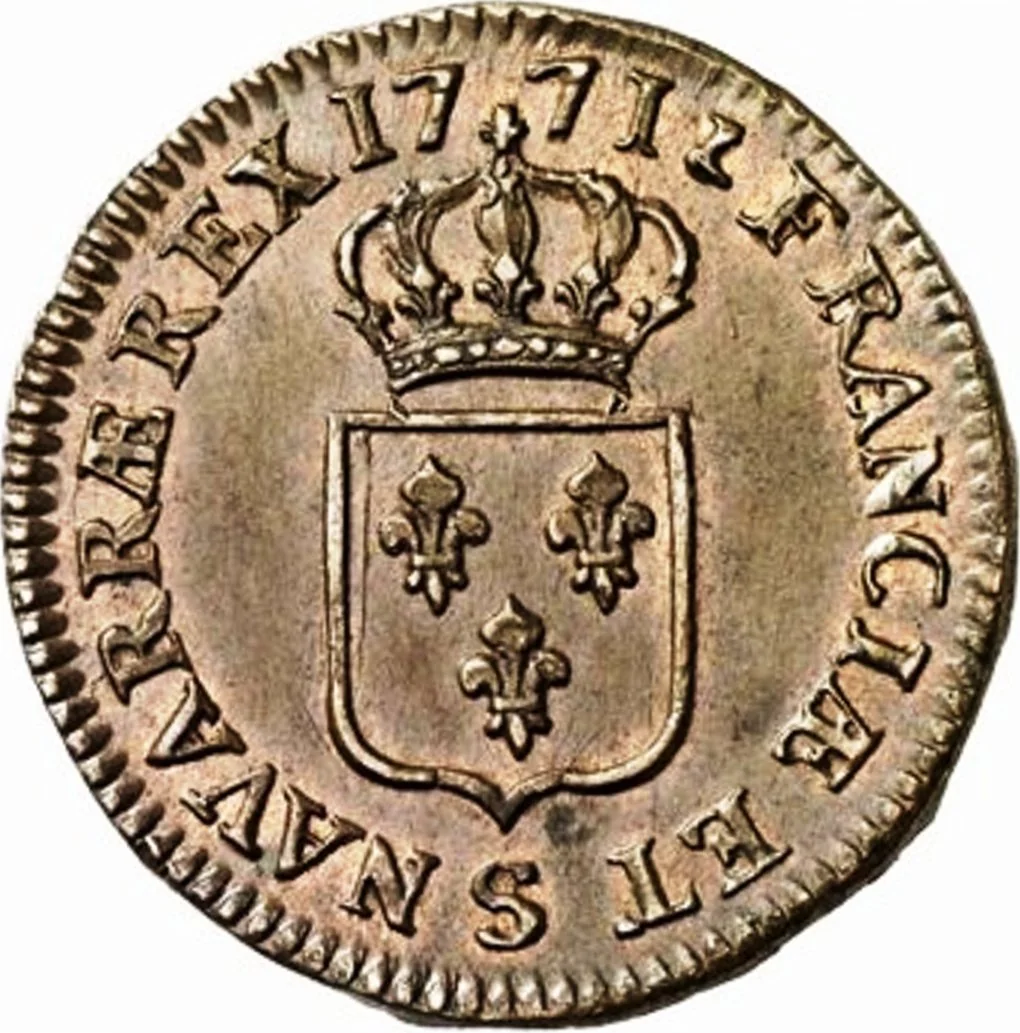
Description:
Crowned square arms, date above.
Inscription:
FRANCIÆ ET NAVARRÆ REX 1771
S
S
Script: Latin
Engraver: Norbert Roettiers
Edge
Plain
Categories
| Symbols> Coat of Arms |
| Symbol> Crown |
| Person> Monarch |
| Symbol> Fleur-de-lis |
Mints
| Name | Mark |
|---|---|
| Monnaie de Paris | A |
| Metz | AA |
| Rouen | B |
| Strasbourg | BB |
| Lyon | D |
| La Rochelle | H |
| Limoges | I |
| Toulouse | M |
| Montpellier | N |
| Reims | S |
| Troyes | V |
| Lille | W |
| Besançon | ϽϹ |
Mintings
| Year | Mint Mark | Mintage | Quality | Collection |
|---|---|---|---|---|
| 1768 | A | — | ||
| 1769 | A | — | ||
| 1769 | M | — | ||
| 1769 | S | — | ||
| 1769 | W | — | ||
| 1769 | ϽϹ | — | ||
| 1770 | AA | — | ||
| 1770 | B | — | ||
| 1770 | BB | — | ||
| 1770 | D | — | ||
| 1770 | M | — | ||
| 1770 | N | — | ||
| 1770 | S | — | ||
| 1770 | V | — | ||
| 1770 | W | — | ||
| 1770 | ϽϹ | — | ||
| 1770 | A | — | ||
| 1771 | A | — | ||
| 1771 | AA | — | ||
| 1771 | B | — | ||
| 1771 | BB | — | ||
| 1771 | D | 1,560,312 | ||
| 1771 | N | 843,597 | ||
| 1771 | S | 532,000 | ||
| 1771 | V | — | ||
| 1771 | W | — | ||
| 1771 | ϽϹ | — | ||
| 1772 | A | — | ||
| 1772 | AA | — | ||
| 1772 | BB | — | ||
| 1772 | D | — | ||
| 1772 | I | — | ||
| 1772 | M | — | ||
| 1772 | N | — | ||
| 1772 | S | — | ||
| 1772 | V | 660,080 | ||
| 1772 | W | — | ||
| 1772 | ϽϹ | — | ||
| — | I | — | ||
| 1773 | A | 43,000 | ||
| 1773 | AA | — | ||
| 1773 | BB | — | ||
| 1773 | D | — | ||
| 1773 | I | 916,000 | ||
| 1773 | N | 286,000 | ||
| 1773 | S | 100,000 | ||
| 1773 | W | 323,000 | ||
| 1774 | A | — | ||
| 1774 | AA | 585,272 | ||
| 1774 | BB | 1,351,000 | ||
| 1774 | D | 1,560,312 | ||
| 1774 | H | 1,827,595 | ||
| 1774 | I | 1,068,000 | ||
| 1774 | M | 864,000 | ||
| 1774 | W | 2,339,000 |
Historical background
In 1768, France operated under a complex and strained monetary system typical of the Ancien Régime. The official currency was the livre tournois (divided into sous and deniers), but the kingdom lacked a uniform, state-issued coinage. Instead, a multitude of gold (louis d'or) and silver (écus) coins, minted by various royal mints, circulated alongside a vast array of foreign coins and, crucially, a growing mass of paper money. This paper took the form of billets de monnaie (treasury notes) and, more problematically, interest-bearing notes issued by the Parisian financial magistracy, the Cour des Monnaies.
The system was under severe pressure due to the colossal debt from the Seven Years' War (1756-1763), which France had lost. To service this debt, the monarchy, under Controller-General Étienne de Silhouette and his successors, had resorted to repeated manipulations that eroded public trust. These included official re-evaluations of coin values, attempts at partial defaults, and the continued issuance of paper notes that were not properly backed by specie. The result was monetary instability, with frequent shortages of small change crippling daily commerce and a widening gap between the face value of paper and its real metallic worth.
This chaotic currency situation was a significant factor in the deepening financial crisis of the crown. It hampered economic recovery, fueled inflation for ordinary people, and undermined confidence in royal financial management. The inability to reform this system effectively would lead, just five years later in 1774, to the appointment of Jacques Turgot as Controller-General and, ultimately, contribute to the fiscal desperation that forced King Louis XVI to convene the Estates-General in 1789, setting the stage for revolution.
The system was under severe pressure due to the colossal debt from the Seven Years' War (1756-1763), which France had lost. To service this debt, the monarchy, under Controller-General Étienne de Silhouette and his successors, had resorted to repeated manipulations that eroded public trust. These included official re-evaluations of coin values, attempts at partial defaults, and the continued issuance of paper notes that were not properly backed by specie. The result was monetary instability, with frequent shortages of small change crippling daily commerce and a widening gap between the face value of paper and its real metallic worth.
This chaotic currency situation was a significant factor in the deepening financial crisis of the crown. It hampered economic recovery, fueled inflation for ordinary people, and undermined confidence in royal financial management. The inability to reform this system effectively would lead, just five years later in 1774, to the appointment of Jacques Turgot as Controller-General and, ultimately, contribute to the fiscal desperation that forced King Louis XVI to convene the Estates-General in 1789, setting the stage for revolution.
🌱 Common