

5 Centimes – France
France

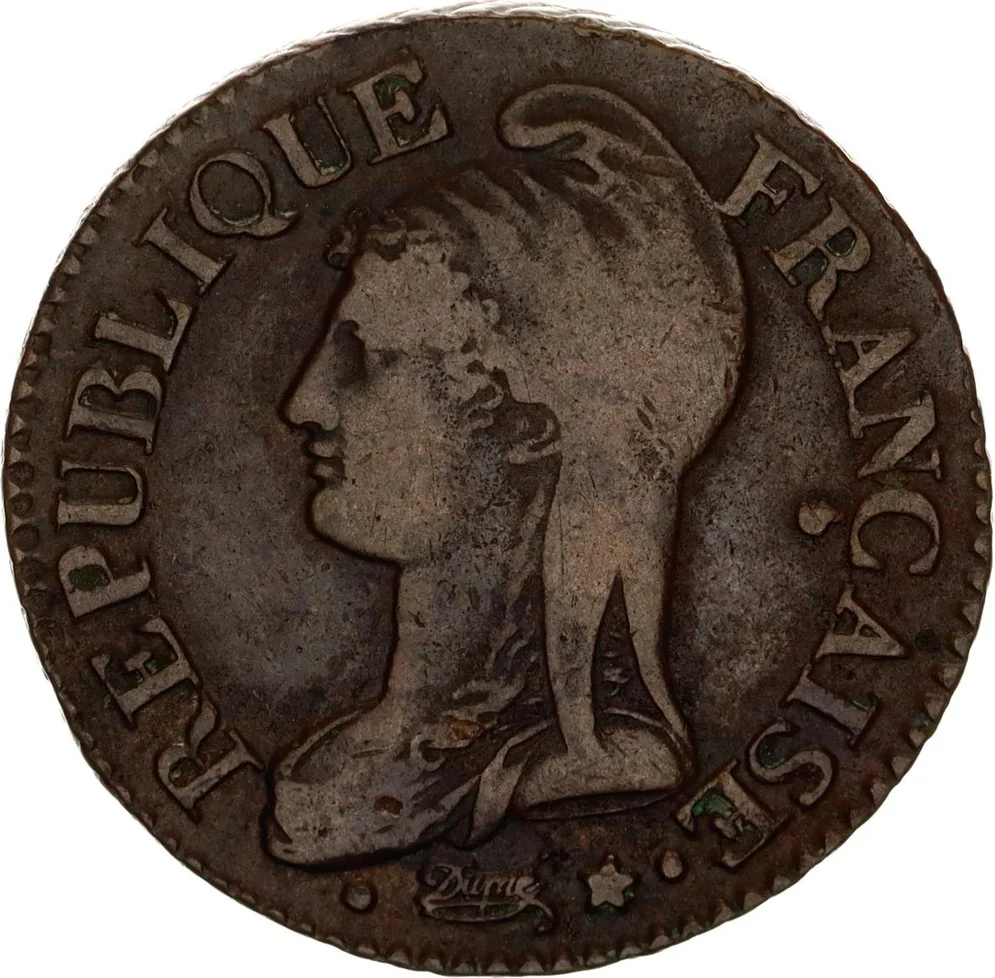
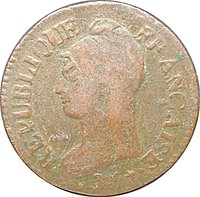
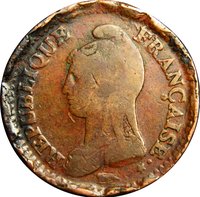
Obverse
Description:
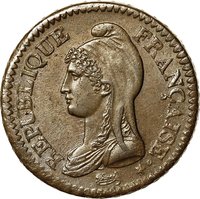
Marianne in a Phrygian cap, with the engraver's signature below.
Inscription:
REPUBLIQUE FRANÇAISE·*
Dupré
Dupré
Script: Latin
Engraver: Augustin Dupré
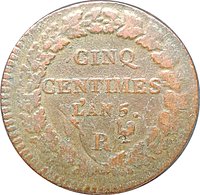
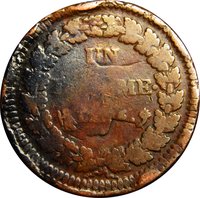
Reverse
Description:
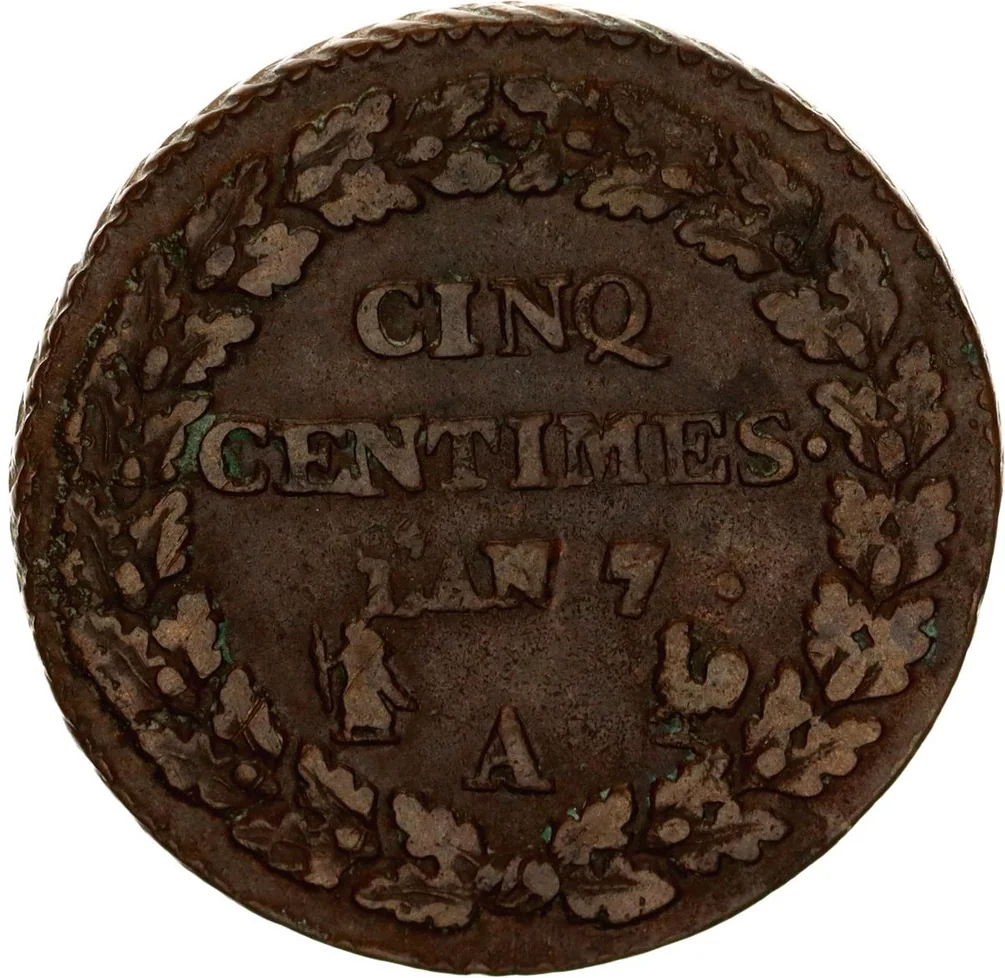
Face value and date in the French Republican Calendar, encircled by an oak wreath.
Inscription:
CINQ
CENTIMES
L'AN 5.
R
CENTIMES
L'AN 5.
R
Script: Latin
Engraver: Augustin Dupré
Edge
Milled (sloping) or chevron
Categories
| Symbol> Phrygian cap |
Mints
| Name | Mark |
|---|---|
| Monnaie de Paris | A |
| Metz | AA |
| Rouen | B |
| Strasbourg | BB |
| Lyon | D |
| Geneva | G |
| Limoges | I |
| Orléans | R |
| Lille | W |
Mintings
| Year | Mint Mark | Mintage | Quality | Collection |
|---|---|---|---|---|
| 1796 | — | — | ||
| 1797 | — | — | ||
| 1798 | — | — | ||
| 1799 | — | — | ||
| 1800 | — | — |
Historical background
By 1796, the currency situation in the French Republic was one of catastrophic collapse, directly stemming from the revolutionary government's reliance on the assignat. Initially issued in 1789 as bonds backed by confiscated church lands, the assignats had evolved into a compulsory paper currency. However, massive over-printing to finance wars and cover state deficits, coupled with a public loss of confidence, led to hyperinflation. The value of the assignat plummeted; by February 1796, it was worth less than 1% of its face value. This rendered coins of precious metal (the ancient écus and louis d'or) the only trusted money, but they were hoarded, creating a severe shortage of usable currency and paralyzing the economy with barter becoming common.
In a desperate attempt to reset the system, the Directory introduced a new paper currency in March 1796: the mandat territorial. Like its predecessor, it was theoretically backed by national lands, but the public, scarred by the experience of the assignat, had no faith in it. The mandats lost their value even more rapidly, falling to just 3% of their nominal worth within months. This final failure of paper money discredited the government further and exacerbated social misery, as wages paid in mandats became worthless, prices in stable coin skyrocketed, and famine threatened Paris.
The utter fiasco of the mandats forced a dramatic and lasting policy reversal. In February 1797, the Directory would make the painful but necessary decision to demonetize all paper currency and return to a metallic standard, effectively declaring bankruptcy to end the inflationary spiral. The experience of 1796-97 left a profound and lasting distrust of paper money in France, shaping monetary policy for over a century and paving the way for the hard-currency reforms that would later be consolidated under Napoleon Bonaparte with the creation of the franc germinal.
In a desperate attempt to reset the system, the Directory introduced a new paper currency in March 1796: the mandat territorial. Like its predecessor, it was theoretically backed by national lands, but the public, scarred by the experience of the assignat, had no faith in it. The mandats lost their value even more rapidly, falling to just 3% of their nominal worth within months. This final failure of paper money discredited the government further and exacerbated social misery, as wages paid in mandats became worthless, prices in stable coin skyrocketed, and famine threatened Paris.
The utter fiasco of the mandats forced a dramatic and lasting policy reversal. In February 1797, the Directory would make the painful but necessary decision to demonetize all paper currency and return to a metallic standard, effectively declaring bankruptcy to end the inflationary spiral. The experience of 1796-97 left a profound and lasting distrust of paper money in France, shaping monetary policy for over a century and paving the way for the hard-currency reforms that would later be consolidated under Napoleon Bonaparte with the creation of the franc germinal.
🌱 Very Common