

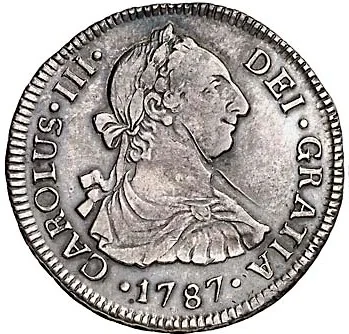
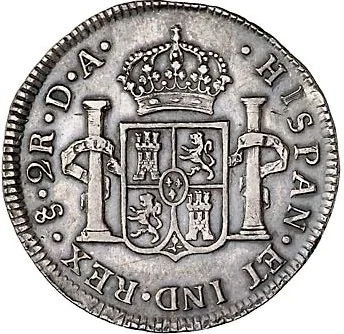
2 Reales – Chile
Chile
Context
Years: 1773–1789
Issuer: Chile 
Ruler: Charles III
Currency:
(1541—1852)
Demonetized: Yes
Total mintage: 607,000
Material
References
KM: #Click to copy to clipboard30
Numista: #88598
Value
Bullion value: $17.68
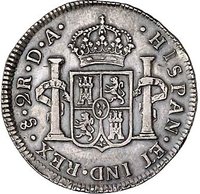
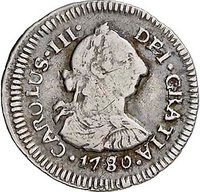
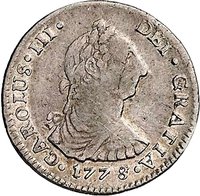
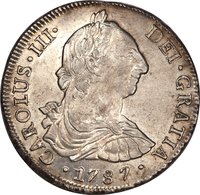
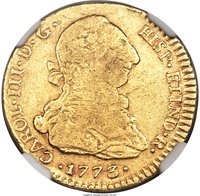
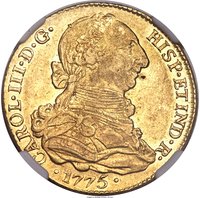
Obverse
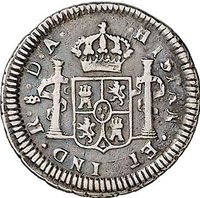
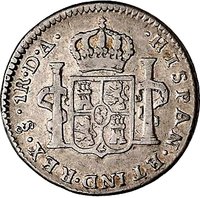
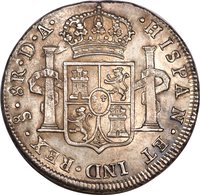
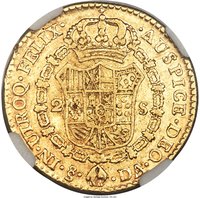
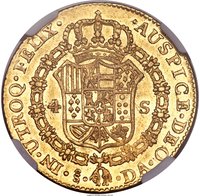
Reverse
Edge
Chained
Mints
| Name | Mark |
|---|---|
| Casa de Moneda de Chile | (So) |
Mintings
| Year | Mint Mark | Mintage | Quality | Collection |
|---|---|---|---|---|
| 1773 | So | 14,000 | ||
| 1775 | So | 34,000 | ||
| 1776 | So | 7,000 | ||
| 1777 | So | 7,000 | ||
| 1778 | /6 | — | ||
| 1778 | So | 68,000 | ||
| 1779 | So | 48,000 | ||
| 1780 | So | 34,000 | ||
| 1781 | So | 44,000 | ||
| 1782 | So | 21,000 | ||
| 1783 | So | — | ||
| 1783 | /2 | 34,000 | ||
| 1784 | /1 | — | ||
| 1784 | So | 54,000 | ||
| 1785 | /4 | — | ||
| 1785 | So | 27,000 | ||
| 1786 | So | 51,000 | ||
| 1787 | So | 31,000 | ||
| 1788 | So | 66,000 | ||
| 1789 | So | 67,000 |
Historical background
In 1773, Chile was a captaincy-general within the Spanish Empire, and its currency situation was characterized by severe scarcity and reliance on a chaotic mix of foreign and improvised coins. The Spanish Crown consistently failed to supply sufficient official coinage, particularly the silver reales and gold escudos minted in Peru and Mexico, to meet the colony's economic needs. This chronic shortage stifled trade and daily transactions, forcing the local economy to adapt through largely informal means.
The primary mediums of exchange were a jumble of coins from other Spanish American mints, alongside significant quantities of clipped, worn, and counterfeit pieces that circulated at discounted values. Most notably, due to trade routes across the Andes and the Pacific, Peruvian and Mexican coins dominated, but even these were insufficient. In the absence of sufficient small change, merchants and large estates often resorted to using boletas or fichas—private tokens made of copper, leather, or even wood—as IOUs for local use, especially for paying laborers. This created a fragmented and unreliable monetary system.
This problematic situation existed within the broader framework of Spanish mercantilist policy, which aimed to extract precious metals from the colonies while restricting their commercial autonomy. The local authorities had little power to mint coins or formally regulate value, leaving the market to determine the worth of each irregular piece. The year 1773 fell within a period of administrative reform under the Bourbon monarchs, but tangible monetary relief for Chile would not come until the establishment of a royal mint (Casa de Moneda) in Santiago decades later, in 1749, highlighting how the scarcity of 1773 was a persistent, long-standing crisis.
The primary mediums of exchange were a jumble of coins from other Spanish American mints, alongside significant quantities of clipped, worn, and counterfeit pieces that circulated at discounted values. Most notably, due to trade routes across the Andes and the Pacific, Peruvian and Mexican coins dominated, but even these were insufficient. In the absence of sufficient small change, merchants and large estates often resorted to using boletas or fichas—private tokens made of copper, leather, or even wood—as IOUs for local use, especially for paying laborers. This created a fragmented and unreliable monetary system.
This problematic situation existed within the broader framework of Spanish mercantilist policy, which aimed to extract precious metals from the colonies while restricting their commercial autonomy. The local authorities had little power to mint coins or formally regulate value, leaving the market to determine the worth of each irregular piece. The year 1773 fell within a period of administrative reform under the Bourbon monarchs, but tangible monetary relief for Chile would not come until the establishment of a royal mint (Casa de Moneda) in Santiago decades later, in 1749, highlighting how the scarcity of 1773 was a persistent, long-standing crisis.
Series: 1773 Chile circulation coins
💎 Very Rare