

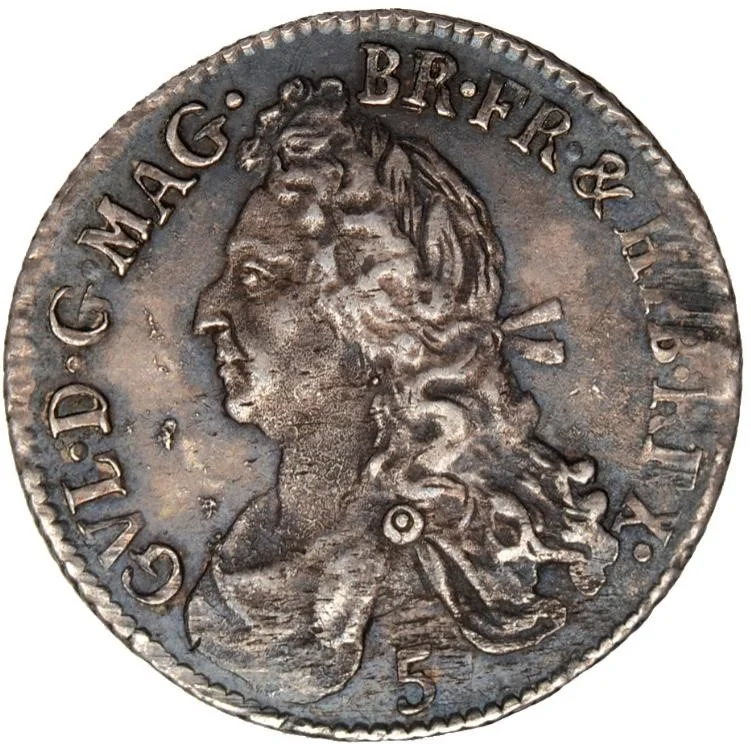
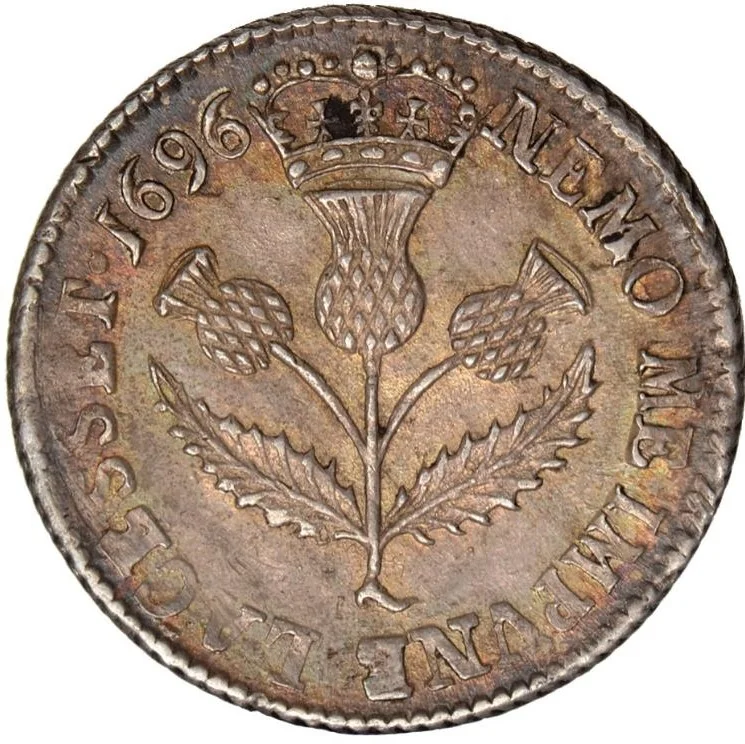
5 Shillings – Scotland
United Kingdom
Context
Years: 1695–1701
Country: United Kingdom 
Issuer: Scotland 
Ruler: William II
Currency:
(1136—1707)
Demonetized: Yes
Material
References
KM: #Click to copy to clipboard140
Numista: #88198
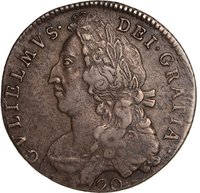
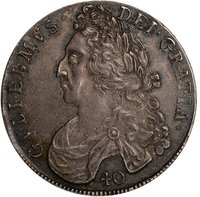
Obverse
Description:
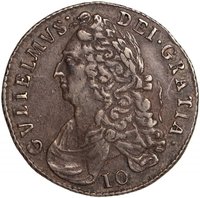
William II left-facing bust, value mark below.
Inscription:
GVL · D · G · MAG · BR · FR · & · HIB · REX
Script: Latin
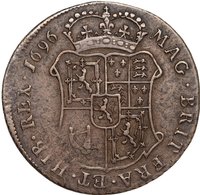
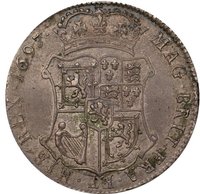
Reverse
Edge
Mints
| Name | Mark |
|---|---|
| Edinburgh | — |
Mintings
| Year | Mint Mark | Mintage | Quality | Collection |
|---|---|---|---|---|
| 1695 | — | — | ||
| 1696 | — | — | ||
| 1697 | — | — | ||
| 1699 | — | — | ||
| 1700 | — | — | ||
| 1701 | — | — |
Historical background
In 1695, Scotland’s currency situation was dire and a central factor in the nation’s deepening economic crisis. The late 17th century saw a chronic shortage of specie (coin), with much of Scotland's limited silver coinage being exported to pay for imports, as the nation consistently bought more from abroad than it sold. What coinage remained in circulation was often clipped, debased, and unreliable, leading to widespread confusion in trade and hampering economic activity. This monetary instability occurred within a broader context of commercial stagnation and famine, creating urgent pressure for financial and economic reform.
It was against this bleak backdrop that the Scottish Parliament passed several pivotal acts in 1695. Most famously, it granted a charter to the Company of Scotland Trading to Africa and the Indies, an ambitious venture aimed at establishing a global trade colony to reverse the balance of payments and bring precious metals into the country. Simultaneously, and less famously, Parliament established the Bank of Scotland, the first public bank in the kingdom, authorised to issue paper banknotes. This was a revolutionary attempt to create a stable paper currency that could supplement and eventually replace the scarce and unreliable coin, providing much-needed credit for commerce.
Thus, 1695 represents a critical juncture where Scotland attempted two radical, interconnected solutions to its currency and economic woes: one through daring overseas colonial enterprise (the Darien Scheme) and the other through domestic financial innovation (the Bank of Scotland). Both were direct responses to the crippling shortage of sound money. The catastrophic failure of the Darien Scheme in the coming years would ultimately exacerbate Scotland’s financial desperation, leading to the political negotiations for union with England in 1707, where currency and debt were central issues.
It was against this bleak backdrop that the Scottish Parliament passed several pivotal acts in 1695. Most famously, it granted a charter to the Company of Scotland Trading to Africa and the Indies, an ambitious venture aimed at establishing a global trade colony to reverse the balance of payments and bring precious metals into the country. Simultaneously, and less famously, Parliament established the Bank of Scotland, the first public bank in the kingdom, authorised to issue paper banknotes. This was a revolutionary attempt to create a stable paper currency that could supplement and eventually replace the scarce and unreliable coin, providing much-needed credit for commerce.
Thus, 1695 represents a critical juncture where Scotland attempted two radical, interconnected solutions to its currency and economic woes: one through daring overseas colonial enterprise (the Darien Scheme) and the other through domestic financial innovation (the Bank of Scotland). Both were direct responses to the crippling shortage of sound money. The catastrophic failure of the Darien Scheme in the coming years would ultimately exacerbate Scotland’s financial desperation, leading to the political negotiations for union with England in 1707, where currency and debt were central issues.
Series: 1695 Scotland circulation coins
💎 Extremely Rare