

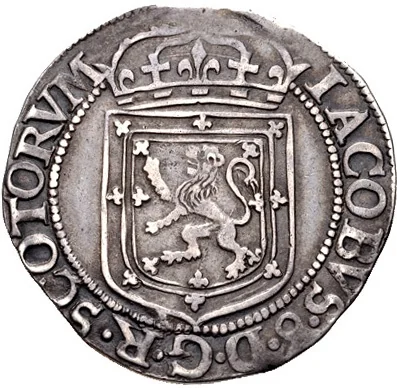
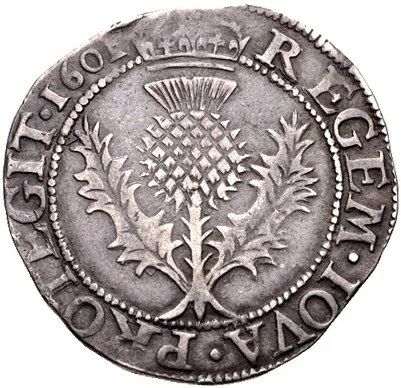
1 Merk – Scotland
United Kingdom
Context
Years: 1601–1604
Country: United Kingdom 
Issuer: Scotland 
Ruler: James VI
Currency:
(1136—1707)
Demonetized: Yes
Material
Diameter: 32 mm
Weight: 6.79 g
Silver weight: 6.22 g
Shape: Irregular round
Composition: 91.6% Silver
Magnetic: No
Technique: Hammered
References
KM: #Click to copy to clipboard16
Numista: #88036
Value
Bullion value: $18.07
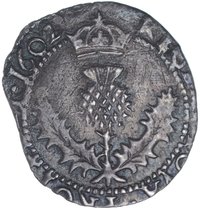
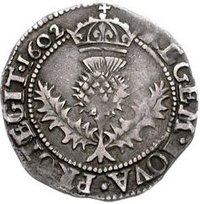
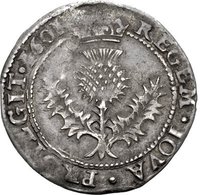
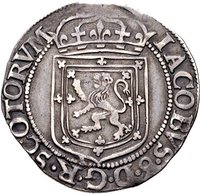
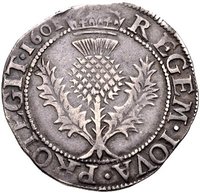
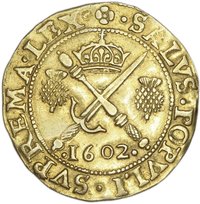
Obverse
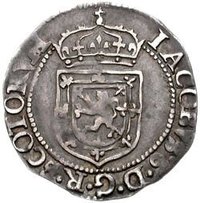
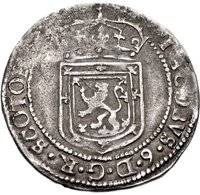
Reverse
Edge
Mints
| Name | Mark |
|---|---|
| Edinburgh | — |
Mintings
| Year | Mint Mark | Mintage | Quality | Collection |
|---|---|---|---|---|
| 1601 | — | — | ||
| 1602 | — | — | ||
| 1603 | — | — | ||
| 1604 | — | — |
Historical background
In 1601, Scotland operated under a distinct and often unstable monetary system, separate from its southern neighbour, England. The official unit of account was the pound Scots (£Scots), which had significantly depreciated against the pound Sterling (£Sterling) due to centuries of debasement and economic factors. By this time, the exchange rate was fixed at £1 Sterling = £12 Scots, a stark indicator of the weaker Scottish economy. The physical currency in circulation was a complex mixture of domestic and foreign coinage, including silver merk coins (worth 13 shillings and 4 pence Scots) and a plethora of English, French, Dutch, and Spanish coins brought in through trade.
The reign of King James VI had seen attempts at monetary reform, but problems persisted. A critical issue was the chronic shortage of high-value gold and full-weight silver coinage within Scotland itself. Much of the nation's sound money was drained abroad to pay for imports, as Scotland's export economy (centred on wool, hides, fish, and linen) could not balance its trade. This led to a reliance on often underweight or clipped foreign coins and prompted the Scottish government to periodically issue bawbees (small silver coins) and other denominations of varying and unreliable silver content.
This unstable currency environment created practical difficulties for daily commerce and long-term business, complicating transactions with Scotland's primary trading partner, England. The situation was a source of economic weakness and political frustration, highlighting Scotland's relative poverty and administrative challenges. Ultimately, this monetary disarray set the stage for a major transformation: within two years, in 1603, the Union of the Crowns would see James VI ascend the English throne as James I, beginning a century-long process of economic and monetary integration that would culminate in the full union of 1707 and the eventual abolition of the pound Scots.
The reign of King James VI had seen attempts at monetary reform, but problems persisted. A critical issue was the chronic shortage of high-value gold and full-weight silver coinage within Scotland itself. Much of the nation's sound money was drained abroad to pay for imports, as Scotland's export economy (centred on wool, hides, fish, and linen) could not balance its trade. This led to a reliance on often underweight or clipped foreign coins and prompted the Scottish government to periodically issue bawbees (small silver coins) and other denominations of varying and unreliable silver content.
This unstable currency environment created practical difficulties for daily commerce and long-term business, complicating transactions with Scotland's primary trading partner, England. The situation was a source of economic weakness and political frustration, highlighting Scotland's relative poverty and administrative challenges. Ultimately, this monetary disarray set the stage for a major transformation: within two years, in 1603, the Union of the Crowns would see James VI ascend the English throne as James I, beginning a century-long process of economic and monetary integration that would culminate in the full union of 1707 and the eventual abolition of the pound Scots.
Series: 1601 Scotland circulation coins
💎 Extremely Rare