

1 rupee – Mughal Empire
Add to wishlist
India
Context
Years: 1748–1753
Country: India
Issuer: Mughal Empire
Ruler: Ahmad Shah Bahadur
Currency:
(1540—1842)
Demonetized: Yes
Material
References
KM: #
Numista: #88005
Value
Bullion value: $27.50
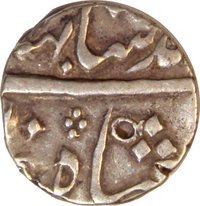
Obverse
Description:
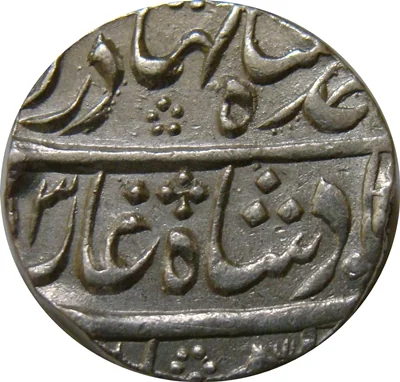
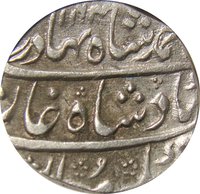
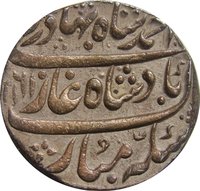
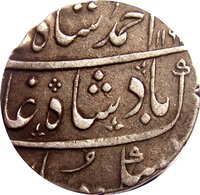
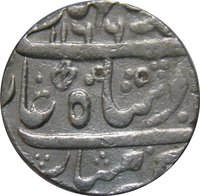
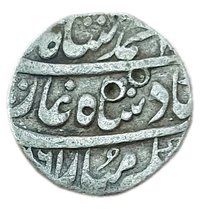
Ahmad Shah Bahadur's inscription
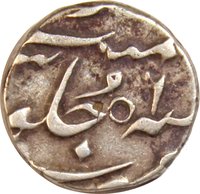
Reverse
Description:
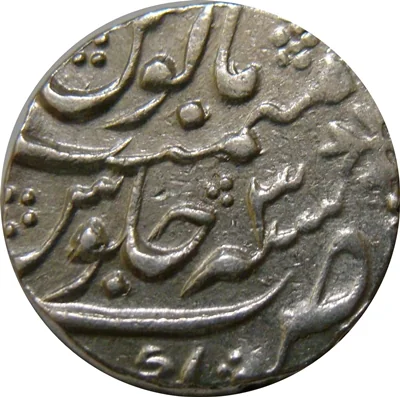
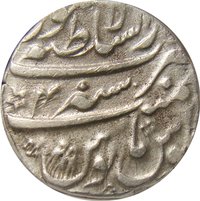
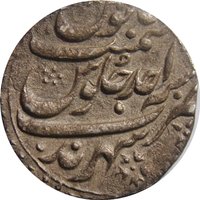
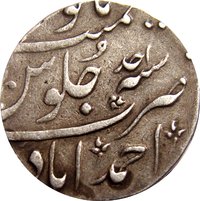
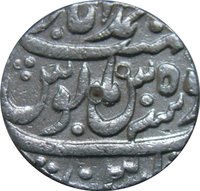
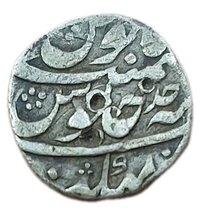
Carved words.
Edge
Mintings
| Year | Mint Mark | Mintage | Quality | Collection |
|---|---|---|---|---|
| — | — | — | ||
| 1748 | — | — | ||
| 1749 | — | — | ||
| 1751 | — | — | ||
| 1753 | — | — |
Historical background
By 1748, the Mughal Empire's currency system, once a pillar of its administrative and economic strength, was in a state of severe strain and fragmentation. The standard silver rupee, established by Emperor Sher Shah Suri and refined by Akbar, remained the nominal unit of account, but its uniformity and authority were collapsing. Decades of imperial decline, following Nader Shah's catastrophic invasion and sack of Delhi in 1739, had drained the central treasury of bullion and shattered political cohesion. The emperor, Muhammad Shah, held little power beyond Delhi, while powerful regional governors and emerging successor states like Bengal, Awadh, and Hyderabad began asserting monetary autonomy.
This political decentralization directly manifested in the coinage. While coins in the core regions still bore the name of the Mughal emperor, their weight, purity, and minting were increasingly controlled by regional subahdars. Furthermore, the influx of European trading companies, particularly the English East India Company, introduced new complexities. Company-minted rupees, often imitating Mughal designs but struck in Madras or Bombay, circulated alongside a proliferation of older, clipped, and debased coins, creating a chaotic monetary environment where the intrinsic silver content of a coin became more critical than its imperial stamp.
Consequently, the year 1748 represents a pivotal moment of transition within this decline. The empire was on the cusp of a new, even more turbulent phase with Ahmad Shah Durrani's first invasion into Punjab that same year, which would further destabilize the northwest. The currency situation, therefore, was not merely one of economic decay but a clear symptom and accelerator of political fragmentation. The unified monetary space of the Mughal Empire was giving way to multiple, competing currency zones, a process that would be ruthlessly exploited and ultimately systematized by the East India Company in the coming decades as it laid the groundwork for colonial economic control.
This political decentralization directly manifested in the coinage. While coins in the core regions still bore the name of the Mughal emperor, their weight, purity, and minting were increasingly controlled by regional subahdars. Furthermore, the influx of European trading companies, particularly the English East India Company, introduced new complexities. Company-minted rupees, often imitating Mughal designs but struck in Madras or Bombay, circulated alongside a proliferation of older, clipped, and debased coins, creating a chaotic monetary environment where the intrinsic silver content of a coin became more critical than its imperial stamp.
Consequently, the year 1748 represents a pivotal moment of transition within this decline. The empire was on the cusp of a new, even more turbulent phase with Ahmad Shah Durrani's first invasion into Punjab that same year, which would further destabilize the northwest. The currency situation, therefore, was not merely one of economic decay but a clear symptom and accelerator of political fragmentation. The unified monetary space of the Mughal Empire was giving way to multiple, competing currency zones, a process that would be ruthlessly exploited and ultimately systematized by the East India Company in the coming decades as it laid the groundwork for colonial economic control.
✨ Legendary