

200 Dollars – Australia
Non-circulating coins
Commemoration: Charles and Diana Royal Wedding
Australia
Context

Material
References
KM: #Click to copy to clipboard73
Numista: #120166
Value
Exchange value: 200 AUD = $142.41
Bullion value: $1525.95
Inflation-adjusted value: 1053.69 AUD
Obverse
Description:
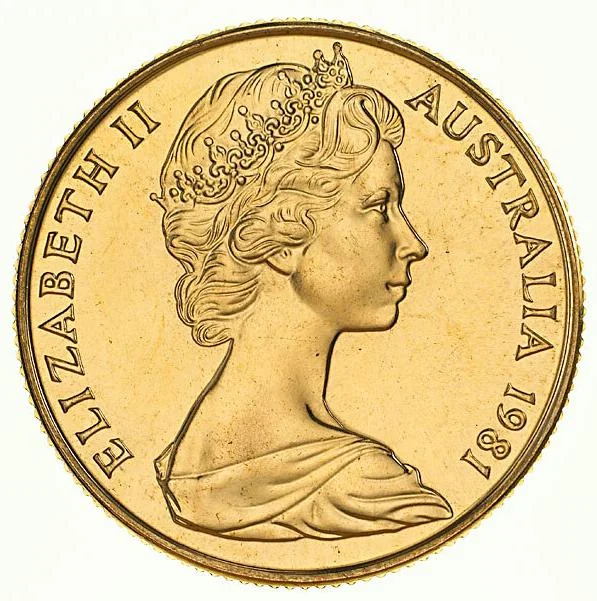
Queen Elizabeth II facing right in the Girls of Great Britain and Ireland Tiara.
Inscription:
ELIZABETH II
AUSTRALIA 1981
AUSTRALIA 1981
Script: Latin
Designer: Arnold Machin
Reverse
Description:
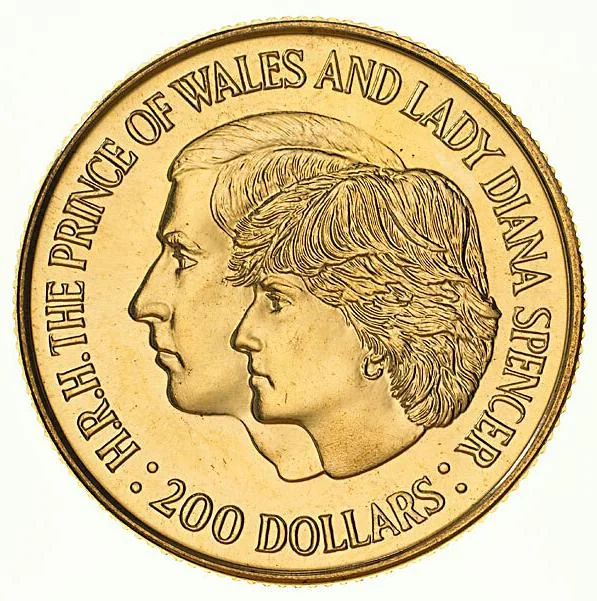
Charles and Diana left-facing busts.
Inscription:
H.R.H. THE PRINCE OF WALES AND LADY DIANA SPENCER
200 DOLLARS
200 DOLLARS
Script: Latin
Edge
Reeded
Categories
| Marriage |
Mints
| Name | Mark |
|---|---|
| Royal Australian Mint | — |
Mintings
| Year | Mint Mark | Mintage | Quality | Collection |
|---|---|---|---|---|
| 1981 | — | 77,890 | BU |
Historical background
In 1981, Australia's currency situation was defined by a managed float of the Australian dollar, operating within a tightly controlled band against a trade-weighted index (TWI) of currencies. This system, established in 1976 following the collapse of the Bretton Woods system, allowed the Reserve Bank of Australia (RBA) to actively intervene in foreign exchange markets to stabilise the currency's value. The period was marked by significant external pressures, including high global inflation, volatile commodity prices, and substantial capital flows, which frequently tested the boundaries of the managed regime. The Australian dollar was particularly sensitive to shifts in the country's terms of trade, heavily influenced by the prices of key export commodities like wool, minerals, and coal.
Domestically, the currency was under strain from persistent double-digit inflation and high interest rates, which created a challenging policy environment. The RBA's interventions aimed to smooth volatility and prevent disorderly markets, but they also required careful management of foreign exchange reserves. A notable feature of the era was the "currency hedge" or "AUD hedge" common in international borrowing, where Australian entities took on significant foreign debt, primarily in US dollars and Japanese yen, to fund domestic development. This practice created substantial long-term exchange rate risk for the corporate and banking sectors, exposing them to future shifts in the dollar's value.
By the end of 1981, the limitations of the managed float were becoming increasingly apparent. The system struggled to reconcile domestic economic objectives with the realities of an increasingly globalised and speculative capital market. The pressures of this period set the stage for the profound financial deregulation that would follow later in the decade, culminating in the decision to float the Australian dollar in December 1983. Thus, 1981 represents a pivotal late chapter in the era of a controlled exchange rate, immediately preceding the move to a market-determined value that would define the modern Australian economy.
Domestically, the currency was under strain from persistent double-digit inflation and high interest rates, which created a challenging policy environment. The RBA's interventions aimed to smooth volatility and prevent disorderly markets, but they also required careful management of foreign exchange reserves. A notable feature of the era was the "currency hedge" or "AUD hedge" common in international borrowing, where Australian entities took on significant foreign debt, primarily in US dollars and Japanese yen, to fund domestic development. This practice created substantial long-term exchange rate risk for the corporate and banking sectors, exposing them to future shifts in the dollar's value.
By the end of 1981, the limitations of the managed float were becoming increasingly apparent. The system struggled to reconcile domestic economic objectives with the realities of an increasingly globalised and speculative capital market. The pressures of this period set the stage for the profound financial deregulation that would follow later in the decade, culminating in the decision to float the Australian dollar in December 1983. Thus, 1981 represents a pivotal late chapter in the era of a controlled exchange rate, immediately preceding the move to a market-determined value that would define the modern Australian economy.
💎 Extremely Rare