

15 Kreuzer – Austrian Empire
Austria
Context
Years: 1663–1675
Country: Austria 
Issuer: Austrian Empire
Ruler: Leopold I
Currency:
(1520—1754)
Demonetized: Yes
Material
References
KM: #Click to copy to clipboard1211
Numista: #87037
Value
Bullion value: $17.69
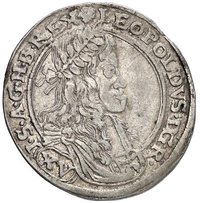
Obverse
Description:
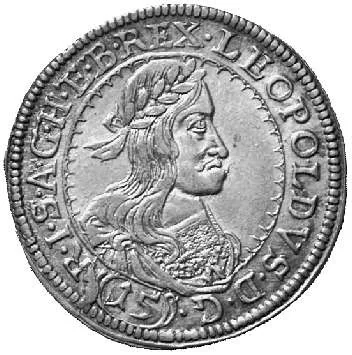
Right-facing laureate portrait in a circle, value below, legend: "LEOPOLDUS...REX".
Inscription:
LEOPOLDVS D G (15) R I S A G H ET B REX
Script: Latin
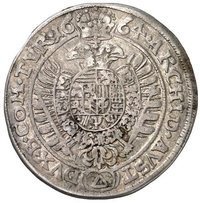
Reverse
Description:
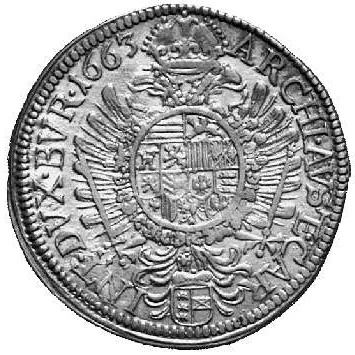
Imperial double-headed eagle with composite arms in a beaded circle, a small Carinthian shield below. Mint marks flank the tail feathers; date in legend.
Inscription:
ARCHI AVS Et CAR // INTH DVX BVR 1663
Script: Latin
Edge
Mints
| Name | Mark |
|---|---|
| Sankt Veit | — |
Mintings
| Year | Mint Mark | Mintage | Quality | Collection |
|---|---|---|---|---|
| 1663 | — | — | ||
| 1663 | H | — | ||
| 1664 | — | — | ||
| 1675 | — | — |
Historical background
In 1663, the Austrian Habsburg monarchy, a sprawling and diverse empire, was grappling with a profound and chronic monetary crisis rooted in the Thirty Years' War (1618-1648). The conflict had devastated regional economies and forced successive emperors to engage in massive coinage debasement to finance military campaigns. By the 1660s, the imperial currency system was characterized by a chaotic mix of overvalued, poor-quality domestic coins and a flood of better-quality foreign money, leading to Gresham's Law in action: "bad money drove out good." The standard silver Reichsthaler remained a theoretical unit of account, but the actual circulating medium was a confusing array of debased Landmünzen (regional coins) and Kipper und Wipper emergency issues, which destroyed public trust and hampered commerce.
The financial strain was exacerbated by the ongoing wars with the Ottoman Empire, which demanded immense military expenditure. Emperor Leopold I's government faced constant budgetary shortfalls, and seigniorage (the profit from minting coins) remained a tempting but destructive source of quick revenue. While the 1659 Münzfuß (coinage standard) of Zinna attempted to establish a uniform monetary standard across several German states, its implementation within the Habsburg hereditary lands was partial and ineffective. In practice, Vienna struggled to control the minting activities of its own territories and noble estates, which often issued their own debased coinage for local profit, further fragmenting the monetary landscape.
Consequently, the year 1663 found the Empire's economy suffering from severe price inflation, volatile exchange rates, and a deep lack of monetary confidence. This instability crippled long-distance trade and complicated tax collection, directly weakening the central government's capacity to govern and wage war. The situation underscored a fundamental weakness of the decentralized Habsburg state: its inability to impose a unified fiscal and monetary policy, a problem that would persist for centuries and contribute to its long-term administrative challenges.
The financial strain was exacerbated by the ongoing wars with the Ottoman Empire, which demanded immense military expenditure. Emperor Leopold I's government faced constant budgetary shortfalls, and seigniorage (the profit from minting coins) remained a tempting but destructive source of quick revenue. While the 1659 Münzfuß (coinage standard) of Zinna attempted to establish a uniform monetary standard across several German states, its implementation within the Habsburg hereditary lands was partial and ineffective. In practice, Vienna struggled to control the minting activities of its own territories and noble estates, which often issued their own debased coinage for local profit, further fragmenting the monetary landscape.
Consequently, the year 1663 found the Empire's economy suffering from severe price inflation, volatile exchange rates, and a deep lack of monetary confidence. This instability crippled long-distance trade and complicated tax collection, directly weakening the central government's capacity to govern and wage war. The situation underscored a fundamental weakness of the decentralized Habsburg state: its inability to impose a unified fiscal and monetary policy, a problem that would persist for centuries and contribute to its long-term administrative challenges.
💎 Extremely Rare