

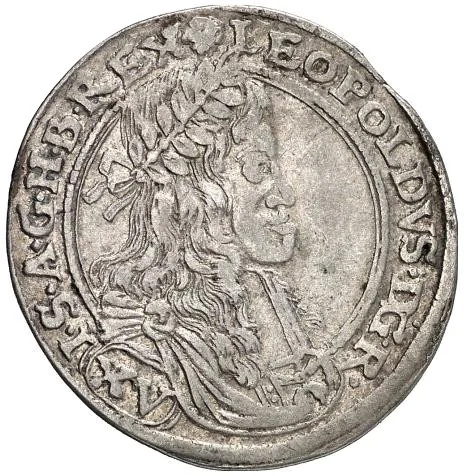
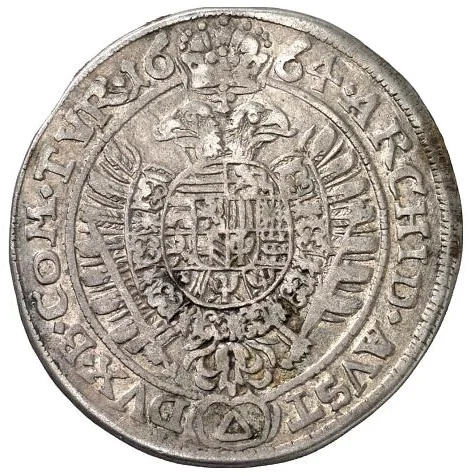
15 Kreuzer – Austrian Empire
Austria
Context
Year: 1664
Country: Austria 
Issuer: Austrian Empire
Ruler: Leopold I
Currency:
(1520—1754)
Demonetized: Yes
Material
References
KM: #Click to copy to clipboard1220
Numista: #78656
Value
Bullion value: $17.87
Obverse
Description:
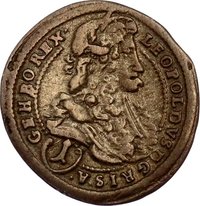
Leopold I facing right, laureate bust dividing legend at rim. Inscription: "Leopoldus Dei Gratia Romanorum Imperator Semper Augustus, ac Germaniae, Hungariae, Bohemiaeque Rex" with value in Roman numerals below.
Inscription:
LEOPOLDVS D G R (XV) I S A G H B REX
ou
LEOPOLDVS D G (XV) R I S A G H B R
ou
LEOPOLDVS D G (XV) R I S A G H B R
Script: Latin
Reverse
Description:
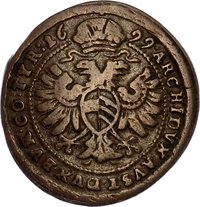
Double-headed imperial eagle with central coat of arms. Crown above divides date. Mint mark (triangle) below divides legend. Surrounding inscription: "Archidux Austriae Dux Burgundiae Comes Tyrolis".
Inscription:
ARCHID AVST (delta) DVX B COM TYR
Script: Latin
Edge
Mints
| Name | Mark |
|---|---|
| Neuburg am Inn | — |
Mintings
| Year | Mint Mark | Mintage | Quality | Collection |
|---|---|---|---|---|
| 1664 | — | — |
Historical background
In 1664, the currency system of the Habsburg Monarchy, often referred to as the Austrian Empire, was characterized by significant complexity and instability. The realm did not have a unified currency; instead, a multitude of silver and gold coins circulated, including domestic issues like the Reichsthaler and the smaller Kreuzer, alongside a vast array of foreign coins from German states, Italy, and the Ottoman frontier. This proliferation created constant challenges in trade, as the value of coins depended not only on their official minted value but also on their precious metal content, which was frequently degraded by both the Vienna mint and countless regional authorities to fund the state's perpetual military expenditures.
The financial situation was dire, heavily burdened by the ongoing wars against the Ottoman Empire, most notably the recent Austro-Turkish War (1663-1664) that culminated in the Battle of Saint Gotthard. To finance these conflicts, the Habsburg state, under Emperor Leopold I, resorted to repeated debasement of the coinage. This practice, where the silver content in coins was reduced while their face value was maintained, led to severe inflation, a loss of public trust in the currency, and Gresham's Law in action ("bad money drives out good money"), as people hoarded older, purer coins.
Consequently, the year 1664 fell within a period of monetary crisis and attempted reform. The government recognized the need for stabilization and was moving toward a major monetary ordinance, which would be enacted in 1667. This reform aimed to standardize the Reichsthaler as a stable accounting unit and curb the worst abuses of debasement. Thus, the currency situation in 1664 was one of transition—marked by the severe inflationary pressures of wartime finance but on the cusp of a concerted, though only partially successful, effort to impose order on the chaotic monetary system.
The financial situation was dire, heavily burdened by the ongoing wars against the Ottoman Empire, most notably the recent Austro-Turkish War (1663-1664) that culminated in the Battle of Saint Gotthard. To finance these conflicts, the Habsburg state, under Emperor Leopold I, resorted to repeated debasement of the coinage. This practice, where the silver content in coins was reduced while their face value was maintained, led to severe inflation, a loss of public trust in the currency, and Gresham's Law in action ("bad money drives out good money"), as people hoarded older, purer coins.
Consequently, the year 1664 fell within a period of monetary crisis and attempted reform. The government recognized the need for stabilization and was moving toward a major monetary ordinance, which would be enacted in 1667. This reform aimed to standardize the Reichsthaler as a stable accounting unit and curb the worst abuses of debasement. Thus, the currency situation in 1664 was one of transition—marked by the severe inflationary pressures of wartime finance but on the cusp of a concerted, though only partially successful, effort to impose order on the chaotic monetary system.
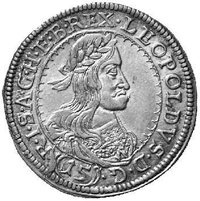
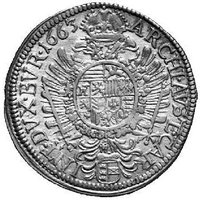
💎 Extremely Rare