

1 Scudo – Republic of Ragusa
Croatia
Context
Years: 1708–1750
Country: Croatia 
Issuer: Republic of Ragusa
Period:
(1294—1803)
Currency:
(1294—1803)
Subdivision: 1 Scudo = 36 Grosetti
Demonetized: Yes
Material
References
KM: #Click to copy to clipboard11
Numista: #86631
Value
Bullion value: $49.92
Obverse
Description:
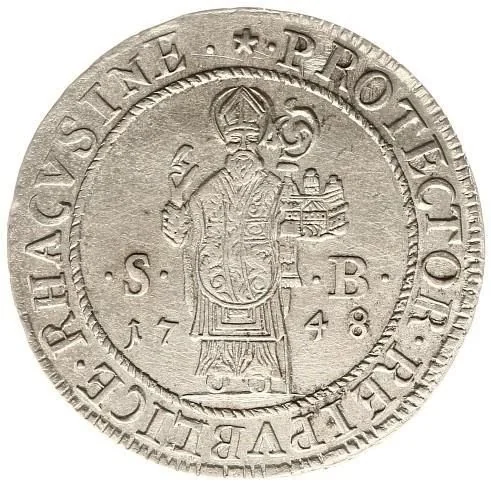
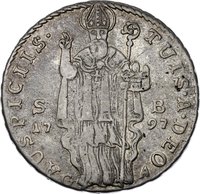
St. Blaze divides date and "S B" within beaded circle, surrounded by lettering.
Inscription:
PROTECTOR REIPVBLICE RHAGVSINE・
Script: Latin
Reverse
Description:
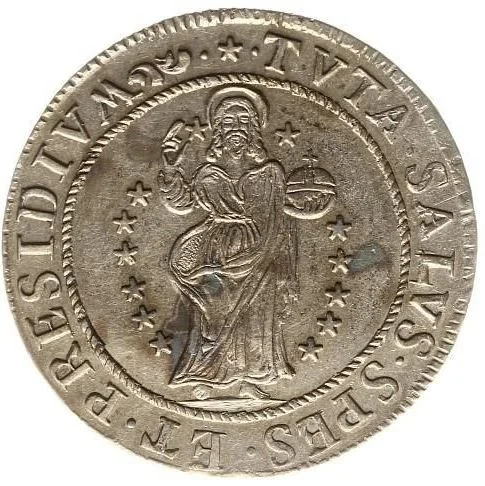
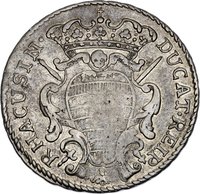
Christ in stars, encircled by beads and text.
Inscription:
TVTA・SALVS・SPES・ET・PRESIDIVM
Script: Latin
Edge
Mintings
| Year | Mint Mark | Mintage | Quality | Collection |
|---|---|---|---|---|
| 1708 | SB | — | ||
| 1709 | — | — | ||
| 1739 | — | — | ||
| 1747 | SB | — | ||
| 1748 | — | — | ||
| 1750 | — | — |
Historical background
In 1708, the Republic of Ragusa (modern-day Dubrovnik) navigated a complex and challenging monetary environment, typical of its status as a small but prosperous maritime republic caught between major empires. Its economy, heavily reliant on maritime trade, banking, and transit commerce across the Balkans, required a stable and reliable currency system. However, Ragusa did not mint its own gold or silver coins for general circulation. Instead, the state issued only a limited silver grossetto and small copper coins, while the monetary landscape was dominated by a plethora of foreign currencies. The most important of these were the Ottoman kuruş (piastre), Venetian ducats and zecchini, and Spanish pieces of eight, reflecting the republic's political deference to the Ottoman Empire and its commercial ties across the Mediterranean.
This dependence on foreign coinage created persistent problems. The value and purity of imported coins fluctuated, leading to instability in exchange rates and facilitating the practice of clipping and debasement. To manage this, the Ragusan Senate exercised strict control, periodically issuing official proclamations (tariffe) that fixed the legal value of dozens of circulating foreign coins in relation to the Ragusan accounting unit, the libera. The libera itself was a money of account, used for bookkeeping and contracts but not physically minted. The 1708 period would have been characterized by such regulatory efforts to maintain public trust and prevent economic dislocation, especially crucial for its sophisticated banking and credit operations.
Ultimately, the currency situation of 1708 highlights Ragusa's precarious sovereignty. Its monetary policy was a defensive tool to preserve economic autonomy despite political vulnerability. By legally fixing rates, the Senate sought to shield domestic transactions from the volatility of the international bullion market and the monetary policies of powerful neighbors. This careful, regulated system of "crying down" or "crying up" foreign coins was essential for the republic's continued prosperity, allowing its merchants to operate confidently in a fragmented monetary zone until the republic's dissolution in the early 19th century.
This dependence on foreign coinage created persistent problems. The value and purity of imported coins fluctuated, leading to instability in exchange rates and facilitating the practice of clipping and debasement. To manage this, the Ragusan Senate exercised strict control, periodically issuing official proclamations (tariffe) that fixed the legal value of dozens of circulating foreign coins in relation to the Ragusan accounting unit, the libera. The libera itself was a money of account, used for bookkeeping and contracts but not physically minted. The 1708 period would have been characterized by such regulatory efforts to maintain public trust and prevent economic dislocation, especially crucial for its sophisticated banking and credit operations.
Ultimately, the currency situation of 1708 highlights Ragusa's precarious sovereignty. Its monetary policy was a defensive tool to preserve economic autonomy despite political vulnerability. By legally fixing rates, the Senate sought to shield domestic transactions from the volatility of the international bullion market and the monetary policies of powerful neighbors. This careful, regulated system of "crying down" or "crying up" foreign coins was essential for the republic's continued prosperity, allowing its merchants to operate confidently in a fragmented monetary zone until the republic's dissolution in the early 19th century.
✨ Legendary