

⅙ thaler – Brunswick-Lüneburg-Calenberg-Hannover
Add to wishlist
Germany
Context
Material
References
KM: #
Numista: #86347
Value
Bullion value: $8.14
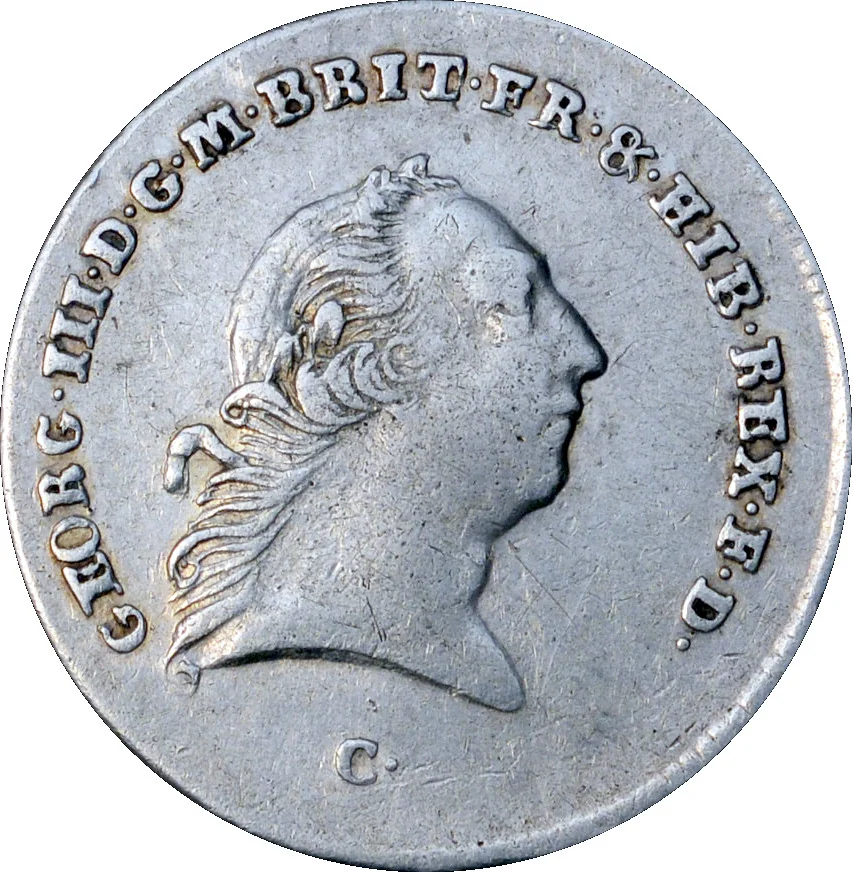
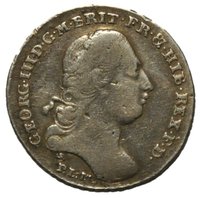
Obverse
Description:
Right-facing bust, mintmaster's initials beneath.
Inscription:
GEORG III D G M BRIT FR & HIB REX F D
Script: Latin
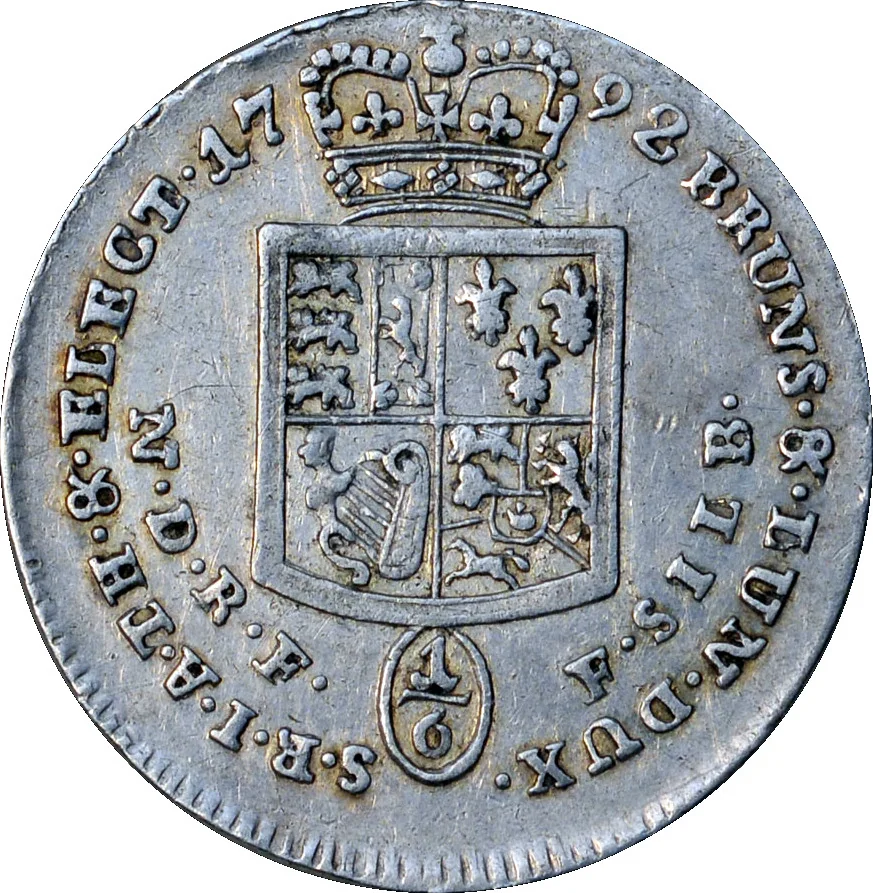
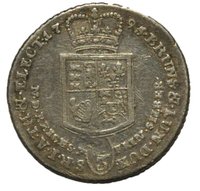
Reverse
Description:
Crowned square shield, quartered arms, value below, date above.
Inscription:
S R I A TH & ELECT 17 92 BRUNS & LUN DUX
N D R F F SILB
⅙
N D R F F SILB
⅙
Script: Latin
Edge
Mints
| Name | Mark |
|---|---|
| Clausthal | — |
Mintings
| Year | Mint Mark | Mintage | Quality | Collection |
|---|---|---|---|---|
| 1792 | C | — | ||
| 1794 | PLM | — | ||
| 1795 | PLM | — | ||
| 1796 | PLM | — | ||
| 1797 | PLM | — |
Historical background
In 1792, the currency situation in the Duchy of Brunswick-Lüneburg, specifically the Principality of Calenberg (with its capital in Hanover), was complex and fragmented, reflecting the broader political structure of the Holy Roman Empire. The territory was part of the Hanoverian possessions of the British monarch, George III, but its monetary system was deeply entangled with regional German conventions. The primary accounting unit was the Reichsthaler (Rthlr), divided into 24 Gute Groschen or 36 Mariengroschen, each of which was further subdivided into 8 Pfennige. However, this "ideal" Reichsthaler existed alongside a multitude of actual circulating coins, including various Thalers, Gulden, and foreign currencies, all with fluctuating values.
This multiplicity created significant practical challenges. Alongside Hanover's own issued coins, numerous currencies from neighboring German states and even Dutch Ducaten and French Louis d'or circulated in trade, their values set by periodic official Kurantzettel (exchange rate bulletins). The system was essentially bimetallic (gold and silver), but the fixed legal ratios between metals often failed to match market rates, leading to instability. Furthermore, the value of the Kurantthaler (the actual circulating Thaler) could differ from the Rechnungsthaler (the accounting unit), adding another layer of complexity for merchants and the state treasury.
The year 1792 itself, marked by the outbreak of the French Revolutionary Wars, introduced new pressures. While not yet experiencing the direct monetary collapse that would come with later French invasion and occupation, the duchy faced the indirect economic strains of a continent at war. The need to finance military preparedness and the disruption to trade networks likely exacerbated the existing inefficiencies, highlighting the system's vulnerability. Thus, the currency landscape was one of entrenched medieval complexity, barely functional for daily commerce and ill-prepared for the economic shocks of the revolutionary era.
This multiplicity created significant practical challenges. Alongside Hanover's own issued coins, numerous currencies from neighboring German states and even Dutch Ducaten and French Louis d'or circulated in trade, their values set by periodic official Kurantzettel (exchange rate bulletins). The system was essentially bimetallic (gold and silver), but the fixed legal ratios between metals often failed to match market rates, leading to instability. Furthermore, the value of the Kurantthaler (the actual circulating Thaler) could differ from the Rechnungsthaler (the accounting unit), adding another layer of complexity for merchants and the state treasury.
The year 1792 itself, marked by the outbreak of the French Revolutionary Wars, introduced new pressures. While not yet experiencing the direct monetary collapse that would come with later French invasion and occupation, the duchy faced the indirect economic strains of a continent at war. The need to finance military preparedness and the disruption to trade networks likely exacerbated the existing inefficiencies, highlighting the system's vulnerability. Thus, the currency landscape was one of entrenched medieval complexity, barely functional for daily commerce and ill-prepared for the economic shocks of the revolutionary era.
💎 Extremely Rare