Logo Title
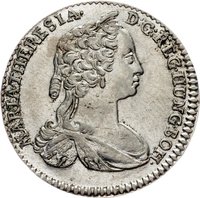
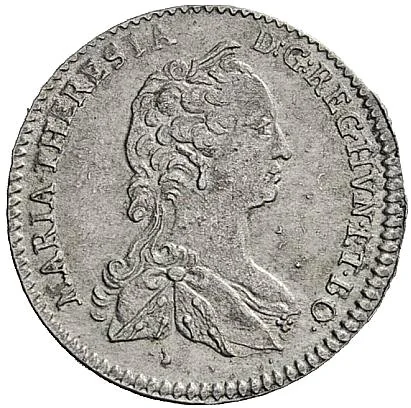
obverse
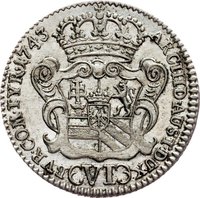
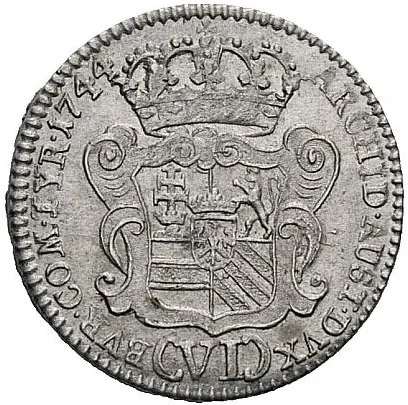
reverse
Auktionen Münzhandlung Sonntag
Austria
Context
Year: 1744
Country: Austria Country flag
Currency:
Demonetized: Yes
Material
Diameter: 25 mm
Weight: 3.3 g
Shape: Round
Composition: Billon (43.7% Silver)
References
KM: #Click to copy to clipboard1711
Numista: #86259

Obverse

Description:
Bust of Maria Theresia facing right, with a surrounding legend.
Inscription:
MARIA THERESIA D G REG HUN ET BO
Script: Latin

Reverse

Description:
Fourfold arms of Hungary, Bohemia, Austria, and Burgundy, with a central Tyrol shield, in a baroque frame. Value in Roman numerals divides the legend.
Inscription:
ARCHID AUST DUX BUR COM TYR 1744

(VI)
Script: Latin

Edge

Mints

NameMark
Hall

Mintings

YearMint MarkMintageQualityCollection
1744

Historical background

In 1744, the County of Tyrol, a crown land of the Habsburg Monarchy, operated within a complex and often unstable monetary system. The primary currency was the Tyrolean Conventionsgeld, based on the Conventionsthaler standard established across much of the Holy Roman Empire in the 1750s, though local Tyrolean kreuzers and gulden were the common units of daily exchange. However, the region's economy was heavily influenced by its strategic position along major trade routes through the Alps, leading to a significant circulation of foreign coins, particularly from neighboring Italian states and southern German territories. This created a persistent problem of currency confusion and valuation disputes in market transactions.

The monetary situation was further strained by the ongoing War of the Austrian Succession (1740-1748). To finance military campaigns, the Habsburg state, under Empress Maria Theresa, frequently resorted to debasement—reducing the precious metal content in coins while maintaining their face value. This practice, alongside the issuance of low-quality subsidiary coinage, led to inflation, a loss of public confidence in the currency, and the hoarding of older, higher-quality coins (Gresham's Law). The resulting scarcity of reliable specie hampered commerce and tax collection within Tyrol, a crucial region for imperial defense.

Local Tyrolean authorities and estates grappled with these challenges by attempting to enforce official exchange rates and regulate the influx of foreign money, but with limited success. The underlying tension was between the crown's need for wartime revenue and the county's requirement for a stable medium of exchange for its agrarian and mercantile economy. Thus, in 1744, Tyrol's currency was characterized by a fragile duality: an official system struggling to maintain authority and a de facto circulation of heterogeneous and deteriorating coins, all set against the backdrop of a continent-wide conflict pressuring the Habsburg financial system to its limits.
💎 Extremely Rare