

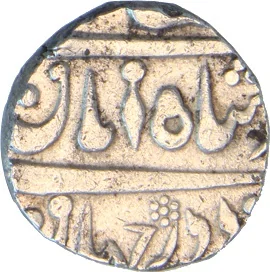
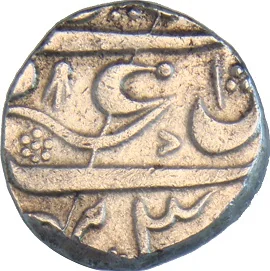

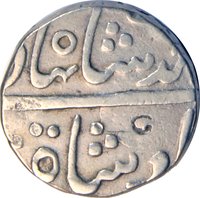
Obverse
Description:
Ba lutf elah couplet
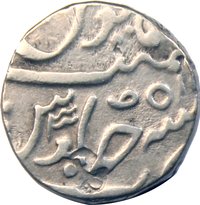
Reverse
Edge
Plain
Mintings
| Year | Mint Mark | Mintage | Quality | Collection |
|---|---|---|---|---|
| — | — | — |
Historical background
By 1719, the Maratha Empire, under the nominal leadership of the young Shahu I and the effective administration of his Peshwa, Balaji Vishwanath, was in a period of significant territorial and political consolidation following decades of war with the Mughals. The currency situation reflected this complex transition, characterized by a lack of a single, uniform monetary system. The empire did not yet issue a standardized imperial coinage in its own name across all its territories; instead, it operated within the established monetary frameworks of the regions it controlled or influenced.
The primary circulating currency in the Deccan heartland remained the Hali Sicca Rupee, a silver coin originally minted by the Mughals at the Ahmedabad mint. Maratha revenue demands, like the chauth and sardeshmukhi, were calculated and often collected in this rupee. However, older regional coins, such as the Shivrai copper coin from Chhatrapati Shivaji's era, remained in local use for smaller transactions. Furthermore, in territories recently acquired from the Mughals or other Deccan Sultanates, their respective local coinages—whether Mughal rupees from Aurangabad or older Bijapuri and Golconda issues—continued to circulate, creating a mosaic of monetary units.
This period was one of pragmatic adaptation rather than systematic reform. The Maratha state, focused on expansion and revenue collection, generally accepted these existing currencies for taxation, thereby legitimizing their continued use. The authority to mint coins was also decentralized, with significant feudatory chiefs like the Gaekwads, Bhonsles of Nagpur, and others beginning to strike their own copper and silver coins in their jagirs, often imitating Mughal prototypes but bearing their own marks or names. Thus, the currency landscape of 1719 was fragmented, serving as a financial mirror to the empire's political structure: a confederacy exercising power through a combination of Mughal-era systems and growing regional assertiveness, yet to impose a unified monetary identity.
The primary circulating currency in the Deccan heartland remained the Hali Sicca Rupee, a silver coin originally minted by the Mughals at the Ahmedabad mint. Maratha revenue demands, like the chauth and sardeshmukhi, were calculated and often collected in this rupee. However, older regional coins, such as the Shivrai copper coin from Chhatrapati Shivaji's era, remained in local use for smaller transactions. Furthermore, in territories recently acquired from the Mughals or other Deccan Sultanates, their respective local coinages—whether Mughal rupees from Aurangabad or older Bijapuri and Golconda issues—continued to circulate, creating a mosaic of monetary units.
This period was one of pragmatic adaptation rather than systematic reform. The Maratha state, focused on expansion and revenue collection, generally accepted these existing currencies for taxation, thereby legitimizing their continued use. The authority to mint coins was also decentralized, with significant feudatory chiefs like the Gaekwads, Bhonsles of Nagpur, and others beginning to strike their own copper and silver coins in their jagirs, often imitating Mughal prototypes but bearing their own marks or names. Thus, the currency landscape of 1719 was fragmented, serving as a financial mirror to the empire's political structure: a confederacy exercising power through a combination of Mughal-era systems and growing regional assertiveness, yet to impose a unified monetary identity.
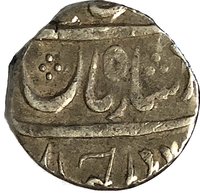
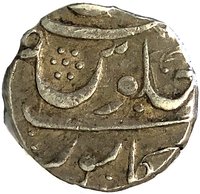
💎 Extremely Rare